

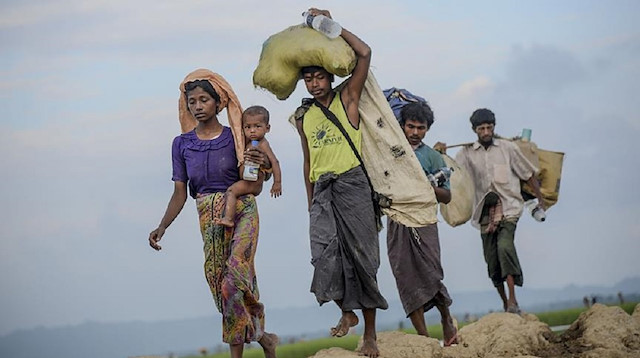
File photo
A UN human rights official has implored Bangladesh to shelve its plans to start the repatriation of Rohingya Muslims to Myanmar this month, fearing they may face violence or abuse.
"I have not seen any evidence of the Government of Myanmar taking concrete and visible measures to create an environment where the Rohingya can return to their place of origin and live there safely with their fundamental rights guaranteed," Yanghee Lee, the special rapporteur on human rights in Myanmar, said in a statement on the UN website on Tuesday.
Lee said she fears the Rohingya may face suffering, violence, or abuse as Myanmar has failed to take any tangible measures for the Rohingya's return to the border state of Rakhine in November.
Facebook Inc on Monday said a human rights report it commissioned on its presence in Myanmar showed it had not done enough to prevent its social network from being used to incite violence.The report by San Francisco-based nonprofit Business for Social Responsibility (BSR) recommended that Facebook more strictly enforce its content policies, increase engagement with both Myanmar officials and civil society groups and regularly release additional data about its progress in the country."The report concludes that, prior to this year, we weren't doing enough to help prevent our platform from being used to foment division and incite offline violence. We agree that we can and should do more," Alex Warofka, a Facebook product policy manager, said in a blog post.Myanmar officials try to convince Rohingya to return, accept ID cardsBSR also warned that Facebook must be prepared to handle a likely onslaught of misinformation during Myanmar's 2020 elections, and new problems as use of its WhatsApp grows in Myanmar, according to the report, which Facebook released.A Reuters special report https://www.reuters.com/invest... in August found that Facebook failed to promptly heed numerous warnings from organizations in Myanmar about social media posts fueling attacks on minority groups such as the Rohingya.In August 2017 the military led a crackdown in Myanmar’s Rakhine State in response to attacks by Rohingya insurgents, pushing more than 700,000 Muslims to neighboring Bangladesh, according to U.N. agencies.Bangladesh says Rohingya repatriation to start mid Nov.The social media website in August removed several Myanmar military officials from the platform to prevent the spread of "hate and misinformation," for the first time banning a country's military or political leaders.It also removed dozens of accounts for engaging in a campaign that "used seemingly independent news and opinion pages to covertly push the messages of the Myanmar military."The move came hours after United Nations investigators said the army carried out mass killings and gang rapes of Muslim Rohingya with “genocidal intent.”Facebook said it has begun correcting shortcomings.Rohingya genocide continues in Myanmar: Rights groupFacebook said that it now has 99 Myanmar language specialists reviewing potentially questionable content. In addition, it has expanded use of automated tools to reduce distribution of violent and dehumanizing posts while they undergo review.In the third quarter, the company said it "took action" on about 64,000 pieces of content that violated its hate speech policies. About 63 percent were identified by automated software, up from 52 percent in the prior quarter.Human Rights Watch (HRW) in Asia said the report showed Facebook is working hard to address the issues and should step up its efforts, especially in combating hate speech ahead of the general election in 2020."It’s often said that in Myanmar, for all intents and purposes Facebook really is the Internet because of its widespread use among online users -- so Facebook needs to act accordingly to head off what will likely be a tsunami of hate speech and attacks in the 2020 election," said Phil Roberston, HRW deputy director.Facebook has roughly 20 million users in Myanmar, according to BSR, which warned Facebook faces several unresolved challenges in Myanmar.BSR said locating staff there, for example, could aid in Facebook's understanding of how its services are used locally but said its workers could be targeted by the country's military, which has been accused by the U.N. of ethnic cleansing of the Rohingya.
Facebook says human rights report shows it should do more in Myanmar
"Not only did the Rohingya face horrific violence at the hands of security forces in 2016 and 2017 with no accountability, they have been subjected to decades-long systematic discrimination and persecution in Myanmar," Lee said, urging both Bangladesh and Myanmar to call off the repatriation.
"I urge the Governments of Bangladesh and Myanmar to halt these rushed plans for repatriation, to ensure the protection of the Rohingya refugees and to adhere to their international human rights and refugee law obligations to ensure any returns are safe, sustainable, voluntary and dignified," she added.
Persecution of Rohingya
The Rohingya, described by the UN as the world's most persecuted people, have faced heightened fears of attack since dozens were killed in communal violence in 2012.
Since Aug. 25, 2017, nearly 24,000 Rohingya Muslims have been killed by Myanmar’s state forces, according to a report by the Ontario International Development Agency (OIDA).
The International Crimes Tribunal in Bangladesh on Monday handed death sentences to two people for war crimes during the Liberation War in 1971.The convicts Liakat Ali, 63, a former ruling party member, and Aminul Islam alias Rajab Ali, 62, are absconding, the Daily Star reported.Speaking to reporters, prosecutor Rana Dasgupta said the convicts were found guilty of committing crimes against humanity including murder and genocide.The court said in its verdict that the prosecution had proven all seven charges brought against the accused. They will be hung by neck till death.Of the 85 suspects in the 35 cases brought before the tribunal, five have died outside of custody. Eighty have been convicted, including 53 sentenced to death.This is not the first time the controversial tribunal, convicted elderly people -- mostly political opponents -- for alleged crimes during the war almost 48 years ago, that marked the country's secession from Pakistan.It is a domestic tribunal in Bangladesh set up in 2009 in order to investigate and prosecute suspects of war crimes in 1971 -- allegedly committed by the Pakistani military and their local collaborators in Bangladesh.However, the tribunal is accused of being used against political opponents under the pretext of punishing the war criminals.Following the formation of the court, international human rights group, including Amnesty International and Human Rights Watch, voiced their deep concern over the “unfair trial” process and absence of the court’s international standard.Indian Ocean Rim Association accepts Turkey’s bidAsian MPs urge halt to Rohingya repatriation plan amid safety fearsKillings in India's northeast raise tension over citizenship survey
Bangladesh court sentences two to death for war crimes
More than 34,000 Rohingya were also thrown into fires, while over 114,000 others were beaten, said the OIDA report, titled "Forced Migration of Rohingya: The Untold Experience."
Some 18,000 Rohingya women and girls were raped by Myanmar’s army and police and over 115,000 Rohingya homes were burned down and 113,000 others vandalized, it added.
According to Amnesty International, more than 750,000 Rohingya refugees, mostly children, and women, fled Myanmar and crossed into neighboring Bangladesh after Myanmar forces launched a crackdown on the minority Muslim community in August 2017.
The UN has documented mass gang rapes, killings -- including of infants and young children -- brutal beatings, and disappearances committed by Myanmar state forces. In a report, UN investigators said such violations may have constituted crimes against humanity.