

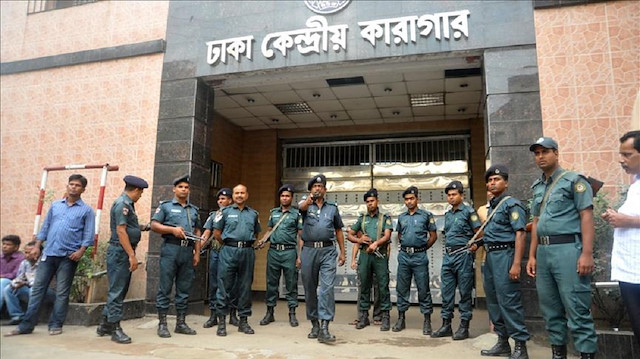
Bangladesh court sentences two to death for war crimes
The International Crimes Tribunal in Bangladesh on Monday handed death sentences to two people for war crimes during the Liberation War in 1971.
The convicts Liakat Ali, 63, a former ruling party member, and Aminul Islam alias Rajab Ali, 62, are absconding, the Daily Star reported.
Speaking to reporters, prosecutor Rana Dasgupta said the convicts were found guilty of committing crimes against humanity including murder and genocide.
The court said in its verdict that the prosecution had proven all seven charges brought against the accused. They will be hung by neck till death.
Of the 85 suspects in the 35 cases brought before the tribunal, five have died outside of custody. Eighty have been convicted, including 53 sentenced to death.
This is not the first time the controversial tribunal, convicted elderly people -- mostly political opponents -- for alleged crimes during the war almost 48 years ago, that marked the country's secession from Pakistan.
It is a domestic tribunal in Bangladesh set up in 2009 in order to investigate and prosecute suspects of war crimes in 1971 -- allegedly committed by the Pakistani military and their local collaborators in Bangladesh.
However, the tribunal is accused of being used against political opponents under the pretext of punishing the war criminals.
Following the formation of the court, international human rights group, including Amnesty International and Human Rights Watch, voiced their deep concern over the “unfair trial” process and absence of the court’s international standard.
Turkey’s bid for the status of Dialogue Partnership in the Indian Ocean Rim Association (IORA) has been approved, the Turkish Foreign Ministry announced on Saturday.“Turkey’s Dialogue Partnership with IORA will contribute to strengthening our relations with the Indian Ocean region which has a great economic potential and the rim countries with many of which we have historical affinity, and in this manner to diversify the international relations and promotion of our country, and its quest for new export markets,” the ministry said in a statement.The decision was taken during the IORA Ministerial Council Meeting, which was held in Durban-South Africa, on Oct. 31-Nov. 2, the ministry added.“IORA is the only platform that brings together 21 countries (Australia, India, Indonesia, Iran, Bangladesh, Somalia, Kenya, Malaysia, Madagascar, Mozambique, South Africa, Tanzania, Thailand, UAE, Yemen, Singapore, Oman, Sri Lanka, Comoros, Seychelles, Mauritius) and has been in operation for more than 20 years,” the ministry added.Gunmen kill a leader of India's ruling party in disputed KashmirKillings in India's northeast raise tension over citizenship surveyIndia unveils tallest statue in world amid protests
Indian Ocean Rim Association accepts Turkey’s bid
Myanmar is not safe enough for the return of hundreds of thousands of Rohingya in camps in Bangladesh, said Asian parliamentarians on Friday, urging both governments to halt plans for repatriation scheduled to begin this month.More than 700,000 Rohingya people crossed into Bangladesh in the four months after deadly attacks by Rohingya insurgents on security forces in August, 2017, which were followed by military operations that the United Nations said targeted civilians.Myanmar has denied most of the allegations.Bangladesh and Myanmar first reached a deal a year ago to begin repatriation, but the process has been delayed. Officials from both countries met this week and announced that it would begin in mid-November.Myanmar officials try to convince Rohingya to return, accept ID cards"This is a poorly thought-out plan," said Charles Santiago, head of ASEAN Parliamentarians for Human Rights, which is comprised of elected representatives from countries that are members of the Association of Southeast Asian Nations (ASEAN).He said Myanmar must first put in place plans for the protection and livelihoods of Rohingya who live under an apartheid-like system, facing restrictions on their movements, as well as access to healthcare, employment and education.Almost all Rohingya lack citizenship, and many of their villages were burned down during the military operations."They were still licking their wounds, they are still living in fear," said Santiago, a Malaysian lawmaker who led a fact-finding mission early this year to refugee camps in Bangladesh's Cox's Bazar district.Bangladesh says Rohingya repatriation to start mid Nov."We're not expecting them to go back to live in barracks and as squatters," he told the Thomson Reuters Foundation.Myint Thu, a senior Myanmar foreign ministry official, has said measures are in place to ensure "a secure environment" for the returnees.Human Rights Watch (HRW) said it had interviewed hundreds of Rohingya refugees and asylums seekers, many of whom said they would only go home if Myanmar guaranteed "security, access to land and livelihoods, freedom of movement, citizenship rights."Rohingya genocide continues in Myanmar: Rights groupDonors should not support the repatriation plan, the New York-based group said."Myanmar's government keeps talking about returns, but it has done nothing to allay the Rohingya's fears of being returned to the same violence and oppression they fled," said Bill Frelick, the group's refugee rights director, in a statement. The United Nations in August recommended that Myanmar military leaders be investigated and prosecuted for "genocide, crimes against humanity and war crimes" against the Rohingya.Stéphane Dujarric, a U.N. spokesman, told reporters this week that conditions "are not yet conducive for a return", and that refugees continue to flee across the border into Bangladesh.
Asian MPs urge halt to Rohingya repatriation plan amid safety fears
Suspected Indian militants shot dead five Bengali-speaking Hindu men in a sensitive border state late on Thursday, police said, as tension grows over a controversial citizenship test to identify illegal immigrants from neighboring Bangladesh.India’s northeastern state of Assam, home to 33 million people, has suffered years of violence as residents, including tribal groups, have clashed with suspected Hindu and Muslim settlers they accuse of plundering resources and grabbing jobs.The state’s draft National Register of Citizens (NRC) released in July excluded 4 million mostly Bengali-speaking Muslims and Hindus.On Friday, police said the five men killed were Indian citizens who had been shot one by one after being taken to a low-lying area by a road in Assam’s district of Tinsukia.India unveils tallest statue in world amid protestsOne young man, picked up by a group of men in army fatigues but presumably left for dead when he passed out at the start of the shooting, said he was lucky to be alive.“I woke up minutes later and saw the five bodies lying in ditches,” Sahadeb Namashudra, also a Bengali Hindu, told reporters at the incident site. “They were in army fatigues and carrying long guns.”Police have not yet made any arrests in the investigation, said a spokesman, Deepak Deka. The situation was tense in Tinsukia because of a 12-hour shutdown called by Bengali associations there, he added.The government has promised strong action against the perpetrators.Angry Sri Lankans rally to support ousted PM, denounce 'coup'The United Liberation Front of Asom (Independent), which has in the past championed the separation of tea and oil-rich Assam from India and is now trying to make a comeback there, denied responsibility for the killings in a statement. No other group has claimed responsibility.Work on the NRC accelerated under the Hindu nationalist government of Prime Minister Narendra Modi, which wants to give all Hindus citizenship, infuriating many Assamese, who want all illegal immigrants expelled.India, which does not have a deportation pact with Bangladesh, has said it will decide on the fate of those eventually deemed foreigners in consultation with the Supreme Court, which is monitoring the registration process.Mamata Banerjee, a staunch Modi critic whose party rules India’s eastern state of West Bengal, said it would hold rallies all over the Bengali-majority state to protest against the killings in neighboring Assam.India's Modi and Japan's Abe draw closer as Tokyo woos BeijingThe state will shelter Assam’s Bengali-speaking people if the NRC process deems them stateless, she added.“Terrible news coming out of Assam,” Banerjee, the state’s chief minister, told reporters. “We strongly condemn the brutal attack in Tinsukia and the killings. Is this the outcome of NRC development?”
Killings in India's northeast raise tension over citizenship survey