

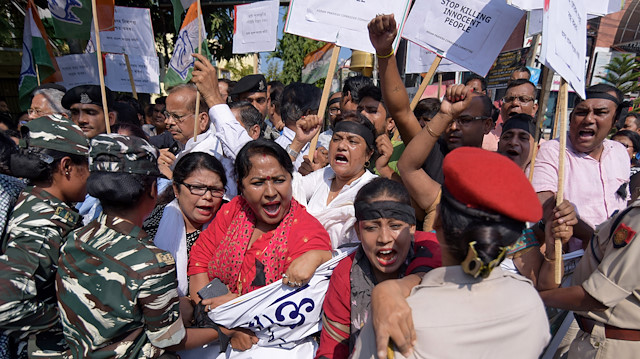
Activists of Assam Pradesh Congress Committee (APCC) shout slogans during a protest against the killings of five Bengali-speaking Hindu men by suspected Indian militants in Assam's Tinsukia district, in Guwahati, India November 2, 2018.
Suspected Indian militants shot dead five Bengali-speaking Hindu men in a sensitive border state late on Thursday, police said, as tension grows over a controversial citizenship test to identify illegal immigrants from neighboring Bangladesh.
India’s northeastern state of Assam, home to 33 million people, has suffered years of violence as residents, including tribal groups, have clashed with suspected Hindu and Muslim settlers they accuse of plundering resources and grabbing jobs.
The state’s draft National Register of Citizens (NRC) released in July excluded 4 million mostly Bengali-speaking Muslims and Hindus.
On Friday, police said the five men killed were Indian citizens who had been shot one by one after being taken to a low-lying area by a road in Assam’s district of Tinsukia.
India on Wednesday unveiled the tallest statue in the world depicting one of its independence leaders amid criticism over the whopping budget spent on it.The statue of Sardar Vallabhbhai Patel at a height of 182 meters is twice the size of Statue of Liberty in New York.Prime Minister Narendra Modi inaugurated the Statue of Unity in Gujarat state, calling Patel the man who led the path for India.“Sardar Vallabhbhai Patel had said infighting was the reason for India's subordination by foreign powers; never again will India make the same mistake and never will India again be enslaved,” Modi said, according to local media reports.India's Modi and Japan's Abe draw closer as Tokyo woos BeijingThe statue at a cost of over $400 million has been criticized for destroying the environment and displacing locals who were not compensated for land taken from them.The chiefs of 22 local villages signed a letter calling on Modi to stay away from the function.According to news reports, before the inauguration police detained dozens of activists to ensure a protest free event.India is also working on a giant statue of 17th-century king Chhatrapati Shivaji, who will be seen riding a horse and brandishing a sword in Mumbai. The statue is touted to be the tallest in the world at 212 metres.
India unveils tallest statue in world amid protests
One young man, picked up by a group of men in army fatigues but presumably left for dead when he passed out at the start of the shooting, said he was lucky to be alive.
“I woke up minutes later and saw the five bodies lying in ditches,” Sahadeb Namashudra, also a Bengali Hindu, told reporters at the incident site. “They were in army fatigues and carrying long guns.”
Police have not yet made any arrests in the investigation, said a spokesman, Deepak Deka. The situation was tense in Tinsukia because of a 12-hour shutdown called by Bengali associations there, he added.
The government has promised strong action against the perpetrators.
More than 10,000 protesting supporters of Sri Lanka's ousted prime minister, Ranil Wickremesinghe, brought parts of the capital, Colombo, to a standstill on Tuesday as political turmoil on the island entered its fifth day.Sri Lanka was plunged into crisis on Friday when President Maithripala Sirisena sacked Wickremesinghe and swore in ex-president Mahinda Rajapaksa to replace him, breaking up a fragile coalition governing the country.Sirisena also suspended parliament, to the fury of Wickremesinghe's supporters, who say the president is trying to prevent lawmakers from keeping him in power.On Tuesday, thousands of protesters gathered near Wickremesinghe's residence to hear the ousted prime minister speak, holding signs demanding that Sirisena to preserve democracy.Sri Lanka police arrest sacked minister over shooting"He has broken his promise and taken the executive powers into his hands," Wickremesinghe told the crowd, referring to Sirisena."He has sidelined parliamentary power."The crowd, which police estimated at more than 10,000, blocked several roads in the city-centre neighbourhood that includes embassies, high-end stores and hotels, according to a Reuters witness."This is a coup. It has all the characteristics of a coup," one of the protesters, Deepanjalie Abeywardene, told Reuters, while holding a sign which read "reconvene the parliament"."This is a third-grade act by Sirisena. We voted him as the president to ensure democracy," said P. Ariyadasa, a 62-year-old farmer from Mesawachchiya, 230 km from Colombo.Sri Lanka president suspends parliament after sacking PM as political rift deepensLEGAL WRANGLESirisena maintains his sacking of Wickremesinghe without the approval of parliament was constitutional.The government's new spokesman, Mahinda Samarasinghe, told a news conference that Sirisena had met foreign diplomats on Monday and told them the constitution allowed for the removal of Wickremesinghe.Sirisena named a new cabinet on Monday with Rajapaksa in charge of finance.Rajapaksa’s crushing of a 26-year insurgency by ethnic Tamil separatists in 2009 won him support among the island nation’s Sinhalese majority, and he has a strong following.Some of Wickremesinghe's ousted ministers have refused to accept his sacking.On Sunday, former oil minister Arjuna Ranatunga attempted to enter his office, leading to violence that left two dead.The speaker of parliament, Karu Jayasuriya, has also refused to recognise Rajapaksa as the new prime minister, warning of "bloodshed" if the standoff moves to the streets.The power struggle in Sri Lanka comes at a critical time for its economy, with credit rating agencies warning that turmoil could raise financing costs and lower foreign capital inflows as it attempts to refinance sizable government debts.Sri Lanka is also a key state in a battle for influence in south Asia between traditional ally India and China. The Chinese government has been one of the few to congratulate the pro-Beijing Rajapaksa on becoming prime minister.
Angry Sri Lankans rally to support ousted PM, denounce 'coup'
The United Liberation Front of Asom (Independent), which has in the past championed the separation of tea and oil-rich Assam from India and is now trying to make a comeback there, denied responsibility for the killings in a statement. No other group has claimed responsibility.
Work on the NRC accelerated under the Hindu nationalist government of Prime Minister Narendra Modi, which wants to give all Hindus citizenship, infuriating many Assamese, who want all illegal immigrants expelled.
India, which does not have a deportation pact with Bangladesh, has said it will decide on the fate of those eventually deemed foreigners in consultation with the Supreme Court, which is monitoring the registration process.
Mamata Banerjee, a staunch Modi critic whose party rules India’s eastern state of West Bengal, said it would hold rallies all over the Bengali-majority state to protest against the killings in neighboring Assam.
Indian Prime Minister Narendra Modi and Japanese Prime Minister Shinzo Abe agreed to seek closer economic and military ties on Monday as the Japanese leader extended a diplomatic charm offensive that last week took him to India's regional rival, China.In a joint statement, the two leaders said they would begin regular talks between their foreign and defence ministers and committed to extending cooperation in areas ranging from agriculture and digital technology to investment in Indian rail projects and infrastructure.Abe and Modi also said they would conclude a $75 billion bilateral currency swap agreement and welcomed an agreement to deepen cooperation between their two navies."A strong India benefits Japan and a strong Japan benefits India," Abe told reporters after he and Modi signed the statement.The talks in Tokyo on Monday followed separate talks on regional issues between the two men the day before at Abe's vacation home near Mount Fuji, the first time he has invited a foreign leader to his private lodge.Asian stocks hit 20-month lows, S&P futures slide as investors flee riskChina, Japan to forge closer ties at 'historic turning point'China's Xi says Japan relations back on 'right track'India and Japan have drawn closer as China's power in Asia has grown. Tokyo is worried about Chinese activity in the Western Pacific. Delhi wants to keep Beijing influence out of the Indian Ocean.In 2015, Japan's Maritime Defence Force became a regular participant in an annual naval exercise, known as Malabar, that the United States and India began in 1992.Delhi and Tokyo this month began talks on a military logistics pact, known as a Acquisition and Cross Servicing Agreement (ACSA). It would allow Japan to refuel and resupply its ships at Indian naval bases on the Andaman and Nicobar islands near the Malacca Straits, a maritime choke point through which seaborne trade passes on route to ports in China, Japan and elsewhere.Japan may also supply the Indian navy with amphibious US-2 aircraft, although the two countries have yet to conclude a deal after five years of negotiations.Yet as cooperation between Japan and India grows, Abe is also seeking to improve ties with China.Abe last week visited Beijing for talks with President Xi Jinping and Premier Li Keqiang in a bid to ease tensions and forge economic cooperation.India and Japan signed a $75 billion bilateral currency swap agreement on Monday, India said, adding the measure was aimed at improving confidence in the foreign exchange and capital markets.New Delhi said the value of the deal was 50 percent higher than the last currency swap between the two countries, signed in 2014 and effective https://in.reuters.com/article... until December 2015.China and Japan on Friday signed a broad range of agreements including a $30 billion currency swap pact, amid rising trade tensions with Washington.Turkish-Indian cooperation in sci-tech ‘promising’Blast at firecracker factory in north India kills eight
India's Modi and Japan's Abe draw closer as Tokyo woos Beijing
The state will shelter Assam’s Bengali-speaking people if the NRC process deems them stateless, she added.
“Terrible news coming out of Assam,” Banerjee, the state’s chief minister, told reporters. “We strongly condemn the brutal attack in Tinsukia and the killings. Is this the outcome of NRC development?”