

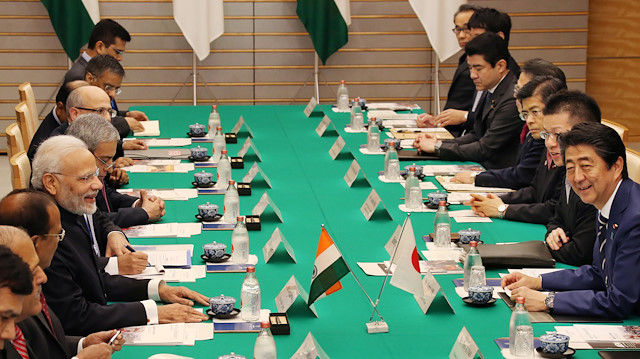
Indian Prime Minister Narendra Modi talks with Japan's Prime Minister Shinzo Abe during their meeting at Abe's official residence,Tokyo, Japan October 29, 2018.
Indian Prime Minister Narendra Modi and Japanese Prime Minister Shinzo Abe agreed to seek closer economic and military ties on Monday as the Japanese leader extended a diplomatic charm offensive that last week took him to India's regional rival, China.
In a joint statement, the two leaders said they would begin regular talks between their foreign and defence ministers and committed to extending cooperation in areas ranging from agriculture and digital technology to investment in Indian rail projects and infrastructure.
Abe and Modi also said they would conclude a $75 billion bilateral currency swap agreement and welcomed an agreement to deepen cooperation between their two navies.
"A strong India benefits Japan and a strong Japan benefits India," Abe told reporters after he and Modi signed the statement.
The talks in Tokyo on Monday followed separate talks on regional issues between the two men the day before at Abe's vacation home near Mount Fuji, the first time he has invited a foreign leader to his private lodge.
Asian shares skidded to 20-month lows, S&P futures fell sharply and China's yuan weakened at the end of a turbulent week for financial markets on Friday, as anxiety over corporate profits added to lingering fears about global trade and economic growth.The gloom enveloping Asia was at odds with a bounce on Wall Street overnight, highlighting fragile investor confidence, as shares of tech titans Amazon.com Inc and Alphabet Inc fell sharply after the closing bell on disappointing earnings.In Friday's Asian session, S&P E-mini futures slumped 0.88 percent, setting up a potentially rough session for U.S. markets which had crumbled on Wednesday on concerns about earnings and sent global equities into a tailspin.MSCI's broadest index of Asia-Pacific shares outside Japan dropped 1.04 percent, erasing tiny gains made in the opening hour and hitting its lowest level since February 2017. Not helping was a slide in the Chinese yuan past a key level, refocusing market attention on slowing growth in the world's second-biggest economy.Shares in Europe are seen following Asia down, with London's FTSE expected to open 0.9 percent lower, Germany's DAX off 1 percent and France's CAC 40 down 1.2 percent, according to David Madden, market analyst at CMC Markets UK."There's no question that the weight of sentiment has been building," said James McGlew, executive director of corporate stockbroking at Argonaut in Brisbane, highlighting in particular rising geopolitical tensions including Brexit, and "internal financial tension" in China."All of these things added up to the volatility hitting a boiling point... and I don't' think at the moment people should be trying to catch the falling knife," he said.The MSCI Asia index has been bruised by a heavy sell-off in the past several days, and is on course for its fifth weekly loss - its longest such streak since 2015. It has fallen more than 4 percent this week.Chinese shares were pulled lower amid the generally dismal mood, and as the yuan fell past the psychologically important 6.96 level to the dollar, touching its lowest levels against the greenback since December 2016.The blue-chip index was down 0.9 percent and the Shanghai Composite was 0.51 percent lower in afternoon trade.Chinese shares have been hit by volatility this week amid a string of official announcements and measures aimed at supporting the markets following a recent plunge. The heavy sell-off has raised concerns about risks posed by about $620 billion worth of shares pledged for loans.In Hong Kong, the Hang Seng index was 1.05 percent lower, with tech shares dropping 2.94 percent.Tech firms also fell in South Korea, where the broader market slid 1.8 percent. The Kospi had earlier touched its lowest level since December 2016.In Australia, shares ended flat at the end of a see-saw day. Japan's Nikkei stock index closed 0.4 percent lower after a volatile session, ending the week down 5.98 percent.Financial markets have been whipsawed in recent sessions on concerns over global growth as investors fretted over Sino-U.S. trade frictions, a mixed bag of U.S. corporate earnings, Federal Reserve rate hikes and Italian budget woes.A slowdown in China has been particularly worrying for policy makers and investors, hitting asset markets from stocks to currencies and commodities. Friday's fresh 22-month low for the yuan adds to the myriad of negative factors roiling investors.Analysts at Capital Economics sounded a cautious note, suggesting that the bounce in the S&P 500 index on Thursday was only temporary as investors worries about the economic outlook worsen."The first, and most important (worry) is that Fed tightening and fading fiscal stimulus will cause the US economy to take a turn for the worse ... The second is that China's economy will continue to struggle," the analysts said in a note to clients."As we have been arguing for a while now, these worries are likely to get worse over the next twelve months or so."Investors will get a chance to check the U.S. economic pulse later Friday when the government releases third-quarter GDP data.ANZ analysts highlighted weak U.S. core durable goods data as suggesting that "investment is not taking off, even with the apparent tailwind from tax cuts and USD repatriation.""This indicates that the boost to GDP growth from the fiscal stimulus could be fairly transitory," the analysts said.Draghi comments hit euroIn currency markets, the euro fell, extending weakness after European Central Bank President Mario Draghi said the bank's 2.6 trillion euro ($2.96 trillion) asset purchase program will end this year and interest rates could rise after next summer, despite fears about the monetary union's economic and political future.The single currency was 0.1 percent lower at $1.1363.The dollar was off 0.2 percent against the yen at 112.18 . The dollar index, which tracks the greenback against a basket of six major rivals, was 0.05 percent lower at 96.633.U.S. Treasury yields fell as equity markets plunged. The 10-year yield fell to 3.1018 percent compared with its U.S. close of 3.136 percent on Thursday.Oil prices gave up ground, heading for their third weekly loss after earlier rising on signals from Saudi Arabia's energy minister that there could be a need for intervention to reduce oil stockpiles.U.S. crude dipped 1.07 percent to $66.61 a barrel. Brent crude fell 0.83 percent to $76.25 per barrel.Spot gold ticked up 0.07 percent to $1,232.44 per ounce. ($1 = 0.8794 euros)
Asian stocks hit 20-month lows, S&P futures slide as investors flee risk
China and Japan on Friday pledged to forge closer ties as both countries stood together at an "historic turning point", signing a broad range of agreements including a $30 billion currency swap pact, amid rising trade tensions with Washington.The pacts were reached on Japanese Prime Minister Shinzo Abe's three-day visit to Beijing as the two neighbours looked to carve out new areas of cooperation and seek new ways to promote trust, which has been fragile at times since diplomatic relations resumed in 1972.Japanese firms including big auto companies like Toyota hope to see normalised ties with China so they can compete with U.S. and European rivals, while Beijing expects Tokyo's endorsement of its ambitious Belt and Road programme, an initiative that Chinese President Xi Jinping hopes will further boost trade and transport links with other countries.Abe said on Friday that bilateral relations with China are at an "historic turning point" and that he expects new possibilities in industries such as infrastructure, logistics, healthcare and finance.China's Premier Li welcomes Japan to participate in China's reformsAbe has held "frank" discussions with Chinese Premier Li Keqiang since arriving in Beijing on Thursday and is expected to meet with Xi later on Friday in the first full-scale Sino-Japanese summit since 2011.Efforts in advancing China-Japan ties should "persevere unremittingly to prevent the appearance of new twists and turns" so that previous efforts did not go to waste, said Li at a joint briefing with Abe on Friday."The Chinese side is willing to work with the Japanese side to return to a normal track, and maintain the stable, sustained and healthy development of bilateral relations," he said, adding that he had held candid discussions with Abe since his arrival on matters of mutual concerns.They reached consensus, Li said, that safeguarding long-term healthy and stable China-Japan ties was in accordance with the interests of both countries and the region and the world.China says army will act 'at any cost' to prevent Taiwan splitChina, Japan seek warmer ties against backdrop of US trade friction
China, Japan to forge closer ties at 'historic turning point'
Chinese President Xi Jinping said on Friday that bilateral relations with Japan had returned to the "right track" and China would ensure the positive momentum continues, state media reported.Xi, who made the remarks while meeting with visiting Japanese Prime Minister Shinzo Abe, added that a healthy and stable relationship was in line with the interests of both countries, state radio reported.China, Japan to forge closer ties at 'historic turning point'
China's Xi says Japan relations back on 'right track'
India and Japan have drawn closer as China's power in Asia has grown. Tokyo is worried about Chinese activity in the Western Pacific. Delhi wants to keep Beijing influence out of the Indian Ocean.
In 2015, Japan's Maritime Defence Force became a regular participant in an annual naval exercise, known as Malabar, that the United States and India began in 1992.
Delhi and Tokyo this month began talks on a military logistics pact, known as a Acquisition and Cross Servicing Agreement (ACSA). It would allow Japan to refuel and resupply its ships at Indian naval bases on the Andaman and Nicobar islands near the Malacca Straits, a maritime choke point through which seaborne trade passes on route to ports in China, Japan and elsewhere.
Japan may also supply the Indian navy with amphibious US-2 aircraft, although the two countries have yet to conclude a deal after five years of negotiations.
Yet as cooperation between Japan and India grows, Abe is also seeking to improve ties with China.
Abe last week visited Beijing for talks with President Xi Jinping and Premier Li Keqiang in a bid to ease tensions and forge economic cooperation.
India and Japan signed a $75 billion bilateral currency swap agreement on Monday, India said, adding the measure was aimed at improving confidence in the foreign exchange and capital markets.
New Delhi said the value of the deal was 50 percent higher than the last currency swap between the two countries, signed in 2014 and effective https://in.reuters.com/article... until December 2015.
China and Japan on Friday signed a broad range of agreements including a $30 billion currency swap pact, amid rising trade tensions with Washington.
The Indian Embassy in Ankara on Friday marked the day of India Technical and Economic Cooperation (ITEC), the government's assistance program established in 1964.Fazlı Çorman, director-general for South Asia at the Turkish Foreign Ministry, Sanjay Bhattacharyya, the Indian ambassador to Ankara, and alumni of the ITEC program were among the participants at the buffet dinner at the embassy.Speaking at the event, Çorman said: “We regard our relations with India as very important.”“From Turkish perspective, India is a country that is becoming more and more significant in science and technology and this is a desire from our side to have cooperation in this area,” he said.He said there is a need to work together with Bhattacharyya for the implementation of recently signed agreements between the two countries.Pakistani Ambassador in Turkey commemorates ‘Black Day’Turkey welcomes holding of Afghan parliament electionsThe most “promising” cooperation between the two countries would be in the fields of science and technology as well as education, Çorman added.He said Turkey is closely following development projects in India such as the Digital India program and the 100 Smart Cities.Bhattacharyya, for his part, said the ITEC has now become a very visible part of India’s role and contribution to South-South cooperation.ITEC and its sister program Special Commonwealth Assistance for Africa Programme (SCAAP) covers 161 countries in Asia, Africa, Eastern Europe, Latin America, the Carribean as well as the Pacific and small island countries, Bhattacharyya said.He added that to date, some 300 people of the Turkish government attended the ITEC program.The program continued with traditional Indian dance shows and food.Pakistani Ambassador in Turkey commemorates ‘Black Day’Blast at firecracker factory in north India kills eightIndia ministers seek to tighten rules against sexual harassment
Turkish-Indian cooperation in sci-tech ‘promising’
An explosion at a firecracker factory in India's northern state of Uttar Pradesh killed eight people and injured three on Friday, police said."The roof was blown away due to the impact of the explosion. The reason is not immediately clear," said Surendra Singh, a police official in Badaun district.Millions of fireworks will be set off during the Hindu festival of Diwali next month and shops are stocking up on supplies.India's Supreme Court said this week only "environmentally safe" fireworks would be allowed, to limit the high pollution across the country.
Blast at firecracker factory in north India kills eight