

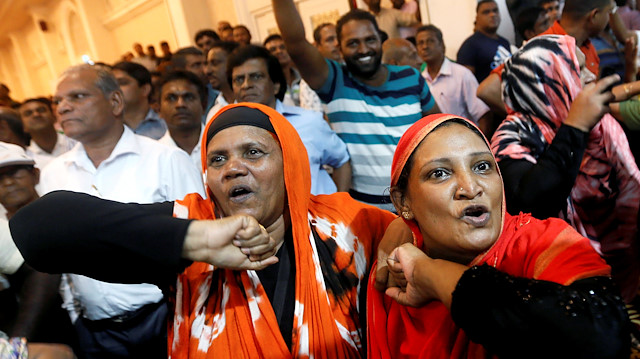
Supporters of Sri Lanka's ousted Prime Minister Ranil Wickremesinghe shout inside the Prime Minister office in Colombo, Sri Lanka October 27, 2018.
More than 10,000 protesting supporters of Sri Lanka's ousted prime minister, Ranil Wickremesinghe, brought parts of the capital, Colombo, to a standstill on Tuesday as political turmoil on the island entered its fifth day.
Sri Lanka was plunged into crisis on Friday when President Maithripala Sirisena sacked Wickremesinghe and swore in ex-president Mahinda Rajapaksa to replace him, breaking up a fragile coalition governing the country.
Sirisena also suspended parliament, to the fury of Wickremesinghe's supporters, who say the president is trying to prevent lawmakers from keeping him in power.
On Tuesday, thousands of protesters gathered near Wickremesinghe's residence to hear the ousted prime minister speak, holding signs demanding that Sirisena to preserve democracy.
Sri Lankan police on Monday arrested deposed oil minister Arjuna Ranatunga over a shooting that killed one person on the weekend, police spokesman said."Colombo Crime division arrested Ranatunga over the shooting incident and he will be produced to the court shortly," police spokesman Ruwan Gunasekera told Reuters.President Maithripala Sirisena on Saturday declared that the cabinet had been dissolved with the appointment of a new prime minister a day earlier.Since then, members of trade unions linked to the new prime minister, Mahinda Rajapaksa, have blocked ministers from the old cabinet from entering their ministries.Police said earlier that in an altercation on Sunday, when Ranatunga tried to enter his office, his security guard shot and killed one person and wounded two.
Sri Lanka police arrest sacked minister over shooting
"He has broken his promise and taken the executive powers into his hands," Wickremesinghe told the crowd, referring to Sirisena.
"He has sidelined parliamentary power."
The crowd, which police estimated at more than 10,000, blocked several roads in the city-centre neighbourhood that includes embassies, high-end stores and hotels, according to a Reuters witness.
"This is a coup. It has all the characteristics of a coup," one of the protesters, Deepanjalie Abeywardene, told Reuters, while holding a sign which read "reconvene the parliament".
"This is a third-grade act by Sirisena. We voted him as the president to ensure democracy," said P. Ariyadasa, a 62-year-old farmer from Mesawachchiya, 230 km from Colombo.
Sri Lanka's President Maithripala Sirisena on Saturday suspended parliament till Nov. 16, a day after removing Ranil Wickremesinghe as prime minister and replacing him with former leader Mahinda Rajapaksa in a surprise move that signals escalating political tensions in the South Asian nation.“The president has prorogued the parliament,” cabinet spokesman Rajitha Senaratne told reporters.Minutes earlier Wickremesinghe, who says he remains prime minister, urged the speaker to convene parliament to prove he retained his parliamentary majority.“I have the majority in the parliament, convene the parliament to resolve this,” Wickremesinghe told a press conference in Colombo on Saturday, flanked by all his coalition partners except Sirisena’s party.“Only parliament can show who has the majority,” he said.The parliament suspension means Wickremesinghe will not immediately have an opportunity to prove his majority, amid speculation that some of his party members would cross over to back Rajapaksa for perks and ministerial portfolios.The island nation’s Media and Finance Minister Mangala Samaraweera on Friday condemned Rajapaksa’s appointment as “an anti-democratic coup” and violation of the constitution.A delegation of the European Union said on Saturday that it was closely following the events in Sri Lanka."We urge all parties to fully act in accordance with Sri Lanka’s constitution, to refrain from violence, to follow due institutional process, to respect the independence of institutions, and freedom of media."Sirisena administered the oath of office to Rajapaksa on Friday after sacking Wickremesinghe, who was away touring the south of the country. Under Sri Lanka's constitution, the prime minister heads parliament and the president has executive powers.The political rift, which comes amid weakening economic growth in Sri Lanka, follows months of infighting in the ruling coalition.Relations between Wickremesinghe’s United National Party (UNP) and Sirisensa’s United People’s Freedom Alliance (UPFA) have been strained recently after Sirisensa criticised Wickremesinghe’s for not adequately investigating an assassination plot against the president. The UPFA had threatened to quit the ruling coalition.Sirisena accused India’s intelligence services of involvement in that plot, a claim New Delhi and Colombo have both denied.There was no immediate reaction from India which has long seen Sri Lanka, located just off its southern tip, as part of its area of influence. India's foreign ministry did not respond to a request seeking comment on the change of leadership in Sri Lanka.India has been concerned about Rajapaksa’s wooing of China -- he ushered in billions of dollars of investment from Beijing to help rebuild the country following the end of a 26-year-long civil war against Tamil separatists in 2009.That investment has since put the island nation deep in debt and forced it to hand over control of a strategic southern port to China, drawing criticism from India and the United States.
Sri Lanka president suspends parliament after sacking PM as political rift deepens
LEGAL WRANGLE
Sirisena maintains his sacking of Wickremesinghe without the approval of parliament was constitutional.
The government's new spokesman, Mahinda Samarasinghe, told a news conference that Sirisena had met foreign diplomats on Monday and told them the constitution allowed for the removal of Wickremesinghe.
Sirisena named a new cabinet on Monday with Rajapaksa in charge of finance.
Rajapaksa’s crushing of a 26-year insurgency by ethnic Tamil separatists in 2009 won him support among the island nation’s Sinhalese majority, and he has a strong following.
Some of Wickremesinghe's ousted ministers have refused to accept his sacking.
On Sunday, former oil minister Arjuna Ranatunga attempted to enter his office, leading to violence that left two dead.
The speaker of parliament, Karu Jayasuriya, has also refused to recognise Rajapaksa as the new prime minister, warning of "bloodshed" if the standoff moves to the streets.
The power struggle in Sri Lanka comes at a critical time for its economy, with credit rating agencies warning that turmoil could raise financing costs and lower foreign capital inflows as it attempts to refinance sizable government debts.
Sri Lanka is also a key state in a battle for influence in south Asia between traditional ally India and China. The Chinese government has been one of the few to congratulate the pro-Beijing Rajapaksa on becoming prime minister.