

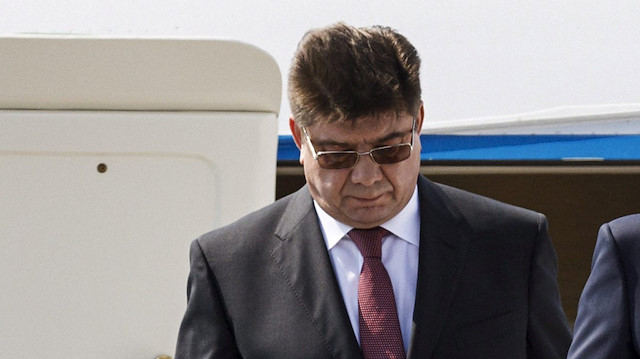
The Russian ambassador to Finland, Pavel Kuznetsov
The Russian ambassador to Finland, Pavel Kuznetsov, has been summoned to a meeting on Monday with Finnish state secretary Matti Anttonen over the disruption of Finland's global positioning system (GPS) signal during recent NATO war games.
"We don't have anything to hide here. Disruption is a serious matter which disturbs civil aviation. We will act towards Russia, we will discuss this and we expect answers," Finnish Foreign Minister Timo Soini said in a statement to public broadcaster Yle while on a state visit to the United States. The Finnish foreign ministry said on Thursday that the disruption of Finland's GPS signal during recent NATO war games came from Russian territory.
The Kremlin said on Friday that it reserved the right to protect the interests of Russian vessels in the Azov Sea where tensions have been rising with Ukraine.Kremlin spokesman Dmitry Peskov told reporters on a conference call that any actions would be in line with international maritime law and said the Kremlin was closely following the situation in the Azov Sea.Japan's obligations to allies important in Pacific island talksJapan's obligations to its allies are an important topic in talks with Russia over four disputed Pacific islands, the Kremlin said on Friday.Japan's Asahi newspaper reported that Prime Minister Shinzo Abe told Putin the United States would not put troops on the islands if they are handed over to Japan."The subject of Japan's obligations to its allies is quite important in the context of discussing the problem of the peace treaty," Kremlin spokesman Dmitry Peskov told reporters. He did not elaborate on what Abe told Russian President Vladimir Putin this week in Singapore. 
Russia may take actions to protect its vessels in Azov Sea: Kremlin
Iraq has restarted exports of Kirkuk oil, halted a year ago due to a standoff between the central government and Kurdistan's semi-autonomous region, industry sources said on Friday after a new government in Baghdad agreed a tentative deal with Erbil.The development is a win for the U.S. government, which has been urging both sides to settle the dispute and resume flows to help address a shortage of Iranian crude in the region after Washington imposed new sanctions on Tehran.Flows resumed on Friday at a modest level of around 50,000-60,000 barrels per day (bpd) versus a peak of 300,000 seen occasionally last year and it was not clear when and by how much they would rise, sources said.The Iraqi Oil Ministry did not immediately respond to a request for comment.YPG is 'Syrian offshoot' of PKK terror group: US envoyThe deal signals new Iraqi Prime Minister Adel Abdul-Mahdi and Oil Minister Thamir Ghadhban are ready to work with Erbil despite previous tensions and a failed independence referendum in September 2017.The halting of exports from Kirkuk in October 2017 stopped nearly 300,000 bpd flowing out of Iraq towards Turkey and international markets - causing a net revenue loss of some $8 billion over the past year.Most of Iraq's exports come from southern fields, but Kirkuk is one of the biggest and oldest oilfields in the Middle East, estimated to contain 9 billion barrels of recoverable oil.Exports have been on hold because Iraqi government forces took control of Kirkuk from Kurdish authorities. The Kurds had controlled Kirkuk and its oilfields after Daesh militants drove the Iraqi army out in 2014, and Kurdish forces in turn ejected the militants.Iraqi president arrives in Jordan for official visitThe pipeline Baghdad once used for export via Turkey was wrecked by Daesh - leaving only one working pipeline, built and controlled by the Kurds.Talks about a flow resumption were also complicated by the fact that the pipeline is controlled by Russian oil major Rosneft, which collects transit fees for exports.Kurdistan is producing and exporting some 400,000 bpd via the pipeline. Kirkuk's flow resumption will boost the volume to 450,000-500,000 bpd, short of the 700,000 bpd Kurdistan was exporting in some periods of last year.Iraqi authorities say they still need to feed local refineries where Kirkuk's output has been diverted over the past year. The refineries are still set to receive some 185,000 bpd under the latest arrangements, according to sources.Baghdad and Erbil have yet to find a compromise over maximum flow levels as well as budget transfers from the central government to Erbil - something the two sides have struggled to agree on for many years. US comes to Talabani’s rescue as Barzani attempts coup after KRG referendum
Iraq restarts some Kirkuk oil flows after year-long halt
The U.S.-led coalition resumed strikes targeting eastern Syria using white phosphorus munitions, Russian Foreign Ministry spokeswoman Maria Zakharova said on Thursday."The Americans have resumed intensive airstrikes against terrorist-controlled settlements along the eastern bank of Euphrates, including, according to local residents, the use of white phosphorus munitions," Zakharova said.A coalition spokesperson earlier denied the use of either cluster bombs or white phosphorus munitions in urban and civilian-populated areas of eastern Syria.Syrian state news agency SANA claimed that the coalition used cluster munitions while targeting the al-Sha’afa and Hajin towns. The strikes allegedly caused civilian casualties.US-led coalition shelling kills 17 in Syria's Deir ez-ZourThe same agency stated that the coalition also used white phosphorus while striking Hajin earlier in the month.The 1977 First Additional Protocol to the 1949 Geneva Conventions bans the use of white phosphorus munitions.Syria has been locked in a vicious civil war since early 2011 when the Assad regime cracked down on pro-democracy protests with unexpected ferocity.Since then, hundreds of thousands of people have been killed and more than 10 million others were displaced, according to UN officials.Syria Task Force to provide security in AfrinTurkey to continue firm stance on Cyprus, Syria, LibyaTurkey sends over 3 million textbooks to SyriansPrice tag for US 'war on terror' pegged at $5.9T
US strikes eastern Syria using banned phosphorus bombs, Russia says
Russia wants to stay out of any oil-production cuts being touted by some of its partners in an OPEC-led supply pact, two high-ranking Russian sources told Reuters.Worried by a drop in oil prices due to slowing demand and record supply from Saudi Arabia, Russia and the United States, the Organization of the Petroleum Exporting Countries is talking about a policy U-turn just months after increasing production.Russian President Vladimir Putin on Thursday avoided giving a direct answer on whether production should be limited, but said he had discussed the situation in global oil markets with U.S. President Donald Trump."We need to be very accurate here, each word matters," Putin told reporters in Singapore. "But the fact that the cooperation (with OPEC) is needed is obvious and we will cooperate."Petrol bombs lobbed at Kiev church as Russia row festersThis week, Trump said he hoped Saudi Arabia and the rest of OPEC would not cut production. Putin said an oil price of around $70 per barrel suited Russia.A steep slide in prices has surprised many oil market participants. Brent crude has fallen from a four-year high of $86 a barrel in early October to $66 as of Thursday. Just weeks ago, some trading firms were talking of $100 oil."I think (oil) production should not be lowered. Yes, we have done this in the past but this was not the right systematic approach," a senior Russian government source said."Oil production in Russia has been on the rise in recent years, by around 100,000 barrels per day each year, and it will continue to do so in future."Russia's Putin: I discussed oil prices with TrumpEarlier this week, three sources familiar with the issue said OPEC and its partners were discussing a proposal to cut oil output by 1.4 million barrels per day (bpd), although Russia may not be on board for such a large reduction.Another source familiar with Russian thinking said Moscow may support smaller cuts, most likely by other producers."We think 1 million bpd (cuts) is more realistic, not 1.4 million bpd ... But who is going to do this is another question," the source said. Putin said last month that Russia was able to add another 200,000–300,000 bpd to its production.Russia pumped 11.41 million bpd in October, a post-Soviet high. October's level was proposed by Saudi Energy Minister Khalid al-Falih as the reference point for any cut.Russia's October level was around 460,000 bpd more than the 10.947 million bpd it had initially been bound to produce under the supply pact agreed with OPEC and other allies.A small reduction from the October level would be a "win-win" for Moscow, the second source said. Alternatively, Russia may propose not to increase output further, instead of a cut, the source said.COMPANIES OPPOSESaudi-led OPEC and a group of non-OPEC nations, dominated by Russia, have been cooperating to limit oil supply since the start of 2017. They partially unwound their reduction in June after pressure from Trump, who wanted lower oil prices.The producers, known informally as "OPEC+", will convene in the first week of December in Vienna to decide further steps.Another indication of the likelihood of any Russian output cut can be gleaned from the head of Kremlin-controlled energy giant Rosneft, Putin ally Igor Sechin.He eschewed a direct response on Wednesday on whether curbs were needed, saying oil prices were adjusting after being hit by initial uncertainty about production in Iran, which later benefited from export waivers from U.S. sanctions."It (the oil price) is already growing," he said, as Brent rebounded from a steep sell-off the previous day. "I believe that this uncertainty which affected the oil price was largely due to Iran. Now everything is being adjusted."Rosneft, which accounts for 40 percent of Russian oil production, plans to raise its liquid hydrocarbon output further next year, to 241 million tonnes, or 4.8-4.9 million bpd, from 4.73 million bpd in the third quarter.Another large Russian oil producer, Gazprom Neft, is ready to lift output by a further 20,000-30,000 bpd this year and by 50,000 bpd next year. The head of Lukoil, Vagit Alekperov, voiced opposition this week to any cut.Surging U.S. production is a headache for OPEC+. The country's crude output is expected to average 12.06 million bpd in 2019, passing 12 million bpd sooner than expected on surging shale supply, the U.S. Energy Information Administration said this month."U.S. oil production will soon plateau. It can't grow indefinitely," the Russian government source said.In the previous round of global production cuts, Russian oil companies first opposed the move but then relented under orders from Putin.The Russian Energy Ministry did not immediately reply to a Reuters request for a comment. 
Russia wants to steer clear of any OPEC-led oil production cut