

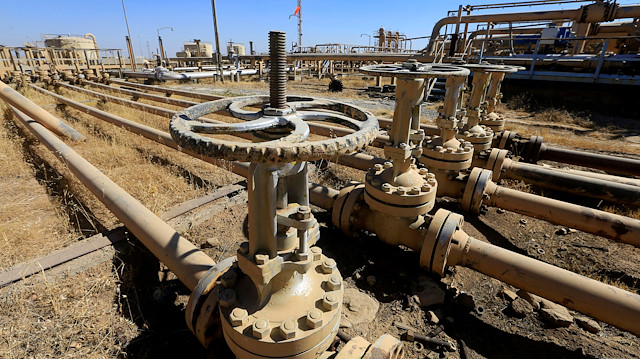
An oil field is seen in Dibis area on the outskirts of Kirkuk, Iraq October 17, 2017.
Iraq has restarted exports of Kirkuk oil, halted a year ago due to a standoff between the central government and Kurdistan's semi-autonomous region, industry sources said on Friday after a new government in Baghdad agreed a tentative deal with Erbil.
The development is a win for the U.S. government, which has been urging both sides to settle the dispute and resume flows to help address a shortage of Iranian crude in the region after Washington imposed new sanctions on Tehran.
Flows resumed on Friday at a modest level of around 50,000-60,000 barrels per day (bpd) versus a peak of 300,000 seen occasionally last year and it was not clear when and by how much they would rise, sources said.
The Iraqi Oil Ministry did not immediately respond to a request for comment.
The PYD/YPG is the Syrian branch of the PKK terror group, the American Special Representative for Syria James Jeffrey said Thursday.He spoke at a panel at the Defense One Summit, which brings top military, foreign policy and intelligence leaders to Washington to discuss American security throughout the world.Jeffrey said U.S. operations in Syria could not be done without the "active participation, coordination, and cooperation of Turkey."The U.S. is not able to function in the northeastern region of Syria while fighting Daesh forces at the same time, and to do both a local partner is needed, according to Jeffrey."That local partner since 2014 has been the PYD, which is the Syrian offshoot of PKK, but we have not designated it as a terrorist organization which we did with the PKK,” said Jeffrey, referring to the political wing of the YPG.Video: 'YPG is Syrian offshoot of PKK terror group'In its more than 30-year terror campaign against Turkey, the PKK -- listed as a terrorist organization by Turkey, the U.S. and the EU -- has been responsible for the deaths of 40,000 people.Turkey has repeatedly told Washington that the PYD/YPG is not any different from the PKK and partnering with one terrorist organization to defeat another would not yield any result.He said that the U.S. is still in the northeast region of Syria to defeat Daesh terrorists, remove Iranians out of the area and ensure the political process in the country.Turkey agrees with all three points but the U.S. added "some conditions" and did not do a proper job of explaining them to Ankara, he said without mentioning what those conditions were.Jeffrey said without Turkey’s help, the U.S. mission in Syria would be over.Turkey neutralizes four PKK terrorists in northern IraqN. Syrian tribes hail Turkey’s anti-YPG/PKK effortsPKK bans hijab in occupied areas of NW Syria
YPG is 'Syrian offshoot' of PKK terror group: US envoy
The deal signals new Iraqi Prime Minister Adel Abdul-Mahdi and Oil Minister Thamir Ghadhban are ready to work with Erbil despite previous tensions and a failed independence referendum in September 2017.
The halting of exports from Kirkuk in October 2017 stopped nearly 300,000 bpd flowing out of Iraq towards Turkey and international markets - causing a net revenue loss of some $8 billion over the past year.
Most of Iraq's exports come from southern fields, but Kirkuk is one of the biggest and oldest oilfields in the Middle East, estimated to contain 9 billion barrels of recoverable oil.
Exports have been on hold because Iraqi government forces took control of Kirkuk from Kurdish authorities. The Kurds had controlled Kirkuk and its oilfields after Daesh militants drove the Iraqi army out in 2014, and Kurdish forces in turn ejected the militants.
Iraqi President Barham Salih arrived in Jordan on Thursday for his first official visit to the Hashemite Kingdom since taking office last month.In a statement, Jordan’s Royal Court said that King Abdullah II had received the visiting Iraqi president, but refrained from providing any additional details.Salih’s reception in the Jordanian capital was reportedly attended by a host of top Jordanian government officials.The Iraqi president is being accompanied on his visit by a high-level delegation including several Iraqi government ministers.
Iraqi president arrives in Jordan for official visit
The pipeline Baghdad once used for export via Turkey was wrecked by Daesh - leaving only one working pipeline, built and controlled by the Kurds.
Talks about a flow resumption were also complicated by the fact that the pipeline is controlled by Russian oil major Rosneft, which collects transit fees for exports.
Kurdistan is producing and exporting some 400,000 bpd via the pipeline. Kirkuk's flow resumption will boost the volume to 450,000-500,000 bpd, short of the 700,000 bpd Kurdistan was exporting in some periods of last year.
Iraqi authorities say they still need to feed local refineries where Kirkuk's output has been diverted over the past year. The refineries are still set to receive some 185,000 bpd under the latest arrangements, according to sources.
Baghdad and Erbil have yet to find a compromise over maximum flow levels as well as budget transfers from the central government to Erbil - something the two sides have struggled to agree on for many years.
A coup prepared by Masoud Barzani in order to take control of the Talabani region after the illegitimate referendum held in the Kurdistan Regional Government (KRG) on Sept. 25, 2017 has been exposed.Kosret Resul, a former Peshmerga commander who took over as general secretary of the Patriotic Union of Kurdistan following Jalal Talabani’s demise conspired with Barzani and took up the role of the commander of the coup. The Goran Movement was also involved in the coup attempt.British and U.S. intelligence services informed Talabani’s son, Bafil, and thus prevented the actualization of the coup. Price tag for US 'war on terror' pegged at $5.9TIran’s intervention assisted in preventing the coupBafil sought help from Iran to prevent the coup. He traveled with his mother Hiro, sibling Kubat and cousin Lahor on Oct. 11 to Sulaymaniyah and met with Hashd Shaabi leader Hadi al-Amiri and Major General in the Islamic Revolutionary Guard Corps and commander of its Quds Force Qasem Soleimani. They agreed that the coup must be prevented.Three days later, on Oct. 14, they met in the Bashir village and finalized their agreement. Bafil, Kubat and Lahor attended this second meeting without Hiro. An agreement was reached regarding a military operation against Barzani’s forces. Two days later, an operation against Barzani’s Peshmerga fighters in Erbil, Mosul and Kirkuk was initiated.Once the coup was prevented, Kosret Sesul fled Sulaymaniyah and took shelter with Barzani.Turkey neutralizes four PKK terrorists in northern IraqOct. 16: CountercoupYeni Şafak daily spoke to figures close to Barzani to discuss the developments experienced in northern Iraq before Oct. 16. A high-level official who wanted to remain anonymous for security reasons confirmed the developments following Sept. 25. The Kurdish official said Talabani’s Peshmerga participated in operations with Hashd Shaabi, and that following Talabani’s demise, the attempt to take control of two regions failed, adding that Oct. 16 was essentially a countercoup against the Talabani family.After the completion of the Oct. 16 process, regional actors brought the parties together again. Kosret Resul, who took shelter in Erbil, the center of Barzani’s forces, returned to Selahaddin after the parties agreed on a new deal. Necrettin Kerim, the former governor of Kirkuk, along with Kosret Resul, will allegedly be the two main actors of the new plan regarding energy resources.Iraq to exchange food for Iranian gas, seeks US approvalU.S. repaid Talabani for his cooperation in the Hood EventFormer head of the Turkish General Staff’s intelligence arm İsmail Hakkı Pekin said “Western forces paid off the Talabani family.”Pekin stated that Lahor Talabani played an active role in the Hood Event in Sulaymaniyah on July 4, 2003, and that 40 Peshmerga fighters were there that day. Following the invasion of Iraq, a group of Turkish troops operating in northern Iraq were caught, led away with hoods covering their heads and interrogated by U.S. soldiers. The U.S. repaid Talabani for his cooperation 15 years later by saving him from the coup attempt, Pekin said.During the raid of the building that was used by Special Forces, many documents against the U.S. belonging to Turkmens, Arabs and Kurds detailing the U.S. occupation were found and many of those figures were later executed, he said. PKK bans hijab in occupied areas of NW SyriaUN to restore Iraq's Kirkuk citadel, Ottoman barracksUS monitors Turkey from military bases located near border
US comes to Talabani’s rescue as Barzani attempts coup after KRG referendum