

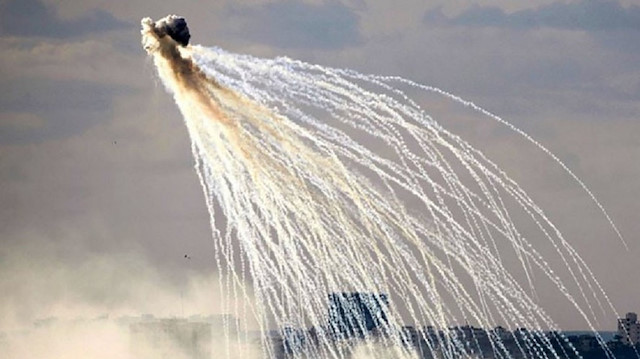
File photo
The U.S.-led coalition resumed strikes targeting eastern Syria using white phosphorus munitions, Russian Foreign Ministry spokeswoman Maria Zakharova said on Thursday.
"The Americans have resumed intensive airstrikes against terrorist-controlled settlements along the eastern bank of Euphrates, including, according to local residents, the use of white phosphorus munitions," Zakharova said.
A coalition spokesperson earlier denied the use of either cluster bombs or white phosphorus munitions in urban and civilian-populated areas of eastern Syria.
Syrian state news agency SANA claimed that the coalition used cluster munitions while targeting the al-Sha’afa and Hajin towns. The strikes allegedly caused civilian casualties.
At least 17 civilians, mostly women and children, were killed Thursday when a U.S.-led coalition shelled positions on the outskirts of Syria's eastern Deir ez-Zour province.Local sources told Anadolu Agency that the shelling had targeted the village of Albo Badran near the Daesh-held town of Al-Sousse.The sources, who spoke on condition of anonymity for security reasons, said that all 17 casualties had hailed from the same family.Most of the slain had been displaced earlier from the nearby town of Al-Baguz, which continues to see fierce fighting between Daesh and the PYD/PKK terrorist group.Earlier this week, at least 20 civilians in the same province were killed by coalition airstrikes.Syria has only just begun to emerge from a devastating conflict that began in 2011 when the Assad regime cracked down on demonstrators with unexpected ferocity.Syria Task Force to provide security in AfrinTurkey to continue firm stance on Cyprus, Syria, LibyaTurkey sends over 3 million textbooks to Syrians
US-led coalition shelling kills 17 in Syria's Deir ez-Zour
The same agency stated that the coalition also used white phosphorus while striking Hajin earlier in the month.
The 1977 First Additional Protocol to the 1949 Geneva Conventions bans the use of white phosphorus munitions.
Syria has been locked in a vicious civil war since early 2011 when the Assad regime cracked down on pro-democracy protests with unexpected ferocity.
Since then, hundreds of thousands of people have been killed and more than 10 million others were displaced, according to UN officials.
Security in Afrin, which was purged of the YPG/PKK terrorist group following Turkey’s Operation Olive Branch, is being provided by a “Syria Task Force” affiliated with the Turkish Police Special Operations Department.Anadolu Agency reporters on Thursday videotaped special teams that are training local police forces and providing them with operational assistance.The Syria Task Force is comprised of 12 different teams from the Special Operations Departments from Turkey’s Ankara, Hatay and Gaziantep provinces.Video: Syria Task Force to provide security in AfrinThe Syria Task Force is also participating in high-risk operations.The nascent police organization, which was formed in accordance with the Turkish police, is composed of seven units specialized in counter-terrorism, intelligence, public order, traffic, crime-scene investigations and commandos.Within this framework, Turkish police are providing training and guidance for the new police organization in Afrin.It is hoped that the local police force will become operational once it gains experience in the field.Turkey to continue firm stance on Cyprus, Syria, LibyaTurkish police will also provide training for police units that will operate inside prisons that will soon be established in the district.Special forces will also be deployed at the entrances and exits of highways and critical points in the region.These special forces, with the approval of the local authorities, will personally engage in risky operations.Within the past three months, several suicide attacks have been thwarted by special teams who have also destroyed more than 100 makeshift explosives left by the YPG/PKK terrorist group.Special forces are continuing operations against terrorist elements in the region.Moreover, the Syria Task Force will carry out joint operations with the Turkish Armed Forces and the Turkish intelligence apparatus when necessary.Turkey sends over 3 million textbooks to Syrians
Syria Task Force to provide security in Afrin
Turkey's vice president said Thursday that the country will continue its "righteous and firm" stance on Cyprus, Syria and Libya.Speaking at a ceremony marking the 35th foundation anniversary of the Turkish Republic of Northern Cyprus (TRNC), Fuat Oktay said the reason for Cyprus still not reaching solution is the irreconcilable attitude of Greek Cypriots who have adopted insolubility as a maxim."Turkey will continue to display its righteous and firm stance with determination in Cyprus, Syria and Libya," Oktay said.Oktay said TRNC is one of the two founding and equal parts of the island and Turkey will not let Greek Cypriots ignore this fact.Turkey's budget posts $13B deficit in Jan-OctThe Turkish Republic of Northern Cyprus was declared on Nov. 15, 1983. It is currently recognized only by Turkey as an independent state.The eastern Mediterranean island has been divided since 1974, when a Greek Cypriot coup was followed by violence against the island's Turks, and Ankara's intervention as a guarantor power.Negotiations over Cyprus resumed after a 2004 UN-backed Annan Plan to reunify the Turkish Cypriot and Greek Cypriot communities.The status of the island remains unresolved in spite of a series of discussions that resumed in May 2015.There has been an on-and-off peace process over recent years, the latest failed initiative having taken place in Crans-Montana, Switzerland under the auspices of guarantor countries Turkey, Greece and the U.K., collapsing last year.Turkey's health spend reaches over $38.5B in 2017Turkey sends over 3 million textbooks to SyriansTurkish private sector loans from abroad down in Sept.Turkey's unemployment rate stays at 11.1 pct in Aug.
Turkey to continue firm stance on Cyprus, Syria, Libya
Turkey’s National Education Ministry has sent 3.6 million textbooks to schools in northern Syria, the ministry said Thursday.The books were delivered to a logistics center run by Turkey's Disaster and Emergency Management Authority (AFAD) in Choban Bayk, or also known as al-Rai, a small town in Aleppo province.Some 360,000 students from primary, secondary and high schools will use the textbooks, which include Arabic and English grammar books as well as science, math, physics and chemistry books.Price tag for US 'war on terror' pegged at $5.9TThe books will be sent to schools in Afrin, Jarablus, al-Bab, Azaz and Mare districts and Ahtarin town, areas where Turkish forces have conducted two major military operations against terrorist groups YPG/PKK and Daesh.Operation Euphrates Shield, which began in August in 2016 and ended in March 2017, eliminated terrorists along the Syrian border.On Jan. 20, Turkey launched Operation Olive Branch to free Afrin of YPG/PKK and Daesh terrorists. On March 18, Turkish troops and the Free Syrian Army liberated the Afrin district center.Video: Turkey sends over 3 million textbooks to Syrians
Turkey sends over 3 million textbooks to Syrians
The U.S. will have spent nearly $6 trillion on various wars and military operations aimed at winning the war on international terrorist groups by October 2019, according to a study released Wednesday.The $5.9 trillion assessment by Brown University's Watson Institute includes costs expected to be accumulated through the fiscal year that runs through September 2019, as well as past expenditures. It includes not just spending from the Defense Department, but all of government resulting as a consequence of the wars.That includes related spending by the State Department and Department of Homeland Security, veterans care spending and interest paid on war debts.US troop levels at Mexico border likely at peak: commanderAs a result, the figure is significantly higher than the Pentagon's $1.5 trillion estimate."If the US continues on its current path, war spending will continue to grow," the report states, noting that even if the wars the U.S. embarked on following the Sept. 11, 2001, terrorist attacks are ended by 2023 the U.S. would be on track to spend an additional $808 billion."Moreover, the costs of war will likely be greater than this because, unless the US immediately ends its deployments, the number of veterans associated with the post-9/11 wars will also grow," it adds.After Washington embarked on its military campaign against al-Qaeda, the group responsible for the 9/11 attacks, and the Taliban which offered it safe harbor, the U.S. invaded Iraq, and went on a global campaign of less expansive military efforts aimed at eliminating terrorist groups and their leaders.Death toll from California wildfire reaches 56That has included a robust targeted killings program, expanded special operations and a global intelligence collection program.Spending in Afghanistan and Iraq has amounted to nearly $1.8 billion alone, despite a withdrawal of U.S. forces from Iraq that was completed in 2011.But Washington re-entered the fray in Iraq and later Syria, deploying troops in support of partnered forces in the fight against Daesh, which overran large portions of the countries before being rolled back through an expansive American-led air campaign and train and advise mission for local forces.Watson's study of the costs associated with the wars comes as a separate congressionally-mandated report warns the U.S. military "might struggle to win, or perhaps lose, a war against China or Russia."Authored by the National Defense Strategy Commission, a bipartisan group of former security and military experts, the assessment warned Washington is not addressing the threats posed by Moscow and Beijing quickly enough."DOD and the White House have not yet articulated clear operational concepts for achieving U.S. security objectives in the face of ongoing competition and potential military confrontation with China and Russia," the report said, referring to the Department of Defense.The commission called for a 3-5 percent increase in Defense spending above inflation in order to address the threats."Failing that, it may be necessary to alter the expectations of U.S. defense strategy and our global strategic objectives," it said.
Price tag for US 'war on terror' pegged at $5.9T