

Fuat Oktay
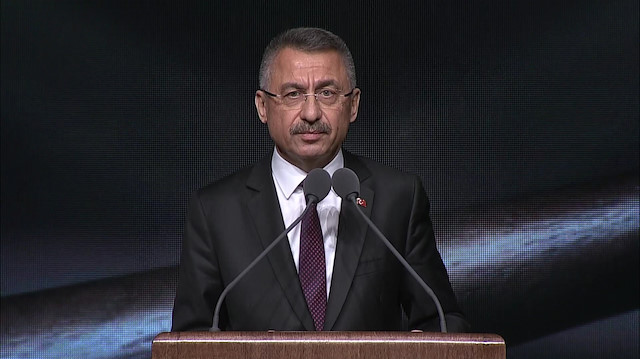
Turkey's vice president said Thursday that the country will continue its "righteous and firm" stance on Cyprus, Syria and Libya.
Speaking at a ceremony marking the 35th foundation anniversary of the Turkish Republic of Northern Cyprus (TRNC), Fuat Oktay said the reason for Cyprus still not reaching solution is the irreconcilable attitude of Greek Cypriots who have adopted insolubility as a maxim.
"Turkey will continue to display its righteous and firm stance with determination in Cyprus, Syria and Libya," Oktay said.
Oktay said TRNC is one of the two founding and equal parts of the island and Turkey will not let Greek Cypriots ignore this fact.
Turkey's central government budget balance recorded a deficit of 62.1 billion Turkish liras ($13 billion) in the first 10 months of 2018, the Treasury and Finance Ministry revealed on Thursday.The country's budget revenues totaled 609 billion Turkish liras ($126.9 billion) from January to October, up nearly 20 percent from the same period last year, the ministry said in a statement.During the same period, budget expenditures rose 23.3 percent to 671.1 billion Turkish liras ($140 billion) -- marking a 62.1 billion Turkish liras ($13 billion) deficit.Turkey's health spend reaches over $38.5B in 2017The budget balance, excluding interest payments, saw a surplus of 2.5 billion Turkish liras ($521 million) from January to October.Official figures showed that tax revenues rose nearly 18 percent to reach nearly 507.9 billion Turkish liras (around $105.8 billion), while interest payments were 64.6 billion Turkish liras ($13.5 billion) in the same period.Turkey's unemployment rate stays at 11.1 pct in Aug.Monthly figuresIn October, the budget balance also saw a deficit of 5.4 billion Turkish liras ($931 million).Turkey's budget revenues totaled 62.1 billion Turkish liras ($10.7 billion) last month, up 17.6 percent on a yearly basis.Budget expenditures in October were 67.5 billion Turkish liras ($11.6 billion), a rise of 20.2 percent annually.Excluding interest payments, the central government budget balance saw a surplus of 197 million Turkish liras ($34 million) last month.The average U.S. dollar/Turkish lira exchange rate in October was 5.80, while one dollar traded for 4.80 liras on average in the first 10 months of 2018.
Turkey's budget posts $13B deficit in Jan-Oct
The Turkish Republic of Northern Cyprus was declared on Nov. 15, 1983. It is currently recognized only by Turkey as an independent state.
The eastern Mediterranean island has been divided since 1974, when a Greek Cypriot coup was followed by violence against the island's Turks, and Ankara's intervention as a guarantor power.
Negotiations over Cyprus resumed after a 2004 UN-backed Annan Plan to reunify the Turkish Cypriot and Greek Cypriot communities.
The status of the island remains unresolved in spite of a series of discussions that resumed in May 2015.
There has been an on-and-off peace process over recent years, the latest failed initiative having taken place in Crans-Montana, Switzerland under the auspices of guarantor countries Turkey, Greece and the U.K., collapsing last year.
Turkey’s health expenditures jumped 17.4 percent in 2017, compared with the previous year, the Turkish Statistical Institute said on Thursday.Total costs reached 140.65 billion Turkish liras ($38.53 billion) last year, TurkStat said, up from around 120 billion Turkish liras ($39.6 billion) in 2016.The institute said that health expenditure per capita increased to 1,751 Turkish liras ($479.7) in 2017 from 1,511 Turkish liras ($498.7) in 2016.The proportion of total health expenditure of the country’s GDP was 4.5 percent last year and 3.5 percent in 2016."Out-of-pocket health expenditures made by households for treatment, pharmaceuticals etc. reached 24.4 billion Turkish liras ($6.7 billion) with an increase of 22.7 percent in the year 2017," TurkStat said.It added: "The proportion of household health expenditure to total health expenditure was 17.1 percent in the year 2017."The proportion of general government health expenditure to total health expenditure was 78 percent in last year and 78.5 percent in 2016.Turkey operates 894 hospitals, 7,950 family health centers, nearly 2,700 emergency health stations, and 171 community mental health centers with around 1 million medical personnel, Fahrettin Koca, Turkish health minister, said on Tuesday.The minister added that the number of doctors per 100,000 population was 186 in the country, under the OECD average -- 351 per 100,000 population.Life expectancy at birth is 78, baby mortality rate per 1,000 live birth is 6.8 while mother mortality rate per 1,000 live birth is 14.6, Koca underlined.Turkey has also general health insurance system to protect all citizens' health.The average of U.S. dollar / Turkish lira rate was 3.65 during the last year, and 3.03 in 2016.
Turkey's health spend reaches over $38.5B in 2017
Turkey’s National Education Ministry has sent 3.6 million textbooks to schools in northern Syria, the ministry said Thursday.The books were delivered to a logistics center run by Turkey's Disaster and Emergency Management Authority (AFAD) in Choban Bayk, or also known as al-Rai, a small town in Aleppo province.Some 360,000 students from primary, secondary and high schools will use the textbooks, which include Arabic and English grammar books as well as science, math, physics and chemistry books.Price tag for US 'war on terror' pegged at $5.9TThe books will be sent to schools in Afrin, Jarablus, al-Bab, Azaz and Mare districts and Ahtarin town, areas where Turkish forces have conducted two major military operations against terrorist groups YPG/PKK and Daesh.Operation Euphrates Shield, which began in August in 2016 and ended in March 2017, eliminated terrorists along the Syrian border.On Jan. 20, Turkey launched Operation Olive Branch to free Afrin of YPG/PKK and Daesh terrorists. On March 18, Turkish troops and the Free Syrian Army liberated the Afrin district center.Video: Turkey sends over 3 million textbooks to Syrians
Turkey sends over 3 million textbooks to Syrians
The Turkish outstanding private sector loans received from abroad fell in September compared to the end of 2017, the Central Bank announced Thursday.Excluding trade credits, private sector's short-term loans totaled $16.5 billion, marking a $2 billion decline from the end of last year, as 76.4 percent consists of liabilities of the financial institutions, according to the Central Bank of the Republic of Turkey (CBRT).As of September, long-term loans amounted to $216.6 billion, going down $5.3 billion over the same period, while non-financial institutions' share was 51.4 percent."Regarding the currency composition, of the total long-term loans in the amount of $216.6 billion, 60.3 percent consists of U.S. dollar, 34.7 percent consists of euro, 3.4 percent consists of Turkish lira and 1.6 percent consists of other currencies,” the bank said."And of the total short-term loans in the amount of $16.5 billion, 46.5 percent consists of U.S. dollar, 34.1 percent consists of euro, 19.3 percent consists of Turkish lira and 0.1 percent consists of other currencies,” it added.The bank also said that principal repayments of the private sector’s total outstanding loans received from abroad amounted to $66.3 billion for the next 12 months.Turkey's unemployment rate stays at 11.1 pct in Aug.
Turkish private sector loans from abroad down in Sept.
Turkey's unemployment rate stood at 11.1 percent in August, the country's statistical authority announced on Thursday.The figure was up 0.5 percentage points compared to the same month a year earlier, according to the Turkish Statistical Institute (TurkStat).The number of unemployed persons aged 15 years and over increased by 266,000 year-on-year to reach 3.67 million in August.The non-agricultural unemployment rate also rose 0.4 percentage points to 13.2 percent during the same period.The youth unemployment rate -- persons aged between 15 and 24 -- was 20.8 percent, indicating an increase of 0.2-percentage points on a yearly basis in August.TurkStat said unemployment for the 15-64 age group went up 0.6 percentage points annually to 11.4 percent in August.In August, the employment rate rose by 0.3 percentage points from the same month last year up to 48.3 percent."The number of employed persons rose by 490,000 to 29.3 million persons in August 2018 compared with the same period of last year," it said.The labor force participation rate (LFPR) rose by 0.6 percentage points year-on-year to reach 54.3 percent in the month."LFPR for males was 74.1 percent with 0.6 percentage point increase and the rate for females was 34.9 percent with 0.6 percentage point increase compared with the same period of last year," TurkStat said.The rate of unregistered employment -- people working without social security related to their principal occupation -- was 34 percent in July, marking a decrease of 1.1-percentage points from August 2017.The institute will release its next unemployment report on Dec. 17.
Turkey's unemployment rate stays at 11.1 pct in Aug.