

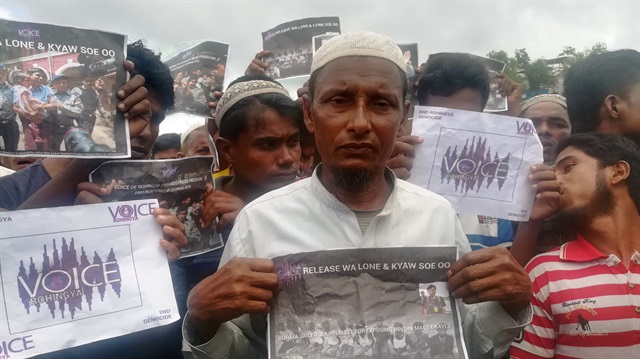
Rohingya Regugee Abdu Shakur, father of one of the victims of Inn Din massacre protests the sentencing of Reuters journalists Wa Lone and Kyaw Soe Oo at Teng Khali camp outside Cox's Bazar in Bangladesh September 5, 2018.
A Myanmar foreign investment official said on Wednesday he "totally underestimated" the economic damage of the Rohingya crisis, adding that the outcry over the jailing of two Reuters reporters would also have some impact on his country's reputation.
Asked at an investor forum in Singapore what impact the crisis had on Myanmar's economy and investment, the director general of the Directorate of Investment and Company Administration (DICA), which promotes private sector development and investment, said previously the government had been able to control outbreaks of communal tension.
But the crisis in Rakhine State was different.
"I totally underestimated," the official, Aung Naing Oo, told the forum, referring to the impact of an eruption of violence in 2016, which snowballed in 2017.
The Justice For Rohingya Minority (JFRM) held a roundtable discussion Monday in London on the genocide against Myanmar’s Rohingya Muslims and offered solutions to the crisis.The panel of speakers included Peter Oborne, an author and columnist for the Daily Mail, Catherine West, an MP and member of the Parliamentary Select Committee on International Trade, Richard Cockett, editor and columnist at The Economist, Mark Farmaner, director of Burma Campaign UK, and S. Sayyid, a professor at the University of Leeds.Also attending the event were leading Rohingya activists Abdullah Faliq, Nurul Islam and Kyaw Win.Dozens of Myanmar civil society groups condemn conviction of Reuters reportersModerating the event was Peter Oborne, who began the discussion by clarifying that the atrocities being perpetrated against the Rohingya were a genocide and that the international community’s silence and lackluster response allowed the perpetrators to get away without any accountability.“It should be known that what is happening to the Rohingya in Myanmar is a genocide, and it is a genocide that has been occurring for the past six years” Oborne said.“That this [genocide] has been and continues to be underreported doesn’t lessen the fact that it is a genocide, and the abysmal response by the international community allows the perpetrators to continue with the atrocities without any fear of accountability whatsoever,” he added.Myanmar army apologises for mistaken photos in book on Rohingya crisisOborne also said that holding such events and discussions was key to spreading awareness of the plight of the Rohingya Muslims and to push for policy changes in government regarding its position on the crisis and its standing at the UN Security Council.Richard Cockett of The Economist spoke on how the recent atrocities against the Rohingya are not a new phenomenon and that Rohingya have for decades experienced routine persecution and oppression from Burmese authorities.Cockett spoke on how the Burmese government would prevent economic and social development from taking place in Rohingya communities in Rakhine state, not offer any employment opportunities for Rohingya Muslims and restrict their freedom of movement and expression. Such oppression, Cockett said, has driven the Rohingya to desperation and the recent genocide has stripped them of their identity, livelihood and normality.Rohingya refugees in Delhi extend hand to flood victimsDiscussing the role the UK can play in bringing an end to the genocide was Catherine West, who said that Britain should use its influence at the Security Council and table a motion in which Burmese government and military officials should be brought before the International Criminal Court and prosecuted for crimes against humanity.“The UK can play a leading role in ending the crisis and bringing to justice the perpetrators of this awful crime,” West said, adding that “as a permanent member of the Security Council, the UK should push for a solution, whether it be sanctions or prosecution by the ICC, to bring an end to the genocide”.Last week, the UN released a report calling for an investigation into Burma’s top military officials, stating they should be prosecuted for genocide, crimes against humanity and war crimes against the Rohingya Muslims.Rohingya herdsman killed, other found dead in MyanmarJustice for Rohingya Minority is a diverse group of lawyers, jurists, academics, campaigners, professionals and community leaders joining forces in a legal campaign for the prosecution of those responsible for crimes against humanity in Myanmar’s Rakhine State, according to its website.Since Aug. 25, 2017, more than 24,000 Rohingya Muslims have been killed by Myanmar’s state forces, according to the Ontario International Development Agency (OIDA).According to Amnesty International, more than 750,000 Rohingya refugees, mostly children and women, have fled Myanmar and crossed into Bangladesh after Myanmar forces launched a crackdown on the minority Muslim community.
UK: Human rights group discusses Rohingya crisis
The prime minister of Bangladesh Sheikh Hasina on Sunday said Myanmar was delaying the Rohingya repatriation process without a specific cause.“When we talk, Myanmar always says it is ready to take back its nationals[...] .but the reality is that they say it, but don’t do it,” she said at a news conference held in Dhaka following a two-day visit to Nepal to attend a BIMSTEC (Bay of Bengal Initiative for Multi-Sectoral Technical and Economic Cooperation) summit, a seven-nation economic bloc of South Asia and South East Asia.Hasina said the Rohingya issue was not discussed at the event but that she had met Myanmar President Win Myint at the summit.“He acknowledged the agreement that we have inked. Myanmar says they are ready to take back their nationals,” Hasina said.Last December Bangladesh and Myanmar signed an agreement to repatriate Rohingya but the process is yet to start.Experts urge China to break silence on Rohingya crisisNearly 24,000 Rohingya killedIn a report, the UNHCR refugee agency said nearly 170,000 Rohingya likely fled Myanmar in 2012 alone.Since Aug. 25, 2017, nearly 24,000 Rohingya Muslims have been killed by Myanmar’s state forces, according to the Ontario International Development Agency (OIDA).In a recent report, Forced Migration of Rohingya: The Untold Experience, the OIDA raised the estimated number of murdered Rohingya to 23,962 (± 881) from a Doctors Without Borders figure of 9,400.More than 34,000 Rohingya were also thrown into fires, while over 114,000 others were beaten, the OIDA report said, adding that 17,718 (±780) Rohingya women and girls were raped by Myanmar’s army and police. Over 115,000 Rohingya houses were also burned down and 113,000 others vandalized, it added.According to Amnesty International, more than 750,000 Rohingya refugees, mostly children and women, have fled Myanmar and crossed into Bangladesh after Myanmar forces launched a crackdown on the minority Muslim community.The Rohingya, described by the UN as the world's most persecuted people, have faced heightened fears of attack since dozens were killed in communal violence in 2012.The UN has documented mass gang rapes, killings -- including of infants and young children -- brutal beatings, and disappearances committed by Myanmar state forces. In a report, UN investigators said such violations may have constituted crimes against humanity.
Bangladesh PM: Myanmar delaying Rohingya repatriation
"But after two years ... now you can see that FDI in Myanmar is heading down, it is declining," he said, referring to foreign direct investment, though adding that he was confident the government could stabilise the situation.
Approved foreign investment into Myanmar has fallen in 2016 and 2017, according to data issued by the DICA, which operates under the Ministry of National Planning and Economic Development, and last year was the lowest since 2013.
Myanmar's government spokesman, Zaw Htay, contacted by telephone, responded with a message to say he was not immediately able to take any questions.
Facebook has removed a feature that allowed users to translate Burmese posts and comments after a Reuters report showed the tool was producing bizarre results.A Reuters investigation published on August 15 documented how Facebook was failing in its efforts to combat vitriolic Burmese language posts about Myanmar's Rohingya Muslims. Some 700,000 Rohingya have fled Myanmar over the past year amid a military crackdown and ethnic violence. In late August, United Nations investigators said Facebook had been "a useful instrument for those seeking to spread hate" against the Muslim minority group.The Reuters article https://www.reuters.com/invest... also showed that the translation feature was flawed. It cited an anti-Rohingya post that said in Burmese, "Kill all the kalars that you see in Myanmar; none of them should be left alive." Kalar is a pejorative for the Rohingya. Facebook had translated the post into English as "I shouldn’t have a rainbow in Myanmar."'UN Security Council will take initiatives on Myanmar'A spokeswoman for Facebook said the Burmese translation feature was "switched off" on August 28. She said the Reuters article and feedback from users "prompted us to do this.""We are working on ways to improve the quality of the translations and until then, we have switched off this feature in Myanmar," the spokeswoman wrote in an email.Facebook has had other problems interpreting Burmese, Myanmar's main local language. In April, the California-based social-media company posted a Burmese translation of its internal "Community Standards" enforcement guidelines.Many of the passages were botched. A sentence that in English stated "we take our role in keeping abuse off our service seriously" was translated into Burmese as "we take our role seriously by abusing our services."Myanmar army apologises for mistaken photos in book on Rohingya crisisThe Reuters investigation found more than 1,000 examples of hate speech on Facebook, including calling the Rohingya and other Muslims dogs, maggots and rapists, suggesting they be fed to pigs, and urging they be shot or exterminated. Facebook's rules specifically prohibit attacking ethnic groups with "violent or dehumanizing speech" or comparing them to animals.Shortly after the article was published, Facebook issued a statement saying it had been "too slow to prevent misinformation and hate" in Myanmar and that it was taking action, including investing in artificial intelligence that can police posts that violate its rules.
Facebook removes Burmese translation feature
More than 700,000 Rohingya Muslims have fled from Myanmar's Rakhine State into Bangladesh since a military crackdown that began a year ago after Rohingya insurgents attacked security posts.
A U.N. mandated fact-finding mission said last week that Myanmar's military carried out mass killings and gang rapes of Rohingya with "genocidal intent" and called for top generals to be prosecuted. Myanmar rejected the findings.
The government of Nobel laureate Aung San Suu Kyi has been criticised for failing to speak out against the military crackdown in Rakhine, and investors have voiced concern that sanctions that long hobbled the economy for years under military rule could be reinstated over it.
Seventy-six Myanmar civil society groups called on Tuesday for the release of two jailed Reuters reporters, denouncing their conviction as unfair and an assault on the right to freedom of information.A court found the two journalists guilty on Monday of breaching a law on state secrets and jailed them for seven years in a landmark case seen as a test of progress towards democracy in Myanmar, which was ruled by a military junta until 2011.Wa Lone, 32, and Kyaw Soe Oo, 28, were investigating the killing of villagers from the Rohingya Muslim minority by security forces and civilians when they were arrested in December. They had pleaded not guilty.UK calls for immediate release of Reuters journalists"The entire trial process was neither free nor fair and was completely manipulated," the groups, including youth, educational and peace organisations, said in a joint statement posted on Twitter.The conviction of the two reporters drew condemnation from the United Nations, many Western governments including the United States, Britain and France, and international organisations.Several diplomats said it raised questions about Myanmar's transition towards democracy after nearly 50 years of harsh military rule, and about the commitment to human rights of the government, led by Nobel laureate Aung San Suu Kyi.UN human rights chief Bachelet urges Myanmar to free Reuters reporters"We take this as a crackdown on the right of access to information and media freedom, and an oppressive gesture on all concerned people of Myanmar who are aspiring and building for a society characterised by rule of law, accountability, freedom and justice," the civil society groups said in an English-language statement.The reporters had told the court two police officials handed them papers at a restaurant in the city of Yangon moments before other officers arrested them on Dec. 12.One police witness testified the restaurant meeting was a set-up to entrap the journalists to block or punish them for their reporting of a mass killing of Rohingya Muslims in Rakhine State. The judge said on Monday that testimony had not been corroborated by any other witnesses.'Myanmar jailing of Reuters journalists harsh setback for media freedom'A police officer also told the court that he burned notes he made at the time of the reporters’ arrest, but didn’t explain why. Several prosecution witnesses contradicted the police account of where the arrests took place. A police major conceded the "secret" information allegedly found on the reporters wasn’t actually a secret.Myanmar government spokesman Zaw Htay could not be reached for comment about the verdict. He has mostly declined to comment throughout the proceedings, saying the courts were independent and the case would be conducted according to the law.European Union demands freedom for two Reuters journalists jailed in MyanmarThe conviction of the reporters comes amid mounting pressure on the government over the crackdown on the Rohingya in Rakhine State in west Myanmar. The crackdown was sparked by attacks by Rohingya insurgents on security forces in August 2017.A U.N mandated fact-finding mission said last week that Myanmar's military carried out mass killings and gang rapes of Rohingya with "genocidal intent" and called for top generals to be prosecuted. Myanmar rejected the findings.More than 700,000 stateless Rohingya Muslims have fled into Bangladesh since the crackdown was launched, according to U.N. agencies.The reporters were arrested on Dec. 12 while investigating the killing of 10 Rohingya Muslim men in Inn Din, a village in Rakhine State. The 10 men were shot and hacked to death by soldiers and civilians, and dumped in a shallow grave.Myanmar has denied allegations of atrocities made by refugees against its security forces, saying they conducted a legitimate counter-insurgency operation against Muslim militants.But the military acknowledged the killing of the 10 Rohingya at Inn Din after arresting the Reuters reporters. In April, the army announced that seven soldiers had been sentenced to "10 years in prison with hard labour in a remote area" for participating in the killings. 
Dozens of Myanmar civil society groups condemn conviction of Reuters reporters
In addition, two Reuters journalists, Wa Lone, 32, and Kyaw Soe Oo, 28, were jailed for seven years on Monday after being found guilty of breaching a law on state secrets.
They denied wrongdoing and their conviction drew international condemnation.
The reporters were investigating a massacre of Rohingya villagers by security forces at the time of their arrest in December. The military later confirmed that a massacre had taken place and punished several soldiers.
The Myanmar military issued a rare apology on Monday, acknowledging that two photographs it published in a book on the crisis over the Rohingya Muslim minority were "published incorrectly".Two of the pictures in the book that aimed at illustrating the army's account of last year's events in the western Myanmar state of Rakhine, were in fact archive pictures of different conflicts, and one was posted with an incorrect caption.The erroneous publication of the photographs comes amid a series of government steps against what it has seen as media abuses, including a report on army activity in an ethnic minority guerrilla zone and the flying of a drone in the capital, Naypyitaw.On Monday, a court jailed for seven years two reporters from Reuters on a charge of violating a secrets law.Myanmar publishes 'book of lies' using fake photos of Rohingya tragedyReuters found that two of the photographs in the military book on the Rohingya crisis were actually taken in Bangladesh and Tanzania and a third was falsely labelled as showing Rohingya entering Myanmar from Bangladesh, when in reality the picture was of refugees leaving Myanmar.The military's official newspaper, the Myawady Daily, issued a statement on Monday from its publishing arm, which produced the book 'Myanmar Politics and Tatmadaw: Part I', apologising for two of the photographs."It was found that two photos were incorrectly published," the publishing arm said in a statement carried by the newspaper, referring to the photograph from Tanzania and another showing victims of Bangladesh's 1971 war of independence."We sincerely apologise to the readers and the owners of the photographs for the mistake," it said.It did not mention the photograph incorrectly captioned as showing Rohingya entering Myanmar when the picture was of them leaving.Myanmar government spokesman Zaw Htay and military spokesman Major General Tun Tun Nyi could not be reached for comment.The army's department of public relations and psychological warfare published the book in English and Burmese in July.Myanmar slaps prison sentences on two Reuters journalists'Heinous'Of the 80 images in the book, most were recent pictures of army chief Min Aung Hlaing meeting foreign dignitaries or other officials visiting Rakhine.Of eight photos presented as historical images, Reuters found the provenance of three to be faked and was unable to determine the provenance of the five others.One faded black-and-white image shows a crowd of men who appear to be on a long march with their backs bent over. "Bengalis intruded into the country after the British Colonialism occupied the lower part of Myanmar," the caption reads.The photo is apparently intended to depict Rohingya arriving in Myanmar during the colonial era, which ended in 1948. Reuters determined the picture is in fact a distorted version of a colour image taken in 1996 of refugees who had fled the genocide in Rwanda.Another picture, also printed in black-and-white, shows men aboard a rickety boat. "Bengalis entered Myanmar via the watercourse," the caption reads.Actually, the original photo depicts Rohingya and Bangladeshi migrants leaving Myanmar in 2015, when tens of thousands fled for Thailand and Malaysia. The original has been rotated and blurred so the photo looks granular. It was sourced from Myanmar's own Ministry of Information.The Myawady's publishing arm, in its statement, made no mention of an alterations of images.The prime minister of neighbouring Bangladesh, where about 700,000 Rohingya Muslims have fled from a Myanmar military crackdown launched after Rohingya insurgent attacks in August last year, denounced the use of the photographs when she was asked in a news conference about them."What Myanmar has done is simply heinous. They have lowered their reputation," Bangladeshi Prime Minister Sheikh Hasina told a news conference in Dhaka on Sunday."They are diminishing their position in the international arena."The 117-page book gives the army's account of the crackdown last year which led to reports of mass killings, rape, and arson.Much of the content is sourced to the military's "True News" information unit, which since the start of the crisis has distributed news giving the army's position, mostly via Facebook.The book is on sale at bookstores across the commercial capital of Yangon.
Myanmar army apologises for mistaken photos in book on Rohingya crisis
Aung Naing Oo, who has played a major role in drafting business laws, said the reporters' case had attracted widespread media coverage and their treatment would be a factor Western businesses would consider when making investment decisions.
"Not only the international community but also ... some of the local communities are not happy with the decision so therefore that will have some impact on our reputation," he told Reuters on the sidelines of the forum.