

File photo
The Myanmar military issued a rare apology on Monday, acknowledging that two photographs it published in a book on the crisis over the Rohingya Muslim minority were "published incorrectly".
Two of the pictures in the book that aimed at illustrating the army's account of last year's events in the western Myanmar state of Rakhine, were in fact archive pictures of different conflicts, and one was posted with an incorrect caption.
The erroneous publication of the photographs comes amid a series of government steps against what it has seen as media abuses, including a report on army activity in an ethnic minority guerrilla zone and the flying of a drone in the capital, Naypyitaw.
On Monday, a court jailed for seven years two reporters from Reuters on a charge of violating a secrets law.
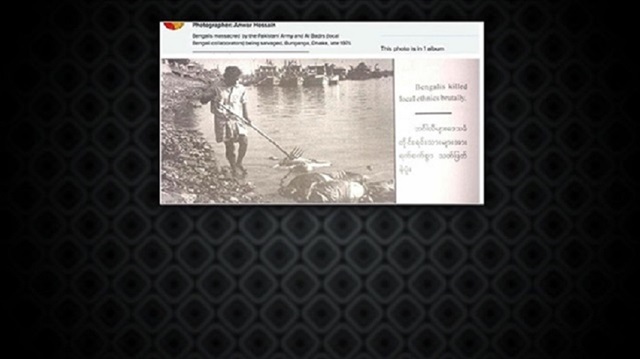
The grainy black-and-white photo, printed in a new book on the Rohingya crisis authored by Myanmar's army, shows a man standing over two bodies, wielding a farming tool. "Bengalis killed local ethnics brutally", reads the caption.The photo appears in a section of the book covering ethnic riots in Myanmar in the 1940s. The text says the image shows Buddhists murdered by Rohingya - members of a Muslim minority the book refers to as "Bengalis" to imply they are illegal immigrants.But it was actually taken during Bangladesh's 1971 independence war, when hundreds of thousands of Bangladeshis were killed by Pakistani troops.It is one of three images that appear in the book, published in July by the army's department of public relations and psychological warfare, that have been misrepresented as archival pictures from the western state of Rakhine.In fact, two of the photos originally were taken in Bangladesh and Tanzania. A third was falsely labelled as depicting Rohingya entering Myanmar from Bangladesh, when in reality it showed migrants leaving the country.Government spokesman Zaw Htay and a military spokesman could not be reached for comment on the authenticity of the images. U Myo Myint Maung, permanent secretary at the Ministry of Information, declined to comment, saying he had not read the book.The 117-page "Myanmar Politics and the Tatmadaw: Part I" relates the army's narrative of August last year, when some 700,000 Rohingya fled Rakhine to Bangladesh, according to United Nations agencies, triggering reports of mass killings, rape, and arson. Tatmadaw is the official name of Myanmar's military.Much of the content is sourced to the military's "True News" information unit, which since the start of the crisis has distributed news giving the army's perspective, mostly via Facebook.The book is on sale at bookstores across the commercial capital of Yangon. A member of staff at Innwa, one of the biggest bookshops in the city, said the 50 copies the store ordered had sold out, but there was no plan to order more. "Not many people came looking for it," said the bookseller, who declined to be named.Video: UN calls for genocide charges against Myanmar officialsOn Monday, Facebook banned the army chief and other military officials accused of using the platform to "inflame ethnic and religious tensions". The same day, U.N investigators accused Senior General Min Aung Hlaing of overseeing a campaign with "genocidal intent" and recommended he and other senior officials be prosecuted for crimes against humanity.In its new book, the military denies the allegations of abuses, blaming the violence on "Bengali terrorists" it says were intent on carving out a Rohingya state named "Arkistan".Attacks by Rohingya militants calling themselves the Arakan Rohingya Salvation Army preceded the military's crackdown in August 2017 in Rakhine state, in which the U.N. investigators say 10,000 people may have been killed. The group denies it has separatist aims.The book also seeks to trace the history of the Rohingya - who regard themselves as native to western Myanmar - casting them as interlopers from Bangladesh.In the introduction to the book the writer, listed as Lieutenant Colonel Kyaw Kyaw Oo, says the text was compiled using "documentary photos" with the aim of "revealing the history of Bengalis".‘Rohingya not only group suffering in Myanmar’"It can be found that whenever a political change or an ethnic armed conflict occurred in Myanmar those Bengalis take it as an opportunity," the book reads, arguing that Muslims took advantage of the uncertainty of Myanmar's nascent democratic transition to ignite "religious clashes".Some of the photographs were examined using Google Reverse Image Search and TinEye, tools commonly used by news organisations and others to identify images that have previously appeared online. Checks were then made with the previously credited publishers to establish the origins of those images.Of the 80 images in the book, most were recent pictures of army chief Min Aung Hlaing meeting foreign dignitaries or local officials visiting Rakhine. Several were screengrabs from videos posted by Rohingya militant group the Arakan Rohingya Salvation Army.One faded black-and-white image shows a crowd of men who appear to be on a long march with their backs bent over. "Bengalis intruded into the country after the British Colonialism occupied the lower part of Myanmar," the caption reads.The photo is apparently intended to depict Rohingya arriving in Myanmar during the colonial era, which ended in 1948. In fact a distorted version of a colour image taken in 1996 of refugees fleeing the genocide in Rwanda. The photographer, Martha Rial, working for the Pittsburgh Post-Gazette, won the Pulitzer Prize. The newspaper did not immediately respond to a request for comment on the use of its photo.Another picture, also printed in black-and-white, shows men aboard a rickety boat. "Bengalis entered Myanmar via the watercourse," the caption reads.Actually, the original photo depicts Rohingya and Bangladeshi migrants leaving Myanmar in 2015, when tens of thousands fled for Thailand and Malaysia. The original has been rotated and blurred so the photo looks granular. It was sourced from Myanmar's own Ministry of Information.Amnesty slams powerful governments' silence on RohingyaRohingya group urges global community to take actionMore than 50,000 evacuated in Myanmar as homes, shops flooded after dam fails'Let us not fail Rohingya again': Oscar-winning actress
Myanmar publishes 'book of lies' using fake photos of Rohingya tragedy
Reuters found that two of the photographs in the military book on the Rohingya crisis were actually taken in Bangladesh and Tanzania and a third was falsely labelled as showing Rohingya entering Myanmar from Bangladesh, when in reality the picture was of refugees leaving Myanmar.
The military's official newspaper, the Myawady Daily, issued a statement on Monday from its publishing arm, which produced the book 'Myanmar Politics and Tatmadaw: Part I', apologising for two of the photographs.
"It was found that two photos were incorrectly published," the publishing arm said in a statement carried by the newspaper, referring to the photograph from Tanzania and another showing victims of Bangladesh's 1971 war of independence.
"We sincerely apologise to the readers and the owners of the photographs for the mistake," it said.
It did not mention the photograph incorrectly captioned as showing Rohingya entering Myanmar when the picture was of them leaving.
Myanmar government spokesman Zaw Htay and military spokesman Major General Tun Tun Nyi could not be reached for comment.
The army's department of public relations and psychological warfare published the book in English and Burmese in July.
Two Myanmar journalists of the Reuters on Monday have been given seven years jail sentence for investigation into the murder of Rohingya Muslim men by the security officials in western Rakhine state.Wa Lone, 32, and Kyaw Soe Oo, 28, are charged with breaching the Official Secrets Act, which carries a maximum sentence of 14 years in prison during the investigation into the murder of 10 Rohingya men in Rakhine state.Judge Ye Lwin of Yangon’s Northern District Court said each journalist was handed a seven-year imprisonment as they were found guilty of obtaining and possessing the state secret documents which they possibly transferred to the insurgent groups that are fighting against the government.Wa Lone said the ruling is unfair as they just did what journalists supposed to do during investigation into the unlawful killings.“We did nothing wrong, and we have no fear. We still believe in democracy and freedom of speech,” said Wa Lone.“We will fight for justice until the end,” he said.Defense lawyer Than Zaw Aung said the ruling is unfair. “We will do everything legally.”'Myanmar jailing of Reuters journalists harsh setback for media freedom'European Union demands freedom for two Reuters journalists jailed in MyanmarCriticismThe United States embassy, after the conviction, called on Myanmar to release the journalists immediately, saying it is “a major setback” to the Government of Myanmar's stated goal of expanding democratic freedoms.“The clear flaws in this case raise serious concerns about rule of law and judicial independence in Myanmar,” it said in a statement.The ruling also drew criticism from local and international rights groups.New York-based Human Rights Watch said it marks “a new low for press freedom and further backsliding on rights” under the government led by State Counselor Aung San Suu Kyi, who was accused of failing to stop the military atrocities on Rohingya Muslims.“The outrageous convictions of the Reuters journalists show Myanmar courts’ willingness to muzzle those reporting on military atrocities,” said HRW’s Asia director Brad Adams.The journalists were investigating the massacre of 10 Rohingya men in a remote village in Rakhine state last September. Military had admitted soldiers were involved in the killing just days after the arrest of Reuters journalists in December.After their arrest, Wa Lone and Kyaw Soe Oo were held incommunicado for two weeks, during which they were deprived of sleep and forced to kneel for hours during interrogation, according to the reporters and their lawyers.“These convictions won’t hide the horrors against the Rohingya from the world,” said Adams.“They merely reveal the precarious state of free speech in the country and the urgent need for international action to free these journalists.”Reporters Without Borders (RSF) also condemned the ruling and reiterated its call for the immediate release of the reporters.“The conviction of Kyaw Soe Oo and Wa Lone is a terrible blow to press freedom in Myanmar,” RSF Secretary-General Christophe Deloire said in a statement.“As the justice system clearly followed orders in this case, we call on the country’s most senior officials, starting with government leader Aung San Suu Kyi, to free these journalists, whose only crime was to do their job. After a farcical prosecution, this outrageous verdict clearly calls into question Myanmar’s transition to democracy,” he added.Video: Families, diplomats 'disappointed' after Myanmar journalists verdict
Myanmar slaps prison sentences on two Reuters journalists
Of the 80 images in the book, most were recent pictures of army chief Min Aung Hlaing meeting foreign dignitaries or other officials visiting Rakhine.
Of eight photos presented as historical images, Reuters found the provenance of three to be faked and was unable to determine the provenance of the five others.
One faded black-and-white image shows a crowd of men who appear to be on a long march with their backs bent over. "Bengalis intruded into the country after the British Colonialism occupied the lower part of Myanmar," the caption reads.
The photo is apparently intended to depict Rohingya arriving in Myanmar during the colonial era, which ended in 1948. Reuters determined the picture is in fact a distorted version of a colour image taken in 1996 of refugees who had fled the genocide in Rwanda.
Another picture, also printed in black-and-white, shows men aboard a rickety boat. "Bengalis entered Myanmar via the watercourse," the caption reads.
Actually, the original photo depicts Rohingya and Bangladeshi migrants leaving Myanmar in 2015, when tens of thousands fled for Thailand and Malaysia. The original has been rotated and blurred so the photo looks granular. It was sourced from Myanmar's own Ministry of Information.
The Myawady's publishing arm, in its statement, made no mention of an alterations of images.
The prime minister of neighbouring Bangladesh, where about 700,000 Rohingya Muslims have fled from a Myanmar military crackdown launched after Rohingya insurgent attacks in August last year, denounced the use of the photographs when she was asked in a news conference about them.
"What Myanmar has done is simply heinous. They have lowered their reputation," Bangladeshi Prime Minister Sheikh Hasina told a news conference in Dhaka on Sunday.
"They are diminishing their position in the international arena."
The 117-page book gives the army's account of the crackdown last year which led to reports of mass killings, rape, and arson.
Much of the content is sourced to the military's "True News" information unit, which since the start of the crisis has distributed news giving the army's position, mostly via Facebook.
The book is on sale at bookstores across the commercial capital of Yangon.