

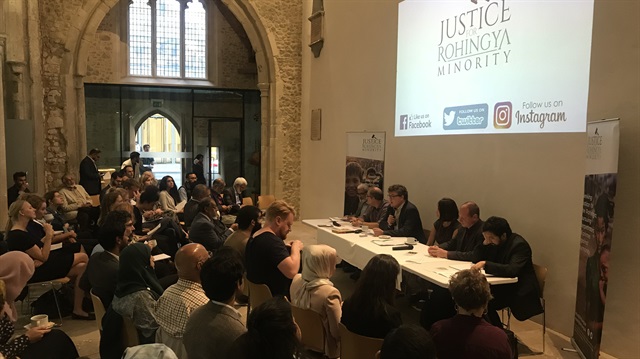
The panel of speakers included Peter Oborne, an author and columnist for the Daily Mail, Catherine West, an MP and member of the Parliamentary Select Committee on International Trade, Richard Cockett, editor and columnist at The Economist, Mark Farmaner, director of Burma Campaign UK, and S. Sayyid, a professor at the University of Leeds.
The Justice For Rohingya Minority (JFRM) held a roundtable discussion Monday in London on the genocide against Myanmar’s Rohingya Muslims and offered solutions to the crisis.
The panel of speakers included Peter Oborne, an author and columnist for the Daily Mail, Catherine West, an MP and member of the Parliamentary Select Committee on International Trade, Richard Cockett, editor and columnist at The Economist, Mark Farmaner, director of Burma Campaign UK, and S. Sayyid, a professor at the University of Leeds.
Also attending the event were leading Rohingya activists Abdullah Faliq, Nurul Islam and Kyaw Win.
Seventy-six Myanmar civil society groups called on Tuesday for the release of two jailed Reuters reporters, denouncing their conviction as unfair and an assault on the right to freedom of information.A court found the two journalists guilty on Monday of breaching a law on state secrets and jailed them for seven years in a landmark case seen as a test of progress towards democracy in Myanmar, which was ruled by a military junta until 2011.Wa Lone, 32, and Kyaw Soe Oo, 28, were investigating the killing of villagers from the Rohingya Muslim minority by security forces and civilians when they were arrested in December. They had pleaded not guilty.UK calls for immediate release of Reuters journalists"The entire trial process was neither free nor fair and was completely manipulated," the groups, including youth, educational and peace organisations, said in a joint statement posted on Twitter.The conviction of the two reporters drew condemnation from the United Nations, many Western governments including the United States, Britain and France, and international organisations.Several diplomats said it raised questions about Myanmar's transition towards democracy after nearly 50 years of harsh military rule, and about the commitment to human rights of the government, led by Nobel laureate Aung San Suu Kyi.UN human rights chief Bachelet urges Myanmar to free Reuters reporters"We take this as a crackdown on the right of access to information and media freedom, and an oppressive gesture on all concerned people of Myanmar who are aspiring and building for a society characterised by rule of law, accountability, freedom and justice," the civil society groups said in an English-language statement.The reporters had told the court two police officials handed them papers at a restaurant in the city of Yangon moments before other officers arrested them on Dec. 12.One police witness testified the restaurant meeting was a set-up to entrap the journalists to block or punish them for their reporting of a mass killing of Rohingya Muslims in Rakhine State. The judge said on Monday that testimony had not been corroborated by any other witnesses.'Myanmar jailing of Reuters journalists harsh setback for media freedom'A police officer also told the court that he burned notes he made at the time of the reporters’ arrest, but didn’t explain why. Several prosecution witnesses contradicted the police account of where the arrests took place. A police major conceded the "secret" information allegedly found on the reporters wasn’t actually a secret.Myanmar government spokesman Zaw Htay could not be reached for comment about the verdict. He has mostly declined to comment throughout the proceedings, saying the courts were independent and the case would be conducted according to the law.European Union demands freedom for two Reuters journalists jailed in MyanmarThe conviction of the reporters comes amid mounting pressure on the government over the crackdown on the Rohingya in Rakhine State in west Myanmar. The crackdown was sparked by attacks by Rohingya insurgents on security forces in August 2017.A U.N mandated fact-finding mission said last week that Myanmar's military carried out mass killings and gang rapes of Rohingya with "genocidal intent" and called for top generals to be prosecuted. Myanmar rejected the findings.More than 700,000 stateless Rohingya Muslims have fled into Bangladesh since the crackdown was launched, according to U.N. agencies.The reporters were arrested on Dec. 12 while investigating the killing of 10 Rohingya Muslim men in Inn Din, a village in Rakhine State. The 10 men were shot and hacked to death by soldiers and civilians, and dumped in a shallow grave.Myanmar has denied allegations of atrocities made by refugees against its security forces, saying they conducted a legitimate counter-insurgency operation against Muslim militants.But the military acknowledged the killing of the 10 Rohingya at Inn Din after arresting the Reuters reporters. In April, the army announced that seven soldiers had been sentenced to "10 years in prison with hard labour in a remote area" for participating in the killings. 
Dozens of Myanmar civil society groups condemn conviction of Reuters reporters
Moderating the event was Peter Oborne, who began the discussion by clarifying that the atrocities being perpetrated against the Rohingya were a genocide and that the international community’s silence and lackluster response allowed the perpetrators to get away without any accountability.
“It should be known that what is happening to the Rohingya in Myanmar is a genocide, and it is a genocide that has been occurring for the past six years” Oborne said.
“That this [genocide] has been and continues to be underreported doesn’t lessen the fact that it is a genocide, and the abysmal response by the international community allows the perpetrators to continue with the atrocities without any fear of accountability whatsoever,” he added.
The Myanmar military issued a rare apology on Monday, acknowledging that two photographs it published in a book on the crisis over the Rohingya Muslim minority were "published incorrectly".Two of the pictures in the book that aimed at illustrating the army's account of last year's events in the western Myanmar state of Rakhine, were in fact archive pictures of different conflicts, and one was posted with an incorrect caption.The erroneous publication of the photographs comes amid a series of government steps against what it has seen as media abuses, including a report on army activity in an ethnic minority guerrilla zone and the flying of a drone in the capital, Naypyitaw.On Monday, a court jailed for seven years two reporters from Reuters on a charge of violating a secrets law.Myanmar publishes 'book of lies' using fake photos of Rohingya tragedyReuters found that two of the photographs in the military book on the Rohingya crisis were actually taken in Bangladesh and Tanzania and a third was falsely labelled as showing Rohingya entering Myanmar from Bangladesh, when in reality the picture was of refugees leaving Myanmar.The military's official newspaper, the Myawady Daily, issued a statement on Monday from its publishing arm, which produced the book 'Myanmar Politics and Tatmadaw: Part I', apologising for two of the photographs."It was found that two photos were incorrectly published," the publishing arm said in a statement carried by the newspaper, referring to the photograph from Tanzania and another showing victims of Bangladesh's 1971 war of independence."We sincerely apologise to the readers and the owners of the photographs for the mistake," it said.It did not mention the photograph incorrectly captioned as showing Rohingya entering Myanmar when the picture was of them leaving.Myanmar government spokesman Zaw Htay and military spokesman Major General Tun Tun Nyi could not be reached for comment.The army's department of public relations and psychological warfare published the book in English and Burmese in July.Myanmar slaps prison sentences on two Reuters journalists'Heinous'Of the 80 images in the book, most were recent pictures of army chief Min Aung Hlaing meeting foreign dignitaries or other officials visiting Rakhine.Of eight photos presented as historical images, Reuters found the provenance of three to be faked and was unable to determine the provenance of the five others.One faded black-and-white image shows a crowd of men who appear to be on a long march with their backs bent over. "Bengalis intruded into the country after the British Colonialism occupied the lower part of Myanmar," the caption reads.The photo is apparently intended to depict Rohingya arriving in Myanmar during the colonial era, which ended in 1948. Reuters determined the picture is in fact a distorted version of a colour image taken in 1996 of refugees who had fled the genocide in Rwanda.Another picture, also printed in black-and-white, shows men aboard a rickety boat. "Bengalis entered Myanmar via the watercourse," the caption reads.Actually, the original photo depicts Rohingya and Bangladeshi migrants leaving Myanmar in 2015, when tens of thousands fled for Thailand and Malaysia. The original has been rotated and blurred so the photo looks granular. It was sourced from Myanmar's own Ministry of Information.The Myawady's publishing arm, in its statement, made no mention of an alterations of images.The prime minister of neighbouring Bangladesh, where about 700,000 Rohingya Muslims have fled from a Myanmar military crackdown launched after Rohingya insurgent attacks in August last year, denounced the use of the photographs when she was asked in a news conference about them."What Myanmar has done is simply heinous. They have lowered their reputation," Bangladeshi Prime Minister Sheikh Hasina told a news conference in Dhaka on Sunday."They are diminishing their position in the international arena."The 117-page book gives the army's account of the crackdown last year which led to reports of mass killings, rape, and arson.Much of the content is sourced to the military's "True News" information unit, which since the start of the crisis has distributed news giving the army's position, mostly via Facebook.The book is on sale at bookstores across the commercial capital of Yangon.
Myanmar army apologises for mistaken photos in book on Rohingya crisis
Oborne also said that holding such events and discussions was key to spreading awareness of the plight of the Rohingya Muslims and to push for policy changes in government regarding its position on the crisis and its standing at the UN Security Council.
Richard Cockett of The Economist spoke on how the recent atrocities against the Rohingya are not a new phenomenon and that Rohingya have for decades experienced routine persecution and oppression from Burmese authorities.
Cockett spoke on how the Burmese government would prevent economic and social development from taking place in Rohingya communities in Rakhine state, not offer any employment opportunities for Rohingya Muslims and restrict their freedom of movement and expression. Such oppression, Cockett said, has driven the Rohingya to desperation and the recent genocide has stripped them of their identity, livelihood and normality.
Football players from Rohingya refugee camps in Delhi extended hand to flood victims in the southern Indian state of Kerala even if they lead a challenging life.The Shine Star FC football club, which consist of students and daily-wage laborers, handed over relief fund to Kerala flood Victims through the Human Welfare Foundation, which has been engaging with the refugee community for years.Rohingya refugee football players went door-to-door in the camp and collected 40,000 Indian rupee ($563) for Kerala flood victims.Rohingya herdsman killed, other found dead in MyanmarMyanmar slaps prison sentences on two Reuters journalistsThe club, which was formed in 2015, mainly participates in tournaments with other teams of refugees held in cooperation with the UNHCR refugee agency.At least 445 people were killed in floods and landslides in the Indian state of Kerala, according to local media.“Though our camp is in Delhi we receive a lot of help from Kerala. The love and support Kerala people show us will always be in our memory.“We pray for them and convey our support with whatever little help we could do,” Rohingya Shine Star Football Club manager Muhammed Shihad said in a press release.Triggered by torrential monsoon rains, the floods and landslides have affected 800,000 people, while more than 5,600 people were shifted to relief camps.Stressing the importance of club’s contribution, Human Welfare Foundation CEO Noufal PK said: "Whatever be the amount of contribution the message Shine Star FC shares to the world is priceless. Therefore this contribution is very special [...].”Recent floods and landslides caused $3 billion worth of losses, submerging 130,000 houses and destroying land.Thousands of people were left homeless because of the floods.According to the UNHCR refugee agency, there were 17,500 registered Rohingya refugees and asylum-seekers in India as of July 2018.- Nearly 24,000 Rohingya killedIn a report, the UNHCR refugee agency said nearly 170,000 Rohingya likely fled Myanmar in 2012 alone.Since Aug. 25, 2017, nearly 24,000 Rohingya Muslims have been killed by Myanmar’s state forces, according to the Ontario International Development Agency (OIDA).In a recent report, Forced Migration of Rohingya: The Untold Experience, the OIDA raised the estimated number of murdered Rohingya to 23,962 (± 881) from a Doctors Without Borders figure of 9,400.More than 34,000 Rohingya were also thrown into fires, while over 114,000 others were beaten, the OIDA report said, adding that 17,718 (±780) Rohingya women and girls were raped by Myanmar’s army and police. Over 115,000 Rohingya houses were also burned down and 113,000 others vandalized, it added.According to Amnesty International, more than 750,000 Rohingya refugees, mostly children and women, have fled Myanmar and crossed into Bangladesh after Myanmar forces launched a crackdown on the minority Muslim community.The Rohingya, described by the UN as the world's most persecuted people, have faced heightened fears of attack since dozens were killed in communal violence in 2012.The UN has documented mass gang rapes, killings -- including of infants and young children -- brutal beatings, and disappearances committed by Myanmar state forces. In a report, UN investigators said such violations may have constituted crimes against humanity.
Rohingya refugees in Delhi extend hand to flood victims
Discussing the role the UK can play in bringing an end to the genocide was Catherine West, who said that Britain should use its influence at the Security Council and table a motion in which Burmese government and military officials should be brought before the International Criminal Court and prosecuted for crimes against humanity.
“The UK can play a leading role in ending the crisis and bringing to justice the perpetrators of this awful crime,” West said, adding that “as a permanent member of the Security Council, the UK should push for a solution, whether it be sanctions or prosecution by the ICC, to bring an end to the genocide”.
Last week, the UN released a report calling for an investigation into Burma’s top military officials, stating they should be prosecuted for genocide, crimes against humanity and war crimes against the Rohingya Muslims.
A Rohingya cattle herdsman was reportedly killed by a group of Buddhists and other was found dead in the western Rakhine state of Myanmar on Sunday.Azizul Haque, 47, was killed by Buddhists without provocation at a river near the town of Kyauktaw in the northern part of the Rakhine state while he was taking care of the cattle, Arakan Rohingya National Organization (ARNO) Chairman Nurul Islam told Anadolu Agency.In addition, a 25-year-old Asauddin's body was found in a creek near the same town after he went to another village on Friday to buy medicine for his sick mother in the hospital, Islam stated."This kind of killing is a regular phenomenon in the Rakhine State with full impunity," Islam added.Additionally, 15 cattle belonging to Rohingya Muslims were stolen on Sunday by police and people from the Rakhine state.Since Aug. 25, 2017, nearly 24,000 Rohingya Muslims have been killed by Myanmar’s state forces, according to the Ontario International Development Agency (OIDA).More than 34,000 Rohingya were also thrown into fires, while over 114,000 others were beaten, the OIDA report said, adding that 17,718 (±780) Rohingya women and girls were raped by Myanmar’s army and police. Over 115,000 Rohingya houses were also burned down and 113,000 others vandalized, it added.The Rohingya, described by the UN as the world's most persecuted people, have faced heightened fears of attack since dozens were killed in communal violence in 2012.The UN has documented mass gang rapes, killings -- including of infants and young children -- brutal beatings, and disappearances committed by Myanmar state forces. In a report, UN investigators said such violations may have constituted crimes against humanity.
Rohingya herdsman killed, other found dead in Myanmar
Justice for Rohingya Minority is a diverse group of lawyers, jurists, academics, campaigners, professionals and community leaders joining forces in a legal campaign for the prosecution of those responsible for crimes against humanity in Myanmar’s Rakhine State, according to its website.
Since Aug. 25, 2017, more than 24,000 Rohingya Muslims have been killed by Myanmar’s state forces, according to the Ontario International Development Agency (OIDA).
According to Amnesty International, more than 750,000 Rohingya refugees, mostly children and women, have fled Myanmar and crossed into Bangladesh after Myanmar forces launched a crackdown on the minority Muslim community.