

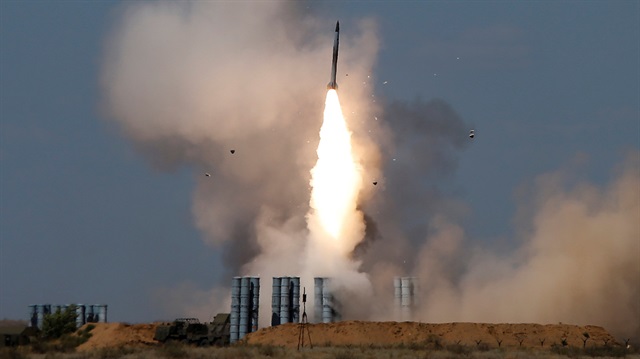
An S-300 air defense missile system launching a missile
An Israeli official played down on Wednesday the Russian upgrading of Syria's air defences, saying the newly supplied S-300 missile system could be defeated by Israel's stealth fighters and possibly destroyed on the ground.
Moscow said on Tuesday that it had delivered the S-300, a decision it took after accusing Israel of indirect responsibility for the downing of a Russian spy plane by Syrian forces as they fired on attacking Israeli jets last month.
Damascus and its big-power backer describe the advanced addition to Syria's arsenal as a major deterrent. Israel and Washington have both voiced misgivings about the S-300 handover.
But asked in an interview if the Syrian acquisition of the S-300 would clip the Israeli military's wings, Tzachi Hanegbi, the country's regional cooperation minister and a non-voting member of its security cabinet, said: "Unequivocally, no."
U.S. Defense Secretary Jim Mattis said on Thursday that Russia's violation of an arms control treaty was "untenable" and unless it changed course the United States would need to match Moscow's capabilities.The United States believes Russia is developing a ground-launched system in breach of a Cold War treaty, known as the Intermediate-Range Nuclear Forces Treaty (INF), that could allow Moscow to launch a nuclear strike on Europe at short notice. Russia has consistently denied any such violation."Russia must return to compliance with the INF treaty or the U.S. will need to match its capabilities to protect U.S. and NATO interests," Mattis said in prepared remarks to reporters during a NATO meeting of defence ministers in Brussels."The United States is reviewing options in our diplomacy and defence posture to do just that. Make no mistake: The current situation, with Russia in blatant violation of this treaty, is untenable," Mattis said.UK says Russian hacking proves Moscow behind Salisbury attackThe 1987 Intermediate-Range Nuclear Forces Treaty bans medium-range missiles capable of hitting Europe or Alaska and ended a Cold War-era crisis, when the Soviet Union installed nearly 400 nuclear warheads pointed at western Europe.Mattis' comments are likely to worsen relations between Moscow and the West that are at a post-Cold War low over Russia's 2014 seizure of Crimea, its bombing campaign in Syria and accusations of meddling in Western elections.While the United States has called for Russia to come back into compliance with the INF treaty for several years, Mattis' comments come just days after Washington's envoy to NATO said Russia must halt its covert development of a banned cruise missile system or the United States would seek to destroy it before it becomes operational.U.S. ambassador to NATO Kay Bailey Hutchison said on Tuesday Washington remained committed to a diplomatic solution but was prepared to "take out" any Russian missile if development of the medium-range system continued.Russia calls UK assertion its spies behind cyber attacks unworthyThe Russian foreign ministry reacted by saying Hutchison's comments were dangerous.Hutchison later clarified in a tweet that she was not talking about a preemptive strike against Russia.U.S. STARTING MISSILE RESEARCHThe top U.S. general in Europe said the United States needed to make strong statements on Russia's violation."We also will take the steps necessary to ensure that we don't have any gaps in a credible defence and deterrence posture," General Curtis Scaparrotti, head of U.S. European Command and NATO's supreme allied commander, told reporters during the NATO meeting.Britain says Russian military intelligence behind host of global cyber attacksA recent U.S. State Department report found Russia had violated obligations "not to possess, produce, or flight-test" a ground-launched cruise missile with a range capability of 500 km to 5,500 km (310-3,420 miles), "or to possess or produce launchers of such missiles".Earlier this year, the U.S. military said in a new national defence strategy that countering Russia, along with China, would be a priority. The move reflects shifting U.S. priorities after more than a decade and a half of focusing on the fight against Islamist militants.The Pentagon's nuclear policy document released in February said that in response to Russia's violation, the United States would start "commencing INF Treaty-compliant research and development by reviewing military concepts and options for conventional, ground-launched, intermediate-range missile systems". 
Pentagon chief says Russian violation of key arms control treaty 'untenable'
"The operational abilities of the air force are such that those (S-300) batteries really do not constrain the air force's abilities to act," he told Israel's Army Radio.
Referring to F-35 Joint Strike Fighters that Israel began receiving from the United States over a year ago, Hanegbi said: "You know that we have stealth fighters, the best planes in the world. These batteries are not even able to detect them."
Reuters reported in 2015 that Israel had trained against a Russian-supplied S-300 system in Greece.
Israel says its air raids on Syria are needed to foil deployments and arms transfers by Iran or Lebanon's Hezbollah guerrillas, allies of Damascus.
The Kurdistan Workers’ Party (PKK) terror organization carries on its drug cultivation and trafficking activities in the regions it occupies in Syria under the watchful eye of the U.S. after seizing thousands of hectares of farmlands in Raqqa, Hasakah and Deir Ezzor.PKK recruits addictsU.S.-PKK-occupied Raqqa, which boasts 120 hectares of farmlands, has become an integral part of a special project to promote the use and sale of drugs, which are found in markets, stationery stores and pharmacies across Raqqa, Deir Ezzor, Hasakah and Tal Abyad.Raqqa resident Anwar Rushdi, who spoke exclusive to Yeni Şafak daily, said the PKK terror group uses drugs as a means to get fighters to join its ranks.“First they turn them into addicts, then they recruit them in PKK ranks,” continued Rushdi.The PKK/YPG controls an area of about 53,000 square kilometers with a percentage of 28.6 of Syrian territory.'Manbij roadmap should be implemented soon'Ex-terrorists narrate how PKK recruits childrenFields under U.S. protection According to Rushdi, cannabis was planted in PYD-occupied areas that included thousands of acres of land that provided the bulk of agriculture in pre-war in Syria. “There are four large drug farms that no one has access to in close proximity to U.S. bases in Raqqa, Hasakah and Tal Abyad in Dimashqiyyeh, Ali Bajeeriyeh and Mazraat al-Rabia. Sometimes, U.S.-armored vehicles go there and stay for a while with PKK terrorists,” continued Rushdi.The U.S. has also has supplied the PYD terror organization and its armed wing, the YPG, with thousands of truckloads of weapons to allegedly use in the fight against Daesh, despite Ankara’s warnings that the fact they are the Syrian offshoots of the PKK terror organization.PKK terrorist oversees traffickingAccording to Raqqa-based lawyer Muhammad Saeed, a PKK terrorist from Ayn al-Arab who operates under the codename “Roni” became in charge of the terror group’s drug industry in 2017. “He was first dispatched to Tal Abyad and then to Raqqa. They are devoting special efforts to spread this poison among Arab and Turkmen populations in FSA-controlled regions. They ship them through the Manbij- Jarabulus route,” said Saeed.Wanted PKK terrorist ‘neutralized’ in southeast TurkeyOperations based in Raqqa After seizing close to 120 hectares of arable lands between 2012- 2017, the PKK turned Afrin into the Middle East’s biggest drug cultivation and trading region, according to Rushdi. “After Operation Olive Branch, a number of drug traffickers fled to Tal Abyad and Hasakah, but the majority resettled in Raqqa. Dozens of businesses in the city’s industrial zone were turned into of drug factories. Raqqa became the new center of drug cultivation and trafficking to Syria, Iraq, Lebanon, Iran, Turkey, and Gulf and European countries,” continued Rushdi. The Turkish military cleared a 2,500 square mile (4,000 square kilometer) area from Daesh and YPG/PKK terrorists as part of the Euphrates Shield and Olive Branch operations in Syria.The PKK is listed as a terrorist organization by Turkey, the European Union and the United States. The PKK has been conducting armed violence in the southeastern part of Turkey since 1984. More than 40,000 people, mostly civilians, have been killed in the three-decade long conflict.Backing from a Lebanese drug lord According to Saeed, Lebanese drug lord Nouh Zaieter is providing logistical support to the Raqqa-based drug trade. A part of the drug shipments are trafficked to Lebanon through the Raqqa- Salamiyyeh- Hom- Qusayr route, from where it’s sold to other Arab and European countries. “Another drug export channel for the PKK is the Latakia- Tartous route operated by terrorist Mihraç Ural.” “Two of the big partners in the 15-year drug trade along the Latakia-Tartous route are President Bashar al-Assad’s cousins Rami and Hafez Makhlouf,” concluded Saeed.
PKK turns Syria into drug farm under US protection
Hanegbi said that Russia had previously stationed its own S-300 in Syria, so the system's capabilities had long been factored into Israeli planning. Syria's military would require "a few months" to get its S-300 operational, he said.
"We have clarified to the Syrians more than once that we will not step back from our commitment to prevent Iran's entrenchment in Syria," Hanegbi said, adding a veiled threat to take action against the S-300 on the ground: "We were already forced, a few months ago, to destroy Syrian missile batteries, and I hope they won't challenge us in the future."
Israel said on Sept. 4 it had carried out more than 200 air strikes in Syria in the previous two years - an average rate of twice a week - with Russia largely turning a blind eye. There have been no reports of such missions since the Russian plane's downing on Sept. 17, however.
Any such hiatus was a "tactical situation over a week or two" rather than a strategic reassessment by Israel, Hanegbi said.
Asked if Iran and its allies had used the period to step up their activities in Syria, he said he had seen "no basis for that" in Israeli intelligence assessments.
A 2016 military aid package agreed upon between the U.S. and Israel went into force on Tuesday. The deal, signed under the Obama administration, will provide Israel with $38 billion in U.S. military financing from 2019 to 2028. It is the largest such aid package in U.S. history. The move also expands a stockpile of U.S. weapons kept in Israel.“The United States will set funding for Israel at levels of $3.3 billion in Foreign Military Financing and $500 million for cooperative programs for missile defense over each of the next 10 years,” State Department Spokeswoman Heather Nauert said in a written statement.“Israel is a valuable and capable ally to the United States that today faces dangerously escalating regional threats, first and foremost from the Iranian regime's sponsorship of terrorist groups seeking to attack not only Israel but also American interests. The United States unconditionally affirms Israel's right to self-defense.”The package “reflects the enduring and unshakable commitment of the President, this Administration, and the American people to Israel's security.”Israel slowly encroaching all of JerusalemPackage to boost Israel’s military capabilitiesThe foreign military financing will enable Israel to advance its military capabilities with possible purchases of new long-range missile defense systems, ballistic missiles and warplanes.The funding is enough for the purchase of almost 450 F-35 fighter jets, 9,000 tanks, various missiles and hundreds of thousands of arms and munitions. Washington’s move has been evaluated as a clear challenge for other regional powers such as Turkey.Eastern Mediterranean being targetedThe move has been evaluated as an effort to actualize the map in which Iraq and Syria’s underground resources provide maritime access through Israel.“The U.S. is not cutting back on anything to sow the seeds of a Great Israel state. Both financially and militarily, the U.S. is strengthening Israel. Another aim of this financial aid is to make Israel be able to control the energy reserves of the Eastern Mediterranean,” an unnamed source said.With its new financial resources, Israel will be able to fund subcontracted terrorist organizations more easily. There are also claims that the enormous funds will be provided by Saudi Arabia.The U.S. unequivocally supports Israel’s attacks that target Russia and Iran in Syria. The funding package can also be viewed as a part of Israel’s agenda against Russia and Iran, who are gaining influence in the region. Israel was responsible for the downing of a Russian intelligence plane in Syria, and following this, Russia dispatched the S-300 missile system, demonstrating that Moscow would continue its activities in the region.US enforces $38bln military aid package to help Israel fight ‘Iran-sponsored terrorists’U.S. considered increasing funding packageIn late February, U.S. senators even called for an increase in the $38 billion in military aid. Senators Lindsey Graham, a leading Republican foreign policy figure, and Chris Coons, a Democratic member of the Senate Foreign Relations Committee, said that they considered the provision of $38 billion over 10 years, “a floor.”Explicit supportAccording to data obtained from the U.S. Congress, the amount of aid sent to Israel to date is over $130 billion. In 2007, a two-year aid package agreement was signed between the two countries during George W. Bush's presidency. A total of $30 billion of this agreement covered the period between 2009 and 2018. Obama made another similar agreement with Israel in 2016, and signed a memorandum of understanding covering the years between 2019 and 2028.Israel claims to arrest Hamas cell over attack plotIsrael detains 7 Palestinians in West Bank raidsIsraeli PM to be grilled on graft allegations on Friday
US preparing Israel for war