

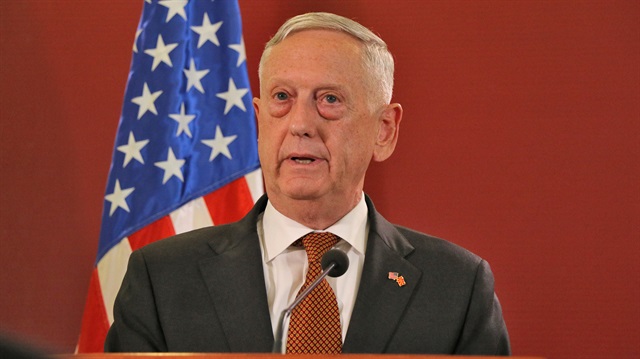
U.S. Defense Secretary Jim Mattis
U.S. Defense Secretary Jim Mattis said on Thursday that Russia's violation of an arms control treaty was "untenable" and unless it changed course the United States would need to match Moscow's capabilities.
The United States believes Russia is developing a ground-launched system in breach of a Cold War treaty, known as the Intermediate-Range Nuclear Forces Treaty (INF), that could allow Moscow to launch a nuclear strike on Europe at short notice. Russia has consistently denied any such violation.
"Russia must return to compliance with the INF treaty or the U.S. will need to match its capabilities to protect U.S. and NATO interests," Mattis said in prepared remarks to reporters during a NATO meeting of defence ministers in Brussels.
"The United States is reviewing options in our diplomacy and defence posture to do just that. Make no mistake: The current situation, with Russia in blatant violation of this treaty, is untenable," Mattis said.
Russia's attempts to hack into the OPCW chemicals weapons watchdog as it investigated the Salisbury nerve agent attack showed without doubt who was behind the poisoning, British foreign minister Jeremy Hunt said on Thursday.Earlier, Dutch authorities said they disrupted an attempt in April by Russian intelligence agents to hack the Netherlands-based Organization for the Prohibition of Chemical Weapons.Sergei Skripal, a former colonel in Russian military intelligence, and his daughter Yulia, were found unconscious on a public bench in Salisbury, southern England in March.Russia must stop cyber attacks on West: NATO's Stoltenberg"If anyone had questions in their mind about Russian military involvement in the Salisbury attacks this will put to rest those doubts," Hunt told the BBC."Russian government needs to know that if they flout international law in this way there will be consequences, they will be exposed and people will see the Russian government for what they are - which is an organisation that is trying to foster instability throughout the world."Russia calls UK assertion its spies behind cyber attacks unworthyBritain says Russian military intelligence behind host of global cyber attacks
UK says Russian hacking proves Moscow behind Salisbury attack
The 1987 Intermediate-Range Nuclear Forces Treaty bans medium-range missiles capable of hitting Europe or Alaska and ended a Cold War-era crisis, when the Soviet Union installed nearly 400 nuclear warheads pointed at western Europe.
Mattis' comments are likely to worsen relations between Moscow and the West that are at a post-Cold War low over Russia's 2014 seizure of Crimea, its bombing campaign in Syria and accusations of meddling in Western elections.
While the United States has called for Russia to come back into compliance with the INF treaty for several years, Mattis' comments come just days after Washington's envoy to NATO said Russia must halt its covert development of a banned cruise missile system or the United States would seek to destroy it before it becomes operational.
U.S. ambassador to NATO Kay Bailey Hutchison said on Tuesday Washington remained committed to a diplomatic solution but was prepared to "take out" any Russian missile if development of the medium-range system continued.
Russia on Thursday rejected British accusations its spies were behind global cyber attacks, saying the allegations were unworthy and part of a disinformation campaign designed to damage Russian interests, the TASS news agency reported.Britain accused Russian military intelligence on Thursday of directing a host of cyber attacks aimed at undermining Western democracies by sowing confusion in everything from sport to transport and the 2016 U.S. presidential election.Britain says Russian military intelligence behind host of global cyber attacksMaria Zakharova, a spokeswoman for the Russian Ministry of Foreign Affairs, told a news briefing that the accusations were the product of someone with a "rich imagination"."It's some kind of a diabolical perfume cocktail (of allegations)," TASS quoted Zakharova as telling reporters.
Russia calls UK assertion its spies behind cyber attacks unworthy
The Russian foreign ministry reacted by saying Hutchison's comments were dangerous.
Hutchison later clarified in a tweet that she was not talking about a preemptive strike against Russia.
U.S. STARTING MISSILE RESEARCH
The top U.S. general in Europe said the United States needed to make strong statements on Russia's violation.
"We also will take the steps necessary to ensure that we don't have any gaps in a credible defence and deterrence posture," General Curtis Scaparrotti, head of U.S. European Command and NATO's supreme allied commander, told reporters during the NATO meeting.
Britain accused Russian military intelligence on Thursday of directing a host of cyber attacks aimed at undermining Western democracies by sowing confusion in everything from sport to transport and the 2016 U.S. presidential election.In a British assessment based on work by its National Cyber Security Centre (NCSC), Russian military intelligence (GRU) was cast as a pernicious cyber aggressor which used a network of hackers to spread discord across the world.GRU, Britain said, was almost certainly behind the BadRabbit and World Anti-Doping Agency attacks of 2017, the hack of the Democratic National Committee (DNC) in 2016 and the theft of emails from a UK-based TV station in 2015."The GRU’s actions are reckless and indiscriminate: they try to undermine and interfere in elections in other countries," said British Foreign Secretary Jeremy Hunt."Our message is clear - together with our allies, we will expose and respond to the GRU’s attempts to undermine international stability," Hunt said. Britain believes the Russian government is responsible for the attacks.Though less well known than the Soviet Union's once mighty KGB, Russia's military intelligence service played a major role in some of the biggest events of the past century, from the Cuban missile crisis to the annexation of Crimea.RUSSIAN CYBER POWER?Though commonly known by the acronym GRU, which stands for the Main Intelligence Directorate, its name was formally changed in 2010 to the Main Directorate of the General Staff (or just GU). Its old acronym - GRU - is still more widely used.It has agents across the globe and answers directly to the chief of the general staff and the Russian defence minister. The GRU does not comment publicly on its actions. Its structure, staff numbers and financing are Russian state secrets.The GRU traces its history back to the times of Ivan the Terrible, though it was founded as the Registration Directorate in 1918 after the Bolshevik Revolution. Vladimir Lenin insisted on its independence from other secret services.British Prime Minister Theresa May has said GRU officers used a nerve agent to try to kill former double agent Sergei Skripal, who was found unconscious in the English city of Salisbury in March. Russia has repeatedly denied the charges.After the Skripal poisoning, the West agreed with Britain's assessment that Russian military intelligence was to blame and launched the biggest expulsion of Russian spies working under diplomatic cover since the height of the Cold War.Russian President Vladimir Putin, himself a former KGB spy, said on Wednesday that Skripal, a GRU officer who betrayed dozens of agents to Britain's MI6 foreign spy service, was a "scumbag" who had betrayed Russia.Britain said the GRU was associated with a host of hackers including APT 28, Fancy Bear, Sofacy, Pawnstorm, Sednit, CyberCaliphate, Cyber Berkut, Voodoo Bear and BlackEnergy Actors."This pattern of behaviour demonstrates their desire to operate without regard to international law or established norms and to do so with a feeling of impunity and without consequences," Foreign Secretary Hunt said.The United States sanctioned GRU officers including its chief, Igor Korobov, in 2016 and 2018 for attempted interference in the 2016 U.S. election and cyber attacks.Australia and New Zealand backed the United Kingdom's findings on the GRU."Cyberspace is not the Wild West. The International Community – including Russia – has agreed that international law and norms of responsible state behaviour apply in cyberspace," Australia's Prime Minister Scott Morrison said."By embarking on a pattern of malicious cyber behaviour, Russia has shown a total disregard for the agreements it helped to negotiate," Morrison said. 
Britain says Russian military intelligence behind host of global cyber attacks
A recent U.S. State Department report found Russia had violated obligations "not to possess, produce, or flight-test" a ground-launched cruise missile with a range capability of 500 km to 5,500 km (310-3,420 miles), "or to possess or produce launchers of such missiles".
Earlier this year, the U.S. military said in a new national defence strategy that countering Russia, along with China, would be a priority. The move reflects shifting U.S. priorities after more than a decade and a half of focusing on the fight against Islamist militants.
The Pentagon's nuclear policy document released in February said that in response to Russia's violation, the United States would start "commencing INF Treaty-compliant research and development by reviewing military concepts and options for conventional, ground-launched, intermediate-range missile systems".