

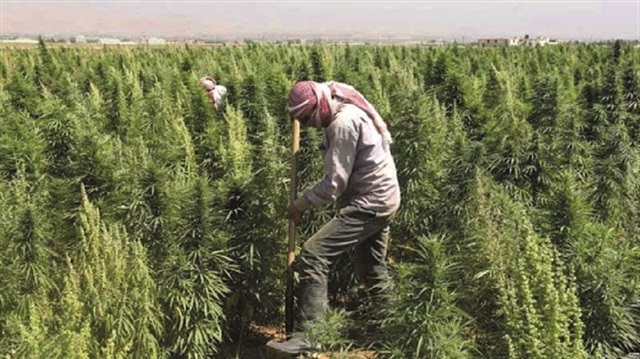
File photo
The Kurdistan Workers’ Party (PKK) terror organization carries on its drug cultivation and trafficking activities in the regions it occupies in Syria under the watchful eye of the U.S. after seizing thousands of hectares of farmlands in Raqqa, Hasakah and Deir Ezzor.
PKK recruits addicts
U.S.-PKK-occupied Raqqa, which boasts 120 hectares of farmlands, has become an integral part of a special project to promote the use and sale of drugs, which are found in markets, stationery stores and pharmacies across Raqqa, Deir Ezzor, Hasakah and Tal Abyad.
Raqqa resident Anwar Rushdi, who spoke exclusive to Yeni Şafak daily, said the PKK terror group uses drugs as a means to get fighters to join its ranks.
“First they turn them into addicts, then they recruit them in PKK ranks,” continued Rushdi.
The PKK/YPG controls an area of about 53,000 square kilometers with a percentage of 28.6 of Syrian territory.
The Manbij roadmap agreed-upon by Turkey and the U.S. should be put into practice as soon as possible, the Turkish presidential aide said on Wednesday."The delaying tactic started becoming a growing problem. Manbij roadmap should be implemented as soon as possible," Ibrahim Kalın said, speaking to reporters following a Cabinet meeting at the presidential complex.Kalın added that Turkey "can take steps at any time to ensure its national security against terror groups in Syria".The Manbij deal between Turkey and the U.S. focuses on the withdrawal of the PKK-affiliated YPG terrorist group from the city in order to stabilize the region.US seeks to merge regions in Iraq, Syria to exploit oil, gas resourcesWashington has claimed the YPG is a “reliable ally” in the fight against Daesh, while Ankara has pointed to its status as an offshoot of the PKK, a recognized terrorist group which has taken some 40,000 lives in Turkey.Syria has been locked in a vicious civil war since early 2011, when the Assad regime cracked down on pro-democracy protests with unexpected ferocity. This led to a military conflict between the Syrian opposition groups and the Assad regime over the war-torn country’s territory.Iran has been supporting the Assad regime during the war while Russia intervened in September 2015. Peace talks were launched in Geneva in 2012 aiming to find a political solution for the conflict while Astana talks began in 2017 discussing cease-fire that has been fragile so far.Hundreds of thousands of civilians have been killed in the conflict mainly by regime airstrikes targeting opposition-held areas while millions more were displaced. During the conflict, Assad regime was accused many times by various international actors of targeting Syrian civilians with chemical weapons.US troops arrive in Turkey for Manbij patrol training
'Manbij roadmap should be implemented soon'
Former PKK/KCK terrorists in Turkish custody have described in detail how children were coerced or misled into joining the group.It is widely known that the terror group recruits large numbers of children -- in many cases kidnapping them -- from the regions where it is active.A.Y., identified only by his initials, said he was abducted along with 15 other people aged 12-20 from a festival and taken to northern Iraq.“I was able to escape somehow three days later,” A.Y. said.US seeks to merge regions in Iraq, Syria to exploit oil, gas resourcesAnother former terrorist was picked up from his home in Turkey’s southeastern Mardin province.“I was taken to a training camp in Iraq. Here, I was trained with roughly 250 other children,” he said.Others were tricked into joining the group with false promises of monetary benefits.O.B. in a confession to security forces said that PKK terrorists had promised to provide 2,000 Turkish liras ($330) every month to their families.PKK terrorist 'neutralized' in SE TurkeyAt an office of the Peoples' Democratic Party (HDP), H.A. was told by a terrorist they would be “rich” and “comfortable” if they joined the PKK.Others like B.R. were targeted for refusing to join at first.“Those who did not take part in these acts were branded as agents and marginalized.“They [the PKK] did not hesitate to push us into the fire. Many members who were looking to flee the organization during the operations [by security forces] were executed.”Time to clear YPG terrorists from Syria's Manbij and leave city to civilians: FMAnother former terrorist -- forced into the group at 13 -- related that children as young as 11 years old were taken to assassin training camps in the Gara region of Iraq.In its more than 30-year terror campaign against Turkey, the PKK -- listed as a terrorist organization by Turkey, the U.S. and the EU -- has been responsible for the deaths of nearly 40,000 people. 
Ex-terrorists narrate how PKK recruits children
Fields under U.S. protection
According to Rushdi, cannabis was planted in PYD-occupied areas that included thousands of acres of land that provided the bulk of agriculture in pre-war in Syria.
“There are four large drug farms that no one has access to in close proximity to U.S. bases in Raqqa, Hasakah and Tal Abyad in Dimashqiyyeh, Ali Bajeeriyeh and Mazraat al-Rabia. Sometimes, U.S.-armored vehicles go there and stay for a while with PKK terrorists,” continued Rushdi.
The U.S. has also has supplied the PYD terror organization and its armed wing, the YPG, with thousands of truckloads of weapons to allegedly use in the fight against Daesh, despite Ankara’s warnings that the fact they are the Syrian offshoots of the PKK terror organization.
PKK terrorist oversees trafficking
According to Raqqa-based lawyer Muhammad Saeed, a PKK terrorist from Ayn al-Arab who operates under the codename “Roni” became in charge of the terror group’s drug industry in 2017.
“He was first dispatched to Tal Abyad and then to Raqqa. They are devoting special efforts to spread this poison among Arab and Turkmen populations in FSA-controlled regions. They ship them through the Manbij- Jarabulus route,” said Saeed.
A wanted PKK terrorist was among the terrorists “neutralized” in an operation carried out in Turkey’s southeastern Mardin province on Sept. 6, the country’s Interior Ministry said on Thursday.Turkish authorities often use the word "neutralized" in their statements to imply that the terrorists in question either surrendered or were killed or captured.In a statement, the Interior Ministry said the terrorist with a codename Cuma Mardin was “neutralized” in an airstrike in Nusaybin district.The terrorist was in the red category of the ministry's wanted terrorists, the statement added.The Interior Ministry's wanted list is divided into five color-coded categories, with red as the most wanted, followed by blue, green, orange and gray.In its more than 30-year terror campaign against Turkey, the PKK -- listed as a terrorist organization by Turkey, the U.S. and the EU -- has been responsible for the deaths of nearly 40,000 people, including women and children.Seven Turkish soldiers martyred in PKK terror attackEx-terrorists narrate how PKK recruits children
Wanted PKK terrorist ‘neutralized’ in southeast Turkey
Operations based in Raqqa
After seizing close to 120 hectares of arable lands between 2012- 2017, the PKK turned Afrin into the Middle East’s biggest drug cultivation and trading region, according to Rushdi.
“After Operation Olive Branch, a number of drug traffickers fled to Tal Abyad and Hasakah, but the majority resettled in Raqqa. Dozens of businesses in the city’s industrial zone were turned into of drug factories. Raqqa became the new center of drug cultivation and trafficking to Syria, Iraq, Lebanon, Iran, Turkey, and Gulf and European countries,” continued Rushdi.
The Turkish military cleared a 2,500 square mile (4,000 square kilometer) area from Daesh and YPG/PKK terrorists as part of the Euphrates Shield and Olive Branch operations in Syria.
The PKK is listed as a terrorist organization by Turkey, the European Union and the United States. The PKK has been conducting armed violence in the southeastern part of Turkey since 1984. More than 40,000 people, mostly civilians, have been killed in the three-decade long conflict.
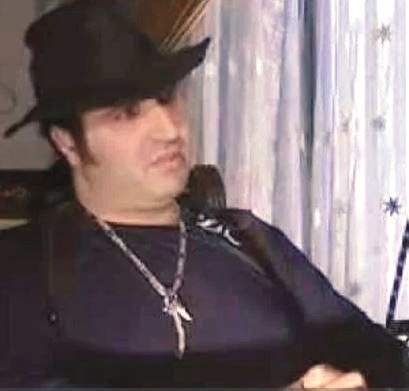
Backing from a Lebanese drug lord
According to Saeed, Lebanese drug lord Nouh Zaieter is providing logistical support to the Raqqa-based drug trade. A part of the drug shipments are trafficked to Lebanon through the Raqqa- Salamiyyeh- Hom- Qusayr route, from where it’s sold to other Arab and European countries.
“Another drug export channel for the PKK is the Latakia- Tartous route operated by terrorist Mihraç Ural.”
“Two of the big partners in the 15-year drug trade along the Latakia-Tartous route are President Bashar al-Assad’s cousins Rami and Hafez Makhlouf,” concluded Saeed.