

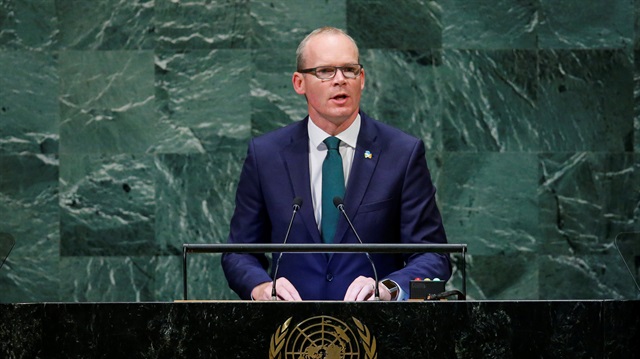
Irish Foreign Minister Simon Coveney
Irish foreign minister Simon Coveney said on Sunday he thought the chances of agreeing a withdrawal treaty between Britain and the European Union were good.
"I think the chances are good, because I think the consequences of not getting a withdrawal treaty agreed are very very negative indeed for the UK, also for Ireland and indeed for many countries in the EU," Coveney told Sky News. He said the talks on the deal were around 90 percent completed.
The European Union will reach a deal with Britain on Brexit in November if it does not do so this month, European Commission president Jean-Claude Juncker told Austrian newspapers.Juncker, whose optimism was echoed in comments on Saturday by European Council President Donald Tusk, said that the potential for a rapprochement had grown in the last few days, confirming what diplomatic sources have told Reuters.EU Brexit negotiators believe a deal with Britain on leaving the bloc is "very close", the sources told Reuters, in a sign a compromise on the most contentious issue - the future Irish border - might be in the making, although details were scarce."We are not there yet. But our will to reach an understanding with the British government is unbroken," Juncker was quoted as saying by Der Standard and Kurier and Der Falter.Tariff deal with US not yet even in 'pre-work' stage: EU trade chiefOn Friday, EU Brexit negotiators told ambassadors of the 27 states remaining in the bloc that there was no breakthrough on the Irish issue and much would depend on what their British counterparts bring to Brussels next week."We have to get away from this no-deal scenario. It wouldn’t be good for Britain or for the rest of the (European) Union," Juncker was quoted as saying.Britain and the EU are trying to push for the divorce deal, as well as an agreement on post-Brexit relations, in time for two leaders' summits scheduled for Oct. 17-18 and Nov. 17-18."My assumption is that we will reach an accord which will achieve the conditions of the withdrawal treaty," Juncker said, adding that it was not possible to predict whether there will be a conclusion to the Brexit negotiations in October."If not, then we will do it in November."Juncker urges EU member states to talk with one voiceTusk also said it was possible to agree a deal with Britain on leaving the European Union by the end of 2018."I have hope close to certainty that we will manage to reach an agreement both on exit and on best possible future relations ... I hope that it will be possible to avoid major losses on both sides," he said on the sidelines of a conference in Krakow, Poland."We will try for it in October ... and I think there is a chance to have an accord by the end of the year," he added.Juncker told the Austrian papers that a political declaration on future relations between Britain and its former European partners was needed to accompany the Brexit deal."You can't absolutely keep separate the withdrawal treaty and the declaration of the future relationship between the United Kingdom and Europe," he said.ITALIAN BUDGETApart from Brexit, one of the biggest headaches facing European Union leaders is the approach of Italy's new government to its public finances.Asked about Italy's recent budget plans, Juncker said it was up to Italian policymakers to find rules and measures that will allow Italy to remain within agreed budgetary targets."We will assess the Italian budget ... and propose changes if necessary," he added.The Italian government this week unveiled the core of its expansionary multi-year budget plan, raising the target for the fiscal deficit to 2.4 percent of gross domestic product in 2019.The deficit is projected to ease gradually in the next two years to 2.1 percent and then 1.8 percent, while remaining far above targets previously agreed with the European Commission.The targets are a "source of serious concern", the European Commission said in a letter to Italy's Economy Minister Giovanni Tria which called on Rome to ensure that the budget will be "in compliance with the common fiscal rules".
EU's Juncker confident of Brexit accord, no-deal not an option
The European Union wants to build as close a future relationship on trade, security and international affairs with Britain as possible but will not give up its fundamental values and interests over Brexit, the bloc's top official said."We very much regret that the UK has decided to leave and we hope for the best relationship in the future," European Council President Donald Tusk told a news conference in Brussels on Thursday with Irish Prime Minister Leo Varadkar."But no one can expect that because of Brexit the EU will give its fundamental values and key interests."EU court may decide before Christmas if UK can unilaterally reverse BrexitUK medicines regulator preparing for no-deal BrexitIrish PM Varadkar in Brussels as Brexit talks enter frenzied fortnightEU court may decide before Christmas if UK can unilaterally reverse Brexit
EU's Tusk wants close British ties after Brexit