

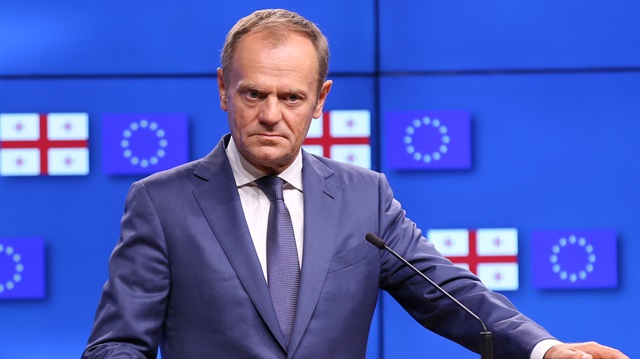
Donald Tusk
The European Union wants to build as close a future relationship on trade, security and international affairs with Britain as possible but will not give up its fundamental values and interests over Brexit, the bloc's top official said.
"We very much regret that the UK has decided to leave and we hope for the best relationship in the future," European Council President Donald Tusk told a news conference in Brussels on Thursday with Irish Prime Minister Leo Varadkar.
"But no one can expect that because of Brexit the EU will give its fundamental values and key interests."
Scotland's Court of Session has asked the European Court of Justice (ECJ) for a preliminary ruling on whether the British parliament can change its mind about leaving the European Union without the bloc's agreement, the Scottish court said on Thursday.Britain's Conservative government is struggling to reach a deal with the EU on how it will leave the world's biggest trading bloc as the March 29 exit date approaches.The petitioners, who represent Scottish voters, successfully argued to the Scottish court that if parliament is to vote on the government's eventual Brexit deal, it needs legal certainty on whether the process can be reversed without permission from the other 27 EU states.The Court of Session has asked the Luxembourg-based ECJ, which rules on the meaning of EU law, for a preliminary ruling, the court said in a statement.UK medicines regulator preparing for no-deal BrexitThe Article 50 withdrawal clause in the EU's Lisbon Treaty can be reversed with the permission of the other 27 EU members.But it does not specify whether the exit process can be unilaterally reversed, although former British diplomat Lord Kerr who drafted it has said Britain can change its mind at any stage before the final exit date in 2019.Scottish law-makers opposed to Brexit filed a petition to the Court of Session, Scotland's highest court, last year.They represent electoral areas in Scotland which voted strongly to remain in the EU in the June 2016 referendum. The United Kingdom as a whole voted to leave.Irish PM Varadkar in Brussels as Brexit talks enter frenzied fortnightThe Scottish National Party, the strongest political party north of the border, has opposed leaving the bloc.Given the urgency of the Brexit deadline the ECJ hopes to make a decision on the case before Christmas, sources close to the case told Reuters.The British government, which has argued that it has no plans to reverse Brexit and therefore does not need to know, could in theory have presented an appeal to this stage of the process, but have not done so."This ship sailed yesterday - when the reference was sent to Luxembourg - and the government wasn't on it," Jo Maugham, a lawyer who is funding the Scottish law-makers, said on Twitter"We believe it's now too late."A British government spokeswoman did not immediately comment.The Scottish petitioners argue that legal certainty about the process is needed in advance of any British parliamentary vote on an EU withdrawal deal because no country has ever before withdrawn from the European Union.Brexit supporters say that after the vote to leave, any attempt to halt the process would be anti-democratic. But opponents say the country should have a right to pass final judgement on any exit deal negotiated, and the Scottish challenge is one of the most robust legals challenges to it so far. 
EU court may decide before Christmas if UK can unilaterally reverse Brexit
Britain's medicines watchdog is preparing for the possibility of the country leaving the European Union without a deal next March, in which case it would have to operate as a stand-alone drugs and medical devices regulator.The Medicines and Healthcare products Regulatory Agency (MHRA) said on Thursday it was opening a consultation on how its legislation and regulatory processes would have to be modified.The move follows a series of government papers on preparations for a potential no-deal Brexit."In the unlikely event of a no-deal scenario, the UK will strive to be at the forefront of regulatory innovation and processes. For example, looking at ways to reduce the length of time required to approve new medicines," said MHRA Chief Executive Ian Hudson. 
UK medicines regulator preparing for no-deal Brexit
Ireland's Prime Minister Leo Varadkar arrives in Brussels to meet European Union officials on Thursday as Brexit talks enter a frenzied fortnight designed to produce a divorce deal with Britain and a blueprint for future ties.The Brexit countdown begins with Varadkar meeting EU leaders' chairman Donald Tusk and the bloc's Brexit negotiator Michel Barnier later on Thursday.Barnier will on Friday meet politicians from Northern Ireland where the Democratic Unionist Party (DUP), on which British Prime Minister Theresa May relies to govern, is key to sealing any agreement to end Britain's four decades in the bloc."It will be long hours and it may get messy but there will be a deal. The cost of no-deal is just too big," said a senior EU diplomat of the talks, aimed at agreeing a fix to the Irish border in time for an Oct.17-18 EU summit and then the outline of post-Brexit ties by another one on Nov.17-18.EU schedules Brexit summit for Oct. 17Both sides are readying concessions and will exchange papers on the main potential deal-breaker - avoiding extensive border checks between EU-state Ireland and Britain's province of Northern Ireland after Brexit - as well as future ties.If they fail to agree, Britain is bound to leave the bloc next March with little or no agreements in place to mitigate the economic shock and broad disruptions expected from air traffic to car production to food trade.Should the leaders of the 27 EU states remaining in the bloc have no Brexit deal to sign off in November, they are due to move into contingency mode, stepping up preparations for a disorderly British departure.Some diplomats and officials say talks could drag on through December, or even January, but any deal must also be ratified by both British and EU parliaments in time for Brexit day on March 29, 2019. May says UK 'not afraid' to leave EU with no dealBrexit minister Raab optimistic about finalising EU deal in November
Irish PM Varadkar in Brussels as Brexit talks enter frenzied fortnight
Scotland's Court of Session has asked the European Court of Justice (ECJ) for a preliminary ruling on whether the British parliament can change its mind about leaving the European Union without the bloc's agreement, the Scottish court said on Thursday.Britain's Conservative government is struggling to reach a deal with the EU on how it will leave the world's biggest trading bloc as the March 29 exit date approaches.The petitioners, who represent Scottish voters, successfully argued to the Scottish court that if parliament is to vote on the government's eventual Brexit deal, it needs legal certainty on whether the process can be reversed without permission from the other 27 EU states.The Court of Session has asked the Luxembourg-based ECJ, which rules on the meaning of EU law, for a preliminary ruling, the court said in a statement.UK medicines regulator preparing for no-deal BrexitThe Article 50 withdrawal clause in the EU's Lisbon Treaty can be reversed with the permission of the other 27 EU members.But it does not specify whether the exit process can be unilaterally reversed, although former British diplomat Lord Kerr who drafted it has said Britain can change its mind at any stage before the final exit date in 2019.Scottish law-makers opposed to Brexit filed a petition to the Court of Session, Scotland's highest court, last year.They represent electoral areas in Scotland which voted strongly to remain in the EU in the June 2016 referendum. The United Kingdom as a whole voted to leave.Irish PM Varadkar in Brussels as Brexit talks enter frenzied fortnightThe Scottish National Party, the strongest political party north of the border, has opposed leaving the bloc.Given the urgency of the Brexit deadline the ECJ hopes to make a decision on the case before Christmas, sources close to the case told Reuters.The British government, which has argued that it has no plans to reverse Brexit and therefore does not need to know, could in theory have presented an appeal to this stage of the process, but have not done so."This ship sailed yesterday - when the reference was sent to Luxembourg - and the government wasn't on it," Jo Maugham, a lawyer who is funding the Scottish law-makers, said on Twitter"We believe it's now too late."A British government spokeswoman did not immediately comment.The Scottish petitioners argue that legal certainty about the process is needed in advance of any British parliamentary vote on an EU withdrawal deal because no country has ever before withdrawn from the European Union.Brexit supporters say that after the vote to leave, any attempt to halt the process would be anti-democratic. But opponents say the country should have a right to pass final judgement on any exit deal negotiated, and the Scottish challenge is one of the most robust legals challenges to it so far. EU court may decide before Christmas if UK can unilaterally reverse Brexit