

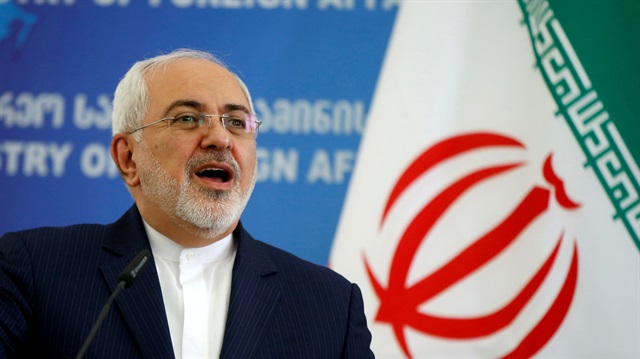
File photo: Iranian Foreign Minister Mohammad Javad Zarif
U.S. President Donald Trump and his allies in the Middle East have become isolated by their hostile policies towards Tehran, Iranian Foreign Minister Mohammad Javad Zarif said on Monday, state TV reported.
"Today, Trump, (Saudi Crown Prince Mohammad) Bin Salman and (Israeli Prime Minister Benjamin) Netanyahu have become the symbol of mistrust in the world," Zarif was quoted as saying.
"Their oppressive policies and violent measures have made them isolated... The world has distanced itself from their hostile policies against Iran."
A first round of U.S. sanctions against Iran, lifted under the 2015 international deal over its nuclear programme, are due to be reinstated on Tuesday.
They will cover Iran’s purchases of dollars, its trade in gold and precious metals and its automotive sector.
Amid U.S. plans to re-impose sanctions on Iran, the European Union and heavyweight members Germany, France, and Britain on Monday expressed "deep" regret and vowed to protect Europeans doing "legitimate" business with Iran."We deeply regret the re-imposition of sanctions by the U.S., due to the latter's withdrawal from the Joint Comprehensive Plan of Action (JCPOA)" -- the formal name for the Iran deal -- said a statement issued by EU foreign policy chief Federica Mogherini along with French Foreign Minister Jean-Yves Le Drian, German Foreign Minister Heiko Maas, and British Foreign Minister Jeremy Hunt.Iran's Revolutionary Guards says it held Gulf war games this week"We are determined to protect European economic operators engaged in legitimate business with Iran, in accordance with EU law and with UN Security Council Resolution 2231," statement added.Underscoring the significance of the Iran nuclear deal, the statement called it “a key element of the global nuclear non-proliferation architecture, crucial for the security of Europe, the region, and the entire world.""The remaining parties to the JCPOA have committed to work on, inter alia, the preservation and maintenance of effective financial channels with Iran, and the continuation of Iran's export of oil and gas. On these, as on other topics, our work continues, including with third countries interested in supporting the JCPOA and maintaining economic relations with Iran."IranAir says to get five more ATR regional planes before sanctionsThe joint statement also stressed that "preserving the nuclear deal with Iran is a matter of respecting international agreements and a matter of international security."In July 2015, the P5 1 group of countries -- the U.S., Britain, France, China, Russia, and Germany -- signed the nuclear deal with Iran.In it, world powers agreed to lift some economic sanctions in return for Tehran agreeing to limit its nuclear activity to peaceful civilian purposes.But on May 8, U.S. President Donald Trump announced his country's unilateral withdrawal from the deal, drawing condemnation worldwide.Iran's Revolutionary Guards says it held Gulf war games this week
Defying US, EU vows to protect legal trade with Iran
Under the deal between Tehran and world powers, most international sanctions imposed on Iran were lifted in 2016 in return for Tehran curbing its nuclear programme.
Saying the deal had failed to address Iran’s ballistic missile programme, its nuclear activities beyond 2025 and its role in regional wars, Trump withdrew from it in May in a move that Israel - which Iran refuses to recognise - and Saudi Arabia welcomed.
Chinese state media on Monday lashed out at U.S. President Donald Trump's trade policies in an unusually personal attack, and sought to reassure investors worried about China's economy as growth concerns rattled its financial markets.China's strictly controlled news outlets have frequently rebuked the United States and the Trump administration as the trade conflict has escalated, but they have largely refrained from specifically targeting Trump.The latest criticism from the overseas edition of the ruling Communist Party's People's Daily newspaper singled out Trump, saying he was starring in his own "street fighter-style deceitful drama of extortion and intimidation".State media says China's response to latest US tariffs restrained, rationalTrump's desire for others to play along with his drama is "wishful thinking", a commentary on the paper's front page said, arguing that the United States had escalated trade friction with China and turned international trade into a "zero-sum game"."Governing a country is not like doing business," the paper said, adding that Trump's actions imperilled the national credibility of the United States.The heated dispute between the world's two biggest economies has roiled financial markets including stocks, currencies and the global trade of commodities from soybeans to coal in recent months.Trump adviser Kudlow warns China after new tariffs announcedThe United States and China implemented tariffs on $34 billion worth of each other's goods in July. Washington is expected to soon implement tariffs on an additional $16 billion of Chinese goods, which China has already said it will match immediately.On Friday, China's finance ministry unveiled new sets of additional tariffs on 5,207 goods imported from the United States worth $60 billion.That move was in response to the Trump administration's proposal of a 25-percent tariff on $200 billion worth of Chinese imports.The trade war, rising corporate bankruptcies, and a steep decline in the value of the yuan versus the dollar have raised concerns that China's economy could face a steeper slowdown.China unveils retaliatory tariffs on $60 billion of US goodsThe government has responded by releasing more liquidity into the banking system, encouraging lending and promising a more "active" fiscal policy.U.S. companies are putting in place measures to cushion the impact of the trade row, including price hikes, and a number of companies - from industrial firms to home furnishers and toymakers - have said they will move some sourcing and manufacturing outside of China.STOCK MARKET SWINGSThe paper's vitriol follows Trump's comments on Twitter from Saturday in which he boasted that his strategy of placing steep tariffs on Chinese imports was "working far better than anyone ever anticipated", and that Beijing was now talking to the United States about trade.Trump cited losses in China's stock market as he predicted the U.S. market could "go up dramatically" once trade deals were renegotiated.China's stocks were lower on Monday as Beijing's latest tariff threats escalated the tit-for-tat Sino-U.S. trade war, though the central bank's efforts to shore up the tumbling yuan helped to stabilise the currency.But a flurry of articles in Chinese state media emphasised the resilience of China's economy and downplayed concerns about the impact of the Sino-U.S. trade war."Market participants foresee a relatively stable Chinese currency in the near term, without fear of impacts from the U.S.-China trade dispute. They expect solid economic growth momentum amid policy fine-tuning," an article in the official English-language China Daily newspaper said, citing Chinese economists.On Friday, the People's Bank of China said it would require banks to keep reserves equivalent to 20 percent of their clients' foreign exchange forwards positions from Monday, in a move to stabilise the yuan."Leading China's economy on a stable and far-reaching path, we have confidence and determination," another commentary in the main edition of the People's Daily said.Trump has threatened tariffs on over $500 billion in Chinese goods, covering virtually all U.S. imports from the Asian giant, demanding that Beijing make fundamental changes to its policies on intellectual property protection, technology transfers and subsidies for high technology industries.The nationalist Global Times, responding in an editorial late on Sunday to White House economic adviser Larry Kudlow's remarks that China should not underestimate Trump's resolve, said China did not fear "sacrificing short-term interests"."China has time to fight to the end. Time will prove that the U.S. eventually makes a fool of itself," the Global Times said. Hardline US 'gundamentalists' pressure NRA from withinTrump aims tweet at LeBron James, questions his intelligenceTrump administration misled public on poverty: Report
Trump's trade 'extortion' won't work: Chinese state media
Israel supported the imminent resumption of U.S. sanctions.
They "will compel the Iranians to decide between meeting the demands of the United States ... or risking the regime’s collapse and fall. The first option is good, the second excellent,” Israeli Intelligence Minister Israel Katz said on Twitter.
Shi’ite Iran has also been at loggerheads for decades with Sunni Muslim Saudi Arabia, fighting a long-running proxy war in the Middle East and beyond that has influenced conflicts in Iraq, Syria, Lebanon and Yemen.
The U.S. will enforce sanctions against Iran on Monday, Secretary of State Mike Pompeo said.Addressing reporters aboard his plane headed back to Washington from his Asia visit, Pompeo said: "The United States is going to enforce these sanctions."“It’s [sanctions] an important part of our efforts to push back against Iranian malign activity,” Pompeo said.Pompeo said the U.S. administration was ready to sit at table with Tehran, which he said would "require enormous change on the part of the Iranian regime."Erdoğan: Turkey to freeze assets of two US secretaries"They’ve got to behave like a normal country,” he said and called the Iranian administration "bad actors."Last week, U.S. President Donald Trump said that he was ready to hold talks with his Iranian counterpart Hassan Rouhani without preconditions.In May, Trump withdrew the U.S. from a nuclear deal, which was signed in 2015 between Iran and the P5 1 group of nations (the five permanent members of the UN Security Council plus Germany).The nuclear deal places restrictions on Iran’s nuclear program in exchange for billions of dollars in sanctions relief.Scattered protests in Iran as US sanctions loomDuring his electoral campaign in 2016, Trump had criticized the agreement, describing it as the “worst deal” he had ever seen.Other members of the P5 1, however, say the deal in its current form still represents the best means of reigning in Iran's nuclear energy program.The first round of sanctions, largely targeting Iran's banking sector, are set to take effect Aug. 6. A second, more robust wave of oil-related sanctions is set to snap back Nov. 4.
US to enforce sanctions against Iran: Pompeo
"These three countries want to create psychological tension against Iran ... We will overcome this period of hardship," Zarif said.
Despite efforts by Russia, China and Europe to salvage the deal, the Trump administration is pushing countries to cut all imports of Iranian oil from November, when the United States reimposes sanctions Iran’s oil and shipping industries.
Fear of sanctions and economic hardship have led to sporadic protests in several cities in Iran in the past days, with ordinary Iranians chanting slogans against Iranian leaders.