

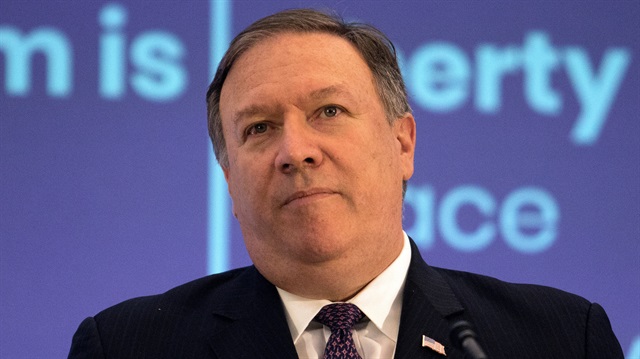
File photo: U.S. Secretary of State Mike Pompeo
The U.S. will enforce sanctions against Iran on Monday, Secretary of State Mike Pompeo said.
Addressing reporters aboard his plane headed back to Washington from his Asia visit, Pompeo said: "The United States is going to enforce these sanctions."
“It’s [sanctions] an important part of our efforts to push back against Iranian malign activity,” Pompeo said.
Pompeo said the U.S. administration was ready to sit at table with Tehran, which he said would "require enormous change on the part of the Iranian regime."
The Turkish president said Saturday they will freeze assets of the U.S. "justice and interior" secretaries in Turkey."I am instructing my friends today. We will freeze assets, if there are any, of the U.S. justice and interior secretaries in Turkey," Recep Tayyip Erdoğan said, speaking at ruling Justice and Development (AK) Party's Women Branch congress in Ankara.Speaking about the U.S. move to freeze assets of Turkish justice and interior ministers, he said: "This is not logic."Erdoğan said the Turkish nation will not step back because of "threatening rhetoric and silly decisions" of sanctions.Turkey, US ties ‘will never be severed,’ says FinMin"Especially the latest step by America regarding pastor Brunson issue in Izmir, is an ill-fitted step for a strategic partner," he added.The U.S. on Wednesday imposed sanctions on Interior Minister Suleyman Soylu and Justice Minister Abdulhamit Gul for not releasing American Pastor Andrew Craig Brunson, who faces terrorism charges in Turkey.Erdoğan said: "Do not enter a swap deal with us by arresting the deputy general manager of Halkbank, who went to the U.S. and came back six times."Mehmet Hakan Atilla, former deputy CEO of Turkish state lender Halkbank, has been sentenced to 32 months in prison in the U.S. for violating the sanctions on Iran.US, Turkey agree to try to resolve disputes"Turkey cannot be an item of U.S. domestic politics like it became in Europe. Repeating the faults that Europe did, will not earn America anything," Erdoğan said.He said they could solve problems with the U.S. by prioritizing their alliance based on mutual interests and strategic partnership."The channels of diplomacy are working very intensely. I think that we will leave behind a major chunk of differences between us soon," he said, adding that they should sort out the issue rationally.Erdoğan warned that if these political and judicial disputes affect the economic dimensions, they will be harmful for both countries.
Erdoğan: Turkey to freeze assets of two US secretaries
"They’ve got to behave like a normal country,” he said and called the Iranian administration "bad actors."
Last week, U.S. President Donald Trump said that he was ready to hold talks with his Iranian counterpart Hassan Rouhani without preconditions.
In May, Trump withdrew the U.S. from a nuclear deal, which was signed in 2015 between Iran and the P5 1 group of nations (the five permanent members of the UN Security Council plus Germany).
The nuclear deal places restrictions on Iran’s nuclear program in exchange for billions of dollars in sanctions relief.
Sporadic protests were taking place in cities in Iran for a fourth day, with demonstrators attacking a Shi'ite seminary west of Tehran, according to Iranian news agencies and social media on Saturday, as Iranians brace for a return of U.S. sanctions.Hundreds have rallied in cities across the country, including Tehran, Isfahan and Karaj, according to videos posted on social media, to protest against high inflation caused in part by a plunging rial over fears of the reimposition of crippling sanctions on Aug. 7.In May, the United States pulled out of a 2015 deal between world powers and Tehran under which international sanctions on Iran were lifted in return for curbs on its nuclear programme.Washington decided to reimpose sanctions on Iran upon its withdrawal, accusing it of posing a security threat, and has told countries they must halt all imports of Iranian oil from Nov. 4 or face U.S. financial measures.D-8 looks to further enhance business among membersThe protests have often begun with slogans against the high cost of living and alleged financial corruption but quickly turned into anti-government rallies.In the town of Eshtehard, 100 km (63 miles) west of Tehran, riot police intervened late on Friday to disperse about 500 people who chanted slogans against the government, with some throwing rocks and bricks at a Shi'ite Muslim seminary, the semi-official news agency Fars said on Saturday.In Tehran, street demonstrators chanted "Death to the dictator," according to a social media video, which could not be independently verified.In Washington, the U.S. State Department said on its Persian-language Twitter account: "While it is ultimately up to the #people_of_Iran to determine their country's path, #America supports the voice of the Iranian people, which has been ignored for a long time."On Aug. 7, Washington will reimpose sanctions on Iran's purchase of U.S. dollars, its trade in gold and precious metals and its dealings with metals, coal and industrial-related software.Sanctions will also be reapplied to U.S. imports of Iranian carpets and foodstuffs and on certain related financial transactions.Iran’s oil exports could fall by as much as two-thirds by the end of the year because of the U.S. sanctions, putting oil markets under huge strain amid supply outages elsewhere in the world. 
Scattered protests in Iran as US sanctions loom
During his electoral campaign in 2016, Trump had criticized the agreement, describing it as the “worst deal” he had ever seen.
Other members of the P5 1, however, say the deal in its current form still represents the best means of reigning in Iran's nuclear energy program.
The first round of sanctions, largely targeting Iran's banking sector, are set to take effect Aug. 6. A second, more robust wave of oil-related sanctions is set to snap back Nov. 4.