

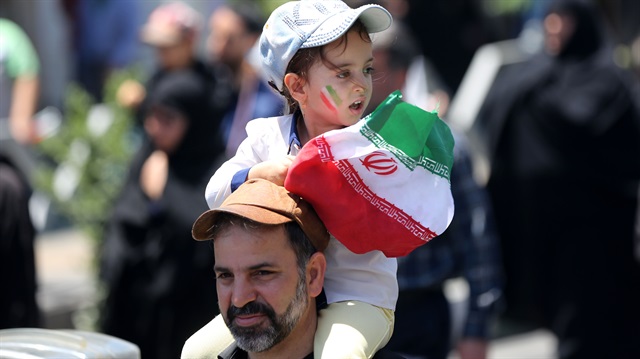
File photo
Sporadic protests were taking place in cities in Iran for a fourth day, with demonstrators attacking a Shi'ite seminary west of Tehran, according to Iranian news agencies and social media on Saturday, as Iranians brace for a return of U.S. sanctions.
Hundreds have rallied in cities across the country, including Tehran, Isfahan and Karaj, according to videos posted on social media, to protest against high inflation caused in part by a plunging rial over fears of the reimposition of crippling sanctions on Aug. 7.
In May, the United States pulled out of a 2015 deal between world powers and Tehran under which international sanctions on Iran were lifted in return for curbs on its nuclear programme.
Washington decided to reimpose sanctions on Iran upon its withdrawal, accusing it of posing a security threat, and has told countries they must halt all imports of Iranian oil from Nov. 4 or face U.S. financial measures.
The D-8 Organization for Economic Cooperation aims to further develop business and tourism activities among the member states by including private sector, the body’s secretary general said.Speaking exclusively to Anadolu Agency in Istanbul, Dato' Ku Jaafar Ku Shaari said that the organization has been changing into a new shape 20 years after its establishment.The economic body also has a "new roadmap," which aims to include new fields such as science and technology after the last summit held in Istanbul last year, Shaari said.“We are trying to encourage business activities in all member states. We are trying and looking to promote tourism in a better way. In this regard, airports play an important role.”His remarks came after a letter of intent was signed on Thursday between Istanbul Sabiha Gokcen International Airport and D-8, also known as "Developing-8" to enhance cooperation among the member countries.Video: Istanbul's Sabiha Gökçen to be D-8’s designated airportThe deal aims to link all the airports of the member states and “provide a better connection among people by providing special facilities such as Fast Track Lane and Lounge services.The Sabiha Gokcen International Airport has been the first designated airport of the D-8, as part of the cooperation.Among other fields, according to Shaari, the D-8 wants to put more focus on science and technology, education and health.“We are now looking at the possibility of establishing a research center for D-8,” he said.The organization is working with some international agencies, including UN and OIC-affiliated bodies, in particular, to develop a new kind of cooperation in the economic field, the secretary general noted.Trade in local currenciesUsing local currencies -- which is a way to ease the pressure of exchange rates on member states -- is one of the goals of the organization.“We are talking about using local currencies, for example, to trade among member states. So, there are many new ideas that we are thinking about,” Shaari said.“The central bank of Turkey is looking to establish what you call ‘Clearing House’ to support using local currency,” he added.Istanbul's Sabiha Gökçen to be D-8’s designated airportThe Developing-8 is also paying attention to the private sector.“I was in close contact with the TOBB [The Union of Chambers and Commodity Exchanges of Turkey]. We are looking to arrange a lot of new activities that will involve private sector’s participation.”The organization, for example, plans to cooperate with Turkish Technic, overhaul center of Turkish Airlines, in terms of using its technology and sharing it with other member states, he said.Turkey's role in D-8Shaari praised Turkey’s chairmanship position and President Recep Tayyip Erdogan’s active role in the organization.“I have respect, appreciation and admirations for Turkey. Turkey has never stopped giving priority to D-8,” he said.“We not only thank the government of Turkey, but also the people of Turkey for giving this opportunity to D-8 to develop itself through economic collaboration.”Expressing his gratitude to Erdogan, whom he described as an “admired” leader, Shaari said: “We look to him not only as a chairman of the D-8 but also his leadership, quality and support and commitment.”“I am very very happy with his [Erdogan’s] support and his desire to see D-8 becoming a new economic powerhouse one day,” he added.Turkey holds the rotating chairmanship of the D-8 for the next two years, and for the second time in 20 years.On June 15, 1997, the D-8 was launched after late Turkish Prime Minister Necmettin Erbakan proposed the creation of an economic group consisting of eight emerging economies from the Muslim world.Alongside Turkey, Indonesia, Bangladesh, Egypt, Iran, Malaysia, Nigeria, and Pakistan founded the organization based in Istanbul.Today, two of its members -- Turkey and Indonesia -- are among the group of the world’s 20 biggest economies.
D-8 looks to further enhance business among members
The protests have often begun with slogans against the high cost of living and alleged financial corruption but quickly turned into anti-government rallies.
In the town of Eshtehard, 100 km (63 miles) west of Tehran, riot police intervened late on Friday to disperse about 500 people who chanted slogans against the government, with some throwing rocks and bricks at a Shi'ite Muslim seminary, the semi-official news agency Fars said on Saturday.
In Tehran, street demonstrators chanted "Death to the dictator," according to a social media video, which could not be independently verified.
In Washington, the U.S. State Department said on its Persian-language Twitter account: "While it is ultimately up to the #people_of_Iran to determine their country's path, #America supports the voice of the Iranian people, which has been ignored for a long time."
On Aug. 7, Washington will reimpose sanctions on Iran's purchase of U.S. dollars, its trade in gold and precious metals and its dealings with metals, coal and industrial-related software.
Sanctions will also be reapplied to U.S. imports of Iranian carpets and foodstuffs and on certain related financial transactions.
Iran’s oil exports could fall by as much as two-thirds by the end of the year because of the U.S. sanctions, putting oil markets under huge strain amid supply outages elsewhere in the world.