

Emergency aid to Indonesia by Istanbul-based IHH
Indonesia on Tuesday ordered independent foreign aid workers to leave the quake zone and said foreign groups with staff in the disaster area on Sulawesi island should pull them out.
Indonesia has traditionally been reluctant to be seen as relying on outside help to cope with disasters, and the government shunned foreign aid this year when earthquakes struck the island of Lombok.
But it has accepted help from abroad to cope with the aftermath of a 7.5 quake and tsunami that hit the west coast of Sulawesi on Sept. 28, killing at least 1,948 people.
Despite that, some foreign groups say they have faced difficulties getting entry permits to bring in staff and equipment, and there has been confusion about the rules.
The death toll from the 7.4-magnitude earthquake and the tsunami that followed in Indonesia's Sulawesi Island late September has risen to 1,944, according to military and disaster agency officials on Sunday.The spokesman of the joint task force for the Central Sulawesi province Col. Muh Thohir said search-and-rescue operations were still ongoing.Over 2,600 people are receiving medical treatment in hospitals, said Sutopo Purwo Nugroho, the spokesman of the National Disaster Management Agency (BNPB).The agency also said 67,000 houses and almost 3,000 schools were damaged while 63,000 people in tents.Children return to schools in Indonesia quake city to clean up, find friendsThe earthquake and tsunami are estimated to have caused $658 million worth of damage up to date.Over 7,000 police officers and soldiers have join the rescue efforts in the cities of Palu and Donggala.Meanwhile, an official from the Ministry of Law and Human Rights said 1,031 out of 1,425 prisoners had apparently escaped in disaster-hit areas.Stating that 349 prisoners had reported their whereabouts to the authorities, Liberti Sitinjak called on the other prisoners to do the same.Indonesia to stop searching for quake victims on ThursdayOn Sept. 28, a 7.4-magnitude earthquake struck Sulawesi Island, which triggered a tsunami in Donggala and Palu cities that towered up to 10 feet (3 meters) high.Over the last two months, four earthquakes with magnitudes 7.4, 6.3, 6.9, and 7 hit the eastern island of Lombok of the Southeast Asian nation.Indonesia lies within the Pacific Ocean’s "Ring of Fire" where tectonic plates collide and cause frequent seismic and volcanic activity.On Dec. 26, 2004, a magnitude 9.1 earthquake struck the eastern coast of Sumatra, triggering a tsunami that killed around 230,000 people as it tore along the coasts of Sri Lanka, India, Malaysia, Indonesia, and Thailand.No siren, no warning: Indonesians caught unawares by devastating tsunami
Indonesia quake, tsunami death toll climbs to 1,944
There have long been restrictions on the activity of foreign aid workers, and the national disaster agency, in a notice posted on Twitter, set the rules out for foreign non-governmental organisations (NGOs).
Foreign groups are not allowed to "go directly to the field" but must conduct all activities "in partnership with local partners", it said.
"Foreign citizens who are working with foreign NGOs are not allowed to conduct any activity on the sites affected," it said.
A week after a massive tsunami struck Indonesia, the U.N. disaster risk agency said on Friday Asia-Pacific governments must do more to empower coastal communities to protect themselves against the threat of earthquakes and tsunamis.One week ago, a 7.5 magnitude quake and tsunami caused devastation on Indonesia's Sulawesi island, killing more than 1,500 people and leaving thousands more homeless."Localisation is a key message here - making sure that community leaders themselves are empowered," said Loretta Hieber Girardet, the regional chief of the U.N.'s disaster risk agency."The communities themselves, and every layer of community, really needs to be engaged," she told the Thomson Reuters Foundation.Indonesia has suffered more deaths from tsunamis than any other country, according to the United Nations, and the Sulawesi disaster is the sixth fatal tsunami to strike the country since the 2004 Indian Ocean tsunami.Indonesia continues relief efforts post-quake, tsunamiLast month, Indonesia was one of 24 countries bordering the Indian Ocean that took part in large-scale tsunami exercises that simulated two magnitude 9.3 earthquakes.The biennial drills, which involved an estimated 150,000 people according to U.N. officials, focused on involving coastal communities more in tsunami planning.But the Sulawesi tsunami was "atypical" and could not have been simulated, said Girardet, of the U.N. International Strategy for Disaster Reduction (UNISDR) in Bangkok.The latest quake was probably triggered by an underwater landslide, rather than a violent, vertical land motion that displaces a high volume of sea water and is most common in earthquakes in the region, she said.Bodies pile up as Indonesia suffers from devastating effects of quake, tsunamiThe narrow shape of the bay where the tsunami hit also helped the wave gather in intensity and focus on the coastline, she said, adding that communities were ill-prepared.Preparedness measures include identifying infrastructure most at risk from disasters, retrofitting buildings, constructing emergency shelters and ensuring escape routes are well-marked, disaster experts said.It should be mandatory for all infrastructure projects to be screened to ensure they are equipped to handle disasters and are then maintained, said Arghya Sinha Roy, a disaster risk specialist at the Asian Development Bank in Manila.Galeri: Indonesians gather for Friday prayers despite devastating quake, tsunami"Simple things can be done at the local level to make sure that at least life-loss is reduced dramatically - and that's very much possible," he said.All disaster planning must be inclusive and include groups in society who are more vulnerable or unable to evacuate, said Girardet, like the disabled or pregnant women."In the long run, the amount of money that would have been spent on prevention is just a drop in a bucket compared to what the response is going to cost," she said. 
After Indonesia quake, empowering coastal communities will save lives: UN
"Foreign NGOs who have deployed its foreign personnel are advised to retrieve their personnel immediately," the agency said in its English-language notice.
The official death toll in Sulawesi stood at 1,948 on Tuesday, with most of the fatalities in Palu, a small city that bore the brunt of the disaster.
No one knows how many people are missing, especially in areas of southern Palu devastated by soil liquefaction, but it could be as high as 5,000, the national disaster agency said.
About 70,000 people have been displaced.
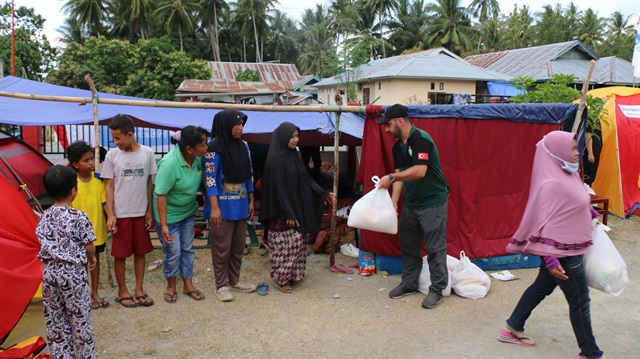
Members of the Humanitarian Relief Foundation (IHH), an Istanbul-based aid agency, humanitarian aid supplies in the quake-hit Palu city, Central Sulawesi province of Indonesia on October 04, 2018. The Turkish aid group on Thursday dispatched aid for 7,400 victims in disaster-hit Indonesia's Palu, Donggala and Makassar cities.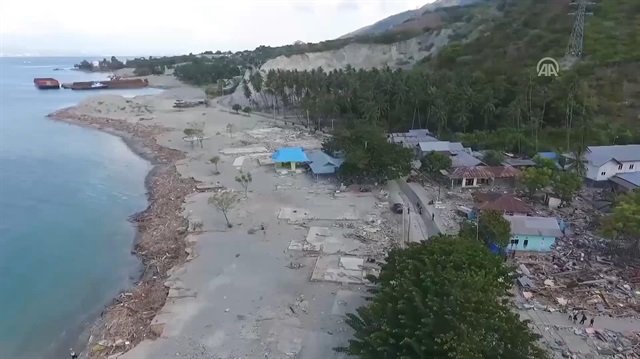
Turkish charity aids 7,400 Indonesia quake victims
As well as being concerned to show it can manage disasters on its own, Indonesian governments are wary of being too open to outside help because they could face criticism from political opponents.
There is particular resistance to the presence of foreign military personnel as it could be seen as an infringement of sovereignty.
"There are political sensitivities, especially with an election coming up, and sovereignty is another issue,” said Keith Loveard, senior analyst with advisory and risk firm Concord Consulting, referring to polls due in Muslim-majority Indonesia next year.
Many countries regulate the activity of foreign aid groups but restrictions are sometimes set aside after major disasters.
Many of the displaced in Sulawesi are living in basic shelters in Palu and surrounding hills. A plan to relocate communities is being drawn up, the agency said.
The government has allocated 560 billion rupiah ($37 million) for quake relief and has said some 20 countries have offered help.
Sulawesi is one of Indonesia's five main islands. The archipelago sees frequent earthquakes and occasional tsunami.
In 2004, a quake off Sumatra island triggered a tsunami across the Indian Ocean that killed 226,000 people in 13 countries, including more than 120,000 in Indonesia.
Foreign governments and aid groups played a big role in the emergency response and recovery efforts in 2004.