

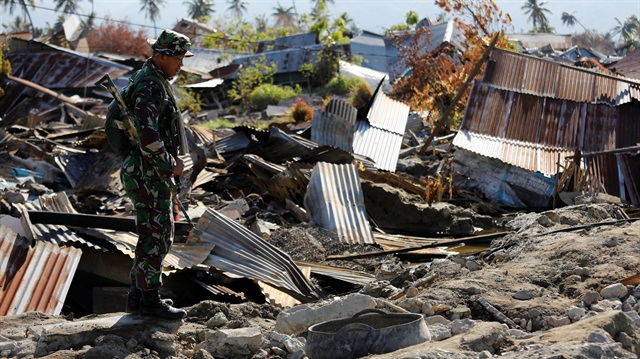
A soldier stands in an area destroyed by an earthquake and liquefaction in the Petabo neighbourhood in Palu, Central Sulawesi, Indonesia, October 8, 2018.
The death toll from the 7.4-magnitude earthquake and the tsunami that followed in Indonesia's Sulawesi Island late September has risen to 1,944, according to military and disaster agency officials on Sunday.
The spokesman of the joint task force for the Central Sulawesi province Col. Muh Thohir said search-and-rescue operations were still ongoing.
Over 2,600 people are receiving medical treatment in hospitals, said Sutopo Purwo Nugroho, the spokesman of the National Disaster Management Agency (BNPB).
The agency also said 67,000 houses and almost 3,000 schools were damaged while 63,000 people in tents.
Children in the Indonesian city of Palu began returning to school on Monday to tidy up their classrooms and to help gather data on how many of them will be coming back 10 days after a major earthquake and tsunami hit their city.The 7.5 magnitude quake on Sept. 28 brought down many buildings in the small city on Sulawesi island, 1,500 km (30 miles) northeast of Jakarta, while tsunami waves smashed into its beachfront.But the biggest killer was probably soil liquefaction, which happens when a powerful quake turns the ground into a liquid mire and which obliterated several Palu neighbourhoods.The official death toll is 1,763 but bodies are still being recovered. No one knows how many people are missing, especially in the areas hit by liquefaction, but it could be as high as 5,000, the national disaster agency said.Indonesia to stop searching for quake victims on ThursdayAt one state high school, teenagers dressed in grey and white uniforms swept up broken glass in the classrooms. Trophies had fallen from a broken school showcase and the basketball court was cracked."It's sad to see our school like this," said Dewi Rahmawati, 17, who expects to graduate next year and wants to study economics at university.The students found out that they had to turn up to school through messages on Facebook and WhatsApp.School principal Kasiludin said authorities told all teachers to show up for work from Monday to collect information on student numbers."We won't force the students to come back because many are traumatised. But we must start again soon to keep their spirits up and so they don't fall behind," he said.The school had lost at least seven students and one teacher, he said.No siren, no warning: Indonesians caught unawares by devastating tsunamiTurkish charity aids 11,900 Indonesia quake victimsPositive ThinkingAt the SMP Negeri 15 Palu middle school, fewer than 50 of its 697 students showed up.School principal Abdul Rashid said he was aware of four students killed in the quake."Classes haven't started. We're only collecting data to find out how many students are safe," he said."I'm still waiting for the Ministry of Education to give us instructions on when to begin classes. For now, I don't think we're ready. Many children are traumatised and frightened."One boy chatting in the school compound with friends said he was disappointed that so few of his class mates had shown up."I haven't heard from so many of them. I want to think positively; I hope they are OK," said Muhamad Islam Bintang Lima, dressed in the school uniform of white shirt and navy blue trousers.Indonesia continues relief efforts post-quake, tsunamiVideo: Child victims of Indonesia's deadly quake, tsunamiMost of the dead from the quake and tsunami were in Palu, the region's main urban centre. Figures for more remote areas are trickling in but they seem to have suffered fewer deaths than the city.Sulawesi is one of Indonesia's five main islands. The archipelago sees frequent earthquakes and occasional tsunamis.In 2004, a quake off Sumatra island triggered a tsunami across the Indian Ocean that killed 226,000 people in 13 countries, including more than 120,000 in Indonesia.A spokesman for the national disaster mitigation agency said on Sunday searches for bodies would stop on Thursday.Debris would be cleared and areas hit by liquefaction would be turned into parks, sports venues and other public spaces, the spokesman said.Indonesia is hosting an International Monetary Fund/World Bank meeting on the resort island of Bali this week, which has drawn some criticism from the political opposition."What is the benefit for us Indonesian people, especially in this time of catastrophe," Fadli Zon, deputy speaker of parliament from the opposition nationalist Gerindra party, said on Twitter, taking issue with government spending on the meeting.The government has allocated $37 million to help victims of the earthquake.
Children return to schools in Indonesia quake city to clean up, find friends
The earthquake and tsunami are estimated to have caused $658 million worth of damage up to date.
Over 7,000 police officers and soldiers have join the rescue efforts in the cities of Palu and Donggala.
Meanwhile, an official from the Ministry of Law and Human Rights said 1,031 out of 1,425 prisoners had apparently escaped in disaster-hit areas.
Stating that 349 prisoners had reported their whereabouts to the authorities, Liberti Sitinjak called on the other prisoners to do the same.
Indonesian rescue workers will stop searching for the bodies of victims of an earthquake and tsunami on the island of Sulawesi on Thursday, the national disaster mitigation agency said on Sunday.The announcement came after the official death toll from the 7.5 magnitude quake and a tsunami it triggered on Sept. 28 rose to 1,763.Bodies are still being recovered, especially from ruins of buildings in the small city of Palu and from neighbourhoods hit by liquefaction, a phenomenon that turns the ground into a roiling quagmire, in the south of city."Evacuation stops on October 11," the national disaster mitigation agency spokesman Sutopo Purwo Nugroho told a news briefing, using an Indonesian word that applies to the search and retrieval of both living and dead people."Victims who have not been found are declared missing," he said. Some limited searching might still be undertaken but large-scale searches with many personnel and heavy equipment would cease, he said.Many hundreds of people are still buried in mud and debris in the south of Palu, where neighbourhoods were obliterated by liquefaction and desperate relatives have been seeking help to find loved ones.UN announces $50M in relief efforts for Indonesia1000 feared under debris in Indonesia quake, tsunamiDozens of rescuers removed 34 bodies from one place on Saturday.Nugroho said the debris would be removed from those places and they would be turned into public spaces like parks and sports venues."We don't want the community to be relocated to such dangerous places," he said.Most of the dead have been found in Palu, the region's main urban centre. Figures for more remote areas, some just re-connected to the outside world by road, are trickling in.Sulawesi is one of Indonesia's five main islands and, like the others, is exposed to frequent earthquakes and tsunamis.In 2004, a quake off Sumatra island triggered a tsunami across the Indian Ocean that killed 226,000 people in 13 countries, including more than 120,000 in Indonesia.A big aid operation is gearing up to help hard-hit communities where some 70,000 people have been displaced.Indonesia has often been reluctant to be seen as relying on outside help to cope with disasters.The government shunned foreign aid this year when earthquakes struck the island of Lombok but it accepted help from abroad for Sulawesi.The government says it particularly needs aircraft, generators, tents, water treatment and field medical facilities.Indonesia continues relief efforts post-quake, tsunamiEruptions recorded on volcanic island in IndonesiaMany lives spared at Indonesia quake epicentre by earlier shakeFrench volunteers in Indonesia search for bodies in jumbled mire
Indonesia to stop searching for quake victims on Thursday
On Sept. 28, a 7.4-magnitude earthquake struck Sulawesi Island, which triggered a tsunami in Donggala and Palu cities that towered up to 10 feet (3 meters) high.
Over the last two months, four earthquakes with magnitudes 7.4, 6.3, 6.9, and 7 hit the eastern island of Lombok of the Southeast Asian nation.
Indonesia lies within the Pacific Ocean’s "Ring of Fire" where tectonic plates collide and cause frequent seismic and volcanic activity.
On Dec. 26, 2004, a magnitude 9.1 earthquake struck the eastern coast of Sumatra, triggering a tsunami that killed around 230,000 people as it tore along the coasts of Sri Lanka, India, Malaysia, Indonesia, and Thailand.
When up to six-metre (20-foot) tsunami waves crashed into the Indonesian city of Palu last month, Didiek Wahyudi Kurniawan's house near the beach was quickly engulfed with water, leaving his wife and two daughters barely any time to escape."I know there is supposed to be a tsunami warning alarm, but maybe it was outdated? I have no idea. We never get any warning from it," said Kurniawan, 46.He said he was out at the time but his family escaped by wading through chest-high water to a neighbour's three-storey building.While his family was spared, scores attending a beach festival in Palu were among those swept away, adding to the more than 1,600 deaths from the 7.5 magnitude quake and tsunami that have been confirmed so far.Other survivors also said they heard no sirens, even though a tsunami warning was issued and then lifted 34 minutes after the quake, based on data available from the closest tidal sensor, around 200 km (125 miles) from Palu, which is on Sulawesi island.As Indonesia struggles with the aftermath of the devastating quake, the spotlight has again been shone on the apparent lack of preparedeness in a sprawling archipelago that suffers regular tremors, lying on the seismically active so-called Pacific Ring of Fire.There was a major push in the region to improve warning systems after the 2004 Indian Ocean tsunami killed more than 120,000 in Indonesia alone, including establishing a network of 22 warning buoys to detect tsunamis that was put in place with German and U.S. help. International agencies and countries poured $4.6 billion into the reconstruction of Indonesia's devastated Aceh province on Sumatra island, with new infrastructure such as strategically placed evacuation centres.Still, with the first waves in Palu arriving within around four minutes and power and communications knocked out by the quake, text message alerts or sirens would probably not have been enough, even if they were working.Denis McClean, a spokesman of the U.N. Disaster Risk Reduction agency, told a briefing only public awareness would have saved people under these circumstances."It happened very quickly. There wasn't much time for warnings to be disseminated, so it was very much dependent on the level of public awareness in order to save lives."Turkish charity aids 11,900 Indonesia quake victims'The earthquake is the warning'Indonesia's national disaster mitigation agency spokesman Sutopo Purwo Nugroho said people still often did not know what to do when a disaster strikes.Unlike in quake-prone countries like Japan and New Zealand, earthquake education and drills are conducted only sporadically in Indonesia."The problem in tsunami early warning systems is not the structure, not its tools, but the culture in our communities," Nugroho told reporters.Palu has some tsunami evacuation route signs, but Mokhtar, a resident, said while he was aware of government sponsored simulations shown on television on what to do in an earthquake, he had not seen any on the ground."There is a warning system but on that day there was none. No siren or anything," said the 51-year-old civil servant, adding that he has never heard the warning system ever.Nugroho of the diaster agency said communities sometimes vandalise early warning tools like tsunami buoys.The network of 22 buoys in Indonesia, which are connected to seabed sensors, have been inoperable since 2012, often due to neglect or vandalism.Fishermen often used buoys to tie their boats, sometimes damaging sensors, while in one case a buoy was towed by fishermen from its original mooring to another part of the sea off Sulawesi. Indonesian President Joko Widodo called this week for the buoys to be repaired or replaced, but experts and officials say investment has also been neglected in other areas.According to data from the disaster agency, out of about 1,000 tsunami sirens needed across Indonesia, only 56 are in place.Video: Child victims of Indonesia's deadly quake, tsunamiOnly about 3,100 km (1,920 miles) of evacuation routes have been established against a need for 11,900 km (7,390 miles), while there are only 50 evacuation shelters compared with estimates of 2,200 needed, the data showed.The speaker of Indonesia's parliament, Bambang Soesatyo, pledged in a statement that at least in the case of buoys, parliament would support the budget for this.Adam Switzer, a tsunami expert at the Earth Observatory of Singapore, said from evidence so far it appeared the tsunami in Palu was generated by a submarine landslide, something most warning systems would not pick up."The earthquake is the warning. The first thing you need to do is take cover in a safe space until the shaking stops and then get yourself away from the coast. It's about education," said Switzer, stressing that this needed "to be ingrained in every child in Asia, especially in Southeast Asia".Even putting aside the human cost, there are powerful economic arguments for doing more to prepare for disasters.Udrekh, a disaster expert at Indonesia's Agency for the Assessment and Application of Technology (BPPT), said Indonesia is discussing with Japan whether to invest in seabed cables with sensors that could detect tsunami and earthquakes, similar to a system in Japan. Such cables would be less vulnerable and quicker than buoys and cost 300 billion rupiah ($19.8 million) a year for every 200 km (125 miles), he said."We always say for disaster infrastructure that you save $7 for every $1 investment you make, so this is needed and the cost is nothing compared to other infrastructure," he said.He estimated Indonesia lost about 30 trillion rupiah ($2 billion) each year from disasters, but spent too little on disaster mitigation infrastructure and education."It's like we never learned from 2004," he said. ($1 = 15,185.0000 rupiah) 
No siren, no warning: Indonesians caught unawares by devastating tsunami