

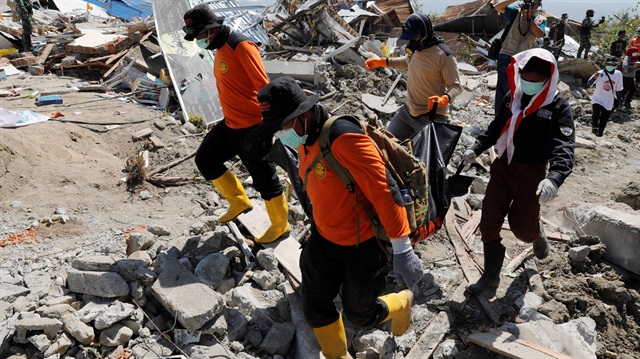
Rescue team members carry a dead body after an earthquake hit Petobo neighbourhood in Palu, Indonesia, October 5, 2018.
A week after a massive tsunami struck Indonesia, the U.N. disaster risk agency said on Friday Asia-Pacific governments must do more to empower coastal communities to protect themselves against the threat of earthquakes and tsunamis.
One week ago, a 7.5 magnitude quake and tsunami caused devastation on Indonesia's Sulawesi island, killing more than 1,500 people and leaving thousands more homeless.
"Localisation is a key message here - making sure that community leaders themselves are empowered," said Loretta Hieber Girardet, the regional chief of the U.N.'s disaster risk agency.
"The communities themselves, and every layer of community, really needs to be engaged," she told the Thomson Reuters Foundation.
Indonesia has suffered more deaths from tsunamis than any other country, according to the United Nations, and the Sulawesi disaster is the sixth fatal tsunami to strike the country since the 2004 Indian Ocean tsunami.
Indonesia on Thursday continued relief efforts for the 6th consecutive day, following the 7.4-magnitude earthquake and tsunami that hit its Sulawesi Island last Friday.According to the Indonesian National Board for Disaster Management (BNPB), the death toll from the quake and tsunami has risen to 1,424, while 113 are still missing.It said 1,407 dead bodies have been buried in a mass grave.Some 2,549 people are critically injured and are receiving treatments at the hospitals in and outside Palu city, the BNPB added.A total of 66,238 houses are estimated to be destroyed and the number of internally displaced people has climbed to 70,821.Video: Drone footage shows devastation in quake hit Petobo VillageOn the 6th day of relief efforts, the Indonesian government and all sections of the community are trying to restore conditions in the disaster-hit areas.In a Cabinet meeting, the Indonesian President Joko Widodo announced some priorities in handling the aftermath of the earthquake and tsunami.The priorities include processing evacuation and search for victims, giving medical treatment and aid, accelerating the recovery of electricity networks, accelerating fuel supply, distribution of logistics and food staples, accelerating recovery of telecommunications networks and coordinating foreign assistance.Galeri: Earthquake victims in Indonesia- Restoration of telecommunication networksAccording to the latest developments related to the restoration of telecommunication networks, STO (automatic telephone center) has been restored by using a power generator. The main network of Palu-Donggala and Palu-Parigi-Manado has also been recovered.In central Sulawesi, 50.7 percent of the Central Transceiver Station (BTS) out of a total of 3,133 stations are recovered.In Palu city of central Sulawesi, 46 out of 203 have been recovered, while 126 BTSs are in recovery process. All of BTSs are being temporarily powered by batteries.Meanwhile, free telephones and Wi-Fi services are available at 11 points, including Makorem Palu, Mutiara Airport, the mayor's office, the governor's office, Undata Hospital, Regional Disaster Management agency of Donggala and Radio Republic Indonesia (RRI).The Communications Ministry and Telecommunications Operators have also prepared VSAT and satellite phones in a number of points, especially government offices and hospitals.The fuel supply in Palu is already supported by 41 mobile fuel stations.A total of 100 gas station attendants have been brought in from Makassar. Solar fuel for 22 days and Premium fuel for 7 days are available.In regard to electricity supply, the 125 MW pre-earthquake capacity is estimated to experience a 30 percent reduction in load post-earthquake.Besides a number of urban strategic points, business locations are beginning to start functioning.*Munira Abdelmenan Awel contributed to the story from Ankara
Indonesia continues relief efforts post-quake, tsunami
Last month, Indonesia was one of 24 countries bordering the Indian Ocean that took part in large-scale tsunami exercises that simulated two magnitude 9.3 earthquakes.
The biennial drills, which involved an estimated 150,000 people according to U.N. officials, focused on involving coastal communities more in tsunami planning.
But the Sulawesi tsunami was "atypical" and could not have been simulated, said Girardet, of the U.N. International Strategy for Disaster Reduction (UNISDR) in Bangkok.
The latest quake was probably triggered by an underwater landslide, rather than a violent, vertical land motion that displaces a high volume of sea water and is most common in earthquakes in the region, she said.
The confirmed death toll from an earthquake and tsunami in Indonesia's Sulawesi Island has risen to 1,407, the disaster mitigation agency said on Wednesday.The 7.5 magnitude quake and deadly tsunami waves it triggered last Friday heavily injured over 2,500 people.It is feared that the death toll will continue to surge, as most of the confirmed dead have come from Palu, a small city 1,500 km (930 miles) northeast of Jakarta, and losses in remote areas largely cut off since Friday are yet to be accounted for.Victims of the disaster are having difficulty obtaining necessities such as food and drinking water. Search and rescue operations in collapsed buildings throughout the region continue.The quake brought down hotels, shopping malls and thousands of houses in Palu, while tsunami waves as high as six meters (20 feet) battered its beachfront shortly afterwards.UN pledges aid for Indonesian quake, tsunami victimsUN pledges aidThe UN said Tuesday that it is allocating $15 million from its Central Emergency Response Fund (CERF) to assist the victims of the devastating natural disaster.“Thousands of people are unable to return to their damaged or destroyed homes and aftershocks continue. While the government and first responders are working tirelessly to deliver life-saving aid, the needs remain vast,” a statement released by the UN said.The UN has estimated that 66,000 homes and vital infrastructure were damaged, including roads and bridges.Volcano erupts on Indonesia’s Sulawesi IslandDifficulty in accessing disaster victimsCentral Sulawesi Disaster Mitigation Agency (BPBD) head Bartholomeus Tandigala said that search and rescue activities had to be paused at nightfall, and that disruptions were breaking out because locals had nearly no access to drinking water.“Lack of electricity is negatively affecting search and rescue activities, access and communication,” said Tandigala.Turkish aid group extends helping handThe Istanbul-based Humanitarian Relief Foundation (IHH) is continuing its aid efforts in the region. The group said on Monday that they had delivered food and shelter provisions to 2,000 victims.The foundation had sent a five-person team as soon as the devastating earthquake struck and launched a fundraising campaign for the quake victims.Indonesia's Widodo makes second visit to quake city as aid effort gears upRampant lootingThere are reports of looting incidents in the quake-hit cities of Palu and Dongala.Police have done little to stop outbreaks of looting. The government has played down the problem, saying that victims could take essentials and shops would be compensated.“Home and shop owners choose to stay with their properties even if they have no food or water in case looting occurs,” BPBD head Tandigala said.Trump offers condolences over deadly Indonesian quake
Bodies pile up as Indonesia suffers from devastating effects of quake, tsunami
The narrow shape of the bay where the tsunami hit also helped the wave gather in intensity and focus on the coastline, she said, adding that communities were ill-prepared.
Preparedness measures include identifying infrastructure most at risk from disasters, retrofitting buildings, constructing emergency shelters and ensuring escape routes are well-marked, disaster experts said.
It should be mandatory for all infrastructure projects to be screened to ensure they are equipped to handle disasters and are then maintained, said Arghya Sinha Roy, a disaster risk specialist at the Asian Development Bank in Manila.
Muslims of Indonesia's Lolu village, located outside Palu, which was struck by a devastating earthquake and tsunami, gathered for Friday prayer in a soccer stadiumIndonesians gather for Friday prayers despite devastating quake, tsunami

Show All
All disaster planning must be inclusive and include groups in society who are more vulnerable or unable to evacuate, said Girardet, like the disabled or pregnant women.
"In the long run, the amount of money that would have been spent on prevention is just a drop in a bucket compared to what the response is going to cost," she said.