

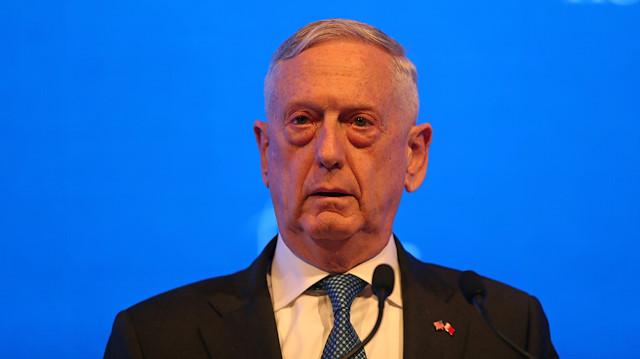
U.S. Defense Secretary James Mattis
U.S. Defense Secretary Jim Mattis said on Sunday that he had met Saudi Arabia's foreign minister and called for a transparent investigation into the killing of journalist Jamal Khashoggi.
Washington Post columnist Khashoggi's murder has escalated into a crisis for the world’s top oil exporter as Saudi Arabia's allies have reacted with outrage.
Mattis said he met Saudi Foreign Minister Adel al-Jubeir during a conference in Bahrain on Saturday and discussed the killing.
"We discussed it. You know the same thing we talked about, the need for transparency, full and complete investigation," Mattis told a small group of reporters travelling to Prague with him.
"(There was) full agreement from foreign minister Jubeir, no reservations at all, he said we need to know what happened and it was very collaborative, in agreement," Mattis added.
U.S. President Donald Trump has said he wants to get to the bottom of the case, while also highlighting Riyadh's role as an ally against Tehran and Islamist militants, as well as a major purchaser of U.S. arms.
Saudi Arabia's public prosecutor has said Khashoggi's killing was premeditated, contradicting a previous official statement that it happened accidentally during a tussle in the Saudi consulate in Istanbul.
On Saturday, Jubeir told a security summit in Bahrain that Riyadh's relations with the United States were "ironclad" amid what he described as "media hysteria" over the killing of Khashoggi.
At the same conference, Mattis had sharp words for Saudi Arabia, saying that the killing undermined Middle Eastern stability and that Washington would take additional measures against those responsible.
Earlier this month U.S. Secretary of State Mike Pompeo met the Saudi king and crown prince to discuss the issue.
Washington has already announced moves against 21 Saudis to either revoke their visas or make them ineligible for U.S. visas after the Khashoggi killing.
Asked whether the U.S. would limit its support to the Saudi-led coalition in Yemen, Mattis said on Sunday: "We'll continue to support the defense of the kingdom."
Saudi Arabia is leading a Western-backed alliance of Sunni Muslim Arab states trying to restore the internationally recognised government of Yemeni President Abd-Rabbu Mansour Hadi, ousted from the capital Sanaa by the Iran-aligned Houthis in 2015.
The United States and other Western powers provide arms, refueling and intelligence to the alliance.
Germany has vowed to halt all German arms exports to Saudi Arabia until the killing of Khashoggi is explained.
The murder of Saudi journalist Jamal Khashoggi will have “tragic ramifications” for the Arab world, prominent Egyptian journalist Fahmy Howeidy has warned.“Khashoggi’s killing will have tragic ramifications for the Arab world, atop of which comes Saudi Arabia,” he told Deutsche Welle in an interview.Khashoggi, a columnist for The Washington Post, had gone missing since entering the Saudi Consulate in Istanbul on Oct. 2.After weeks of denying any knowledge of his whereabouts, Saudi officials last week admitted that Khashoggi had died inside the consulate building.In hopes of defusing the international furor over the journalist’s demise, Saudi King Salman sacked the deputy head of the Saudi intelligence agency and a top aide, while also ordering the arrest of 18 individuals suspected of involvement in the case.Howeidy believes that Khashoggi’s murder “will cause a rift” among allies of Saudi Crown Prince Mohammed bin Salman.“In case bin Salman is sacked, this will create a crisis for other allies,” he said.The veteran journalist said he “is confident Abu Dhabi Crown Prince Mohammed bin Zayed is not sleeping in the night these days and is closely following what will happen to his friend (bin Salman)”.Howeidy sees that the position of the international community has changed regarding the Khashoggi case.“U.S. President Donald Trump is talking that sanctions may be imposed on Saudi Arabia,” he said.Turkish police have been investigating the Khashoggi’s murder. Turkish President Recep Tayyip Erdogan said 18 suspects arrested in Saudi Arabia over the killing should be extradited to Turkey to face the trial.Mattis to stress US-Mideast security ties amid Khashoggi strainsKhashoggi's fiancee says journalist was 'worried' before entering Saudi consulateTurkish FM discusses Khashoggi case with Saudi counterpart
Khashoggi murder has ‘tragic impact’ on Arabs: Howeidy
Saudi Arabia and key ally Bahrain said on Saturday that Gulf states are playing a critical role in maintaining stability in the Middle East by combating Iran's "vision of darkness", as Riyadh faces its worst political crisis in decades.Saudi Arabia is the lynchpin of a U.S.-backed regional bloc against growing Iranian influence in the Middle East but the murder of journalist Jamal Khashoggi at its consulate in Istanbul on Oct. 2. has prompted a global outcry and strained Riyadh's ties with the West."We are now dealing with two visions in the Middle East. One is a (Saudi) vision of light ... One is a (Iranian) vision of darkness which seeks to spread sectarianism throughout the region," Foreign Minister Adel al-Jubeir told a security summit in Bahrain."History tells us that light always wins out against the dark ... The question is how do we defeat them."U.S. Defense Secretary Jim Mattis said on Saturday that the killing of Khashoggi, a prominent critic of Saudi policy, undermined regional stability and that Washington would take additional measures against those responsible after announcing visa bans on 21 suspects in the case."Failure of any one nation to adhere to international norms and the rule of law undermines regional stability at a time when it is needed most," Mattis told a separate session of the annual Manama Dialogue security conference.The long-planned event has been the focus of greater scrutiny this year after the killing of Khashoggi, with Jubeir questioned about how the case would affect Saudi Arabia's credibility on foreign policy and security matters.He reiterated that Riyadh would bring to justice those responsible for Khashoggi's death, saying they would be prosecuted in the kingdom, a day after Turkey demanded the extradition of 18 Saudis suspected of involvement in his murder.Jubeir said ties between Saudi Arabia, the world's top oil exporter, and the United States are "ironclad" and praised what he described as the "rational, realistic" foreign policy of the current U.S. administration.President Donald Trump has said he wants to get to the bottom of the Khashoggi case, while also highlighting Riyadh's role as an ally against Iran and Islamist militants, as well as a major purchaser of U.S. arms.Sunni Muslim Saudi Arabia and Shi'ite Muslim Iran, which was not represented in the Manama conference agenda, have long been locked in a proxy war, competing for regional supremacy from Iraq to Syria and Lebanon to Yemen.Trump, who in May withdraw the United States from a 2015 international nuclear accord with Tehran, has strongly backed Saudi Arabia in its efforts to counter Iran's influence. The next wave of U.S. sanctions against Iran are due to come into effect on Nov 4.Iran, for its part, accuses Saudi Arabia and the United Arab Emirates of funding gunmen who attacked a military parade in Iran last month, killing 25 people, 12 of them members of the elite Revolutionary Guards. Saudi Arabia and the UAE have denied any involvement.The Guards accused them of creating "plots and tensions".Turkey is a ‘friendly country’: Saudi foreign ministerSecurity AllianceBahrain's foreign minister, Shiekh Khalid bin Ahmed Al Khalifa, told the conference the Gulf bloc would remain a "pillar" of regional security and that a proposed security alliance grouping the United States, Gulf states, Jordan and Egypt would be activated next year.The Middle East Strategic Alliance (MESA) is meant to serve as a bulwark against Iran and extremism, Washington says. But there has been uncertainty about how it can get off the ground given a protracted dispute between Qatar and four Arab states led by Saudi Arabia who launched a boycott of Doha in 2017.Saudi Arabia, the Emirates, Bahrain and Egypt cut off travel and trade ties with Qatar in June 2017, accusing it of backing their archrival, Iran, and supporting terrorism. Qatar denies the charges and says the boycott impinges on its sovereignty.Mattis said that it was important to end the 16-month-old Arab dispute with Qatar that analysts say has weakened regional coordination against Iran.Jubeir said recent discussions in Saudi Arabia about a framework for MESA included Qatari officials and that the proposed alliance would not be affected by the diplomatic row."It (MESA) is an alliance for security and prosperity for the region and will be open to those who accept its principles," Sheikh Khalid said, adding that the alliance would also cooperate on economic issues.Gulf Arab foreign ministers also touched on Middle East peace initiatives, with Sheikh Khalifa lauding efforts by Oman, which hosted Israeli Prime Minister Benjamin Netanyahu on Friday in a rare visit.Oman's foreign minister, Yousuf bin Alawi bin Abdullah, told the forum that Muscat was offering ideas to help Israel and the Palestinians to come together but was not acting as mediator.Mattis to stress US-Mideast security ties amid Khashoggi strainsMattis: US to take additional measures against those behind Khashoggi killingMattis said Khashoggi’s murder undermines Mideast stabilityMattis says in close contact with European allies on INF treaty
Saudi Arabia says it is beacon of 'light' against Iran despite Khashoggi crisis
Pittsburgh synagogue gunman a "coward"
Mattis also said the gunman who stormed a Pittsburgh synagogue and killed 11 worshippers was a coward and the "poorest excuse for a man you could ever come up with."
"If there is one person responsible, this individual, I won't even call him a man, he was (the) poorest excuse for a man you could ever come up with, who would use a weapon in a house of worship on unarmed innocent people," Mattis told a group of reporters travelling with him to Prague.
"This is a coward and he is not a man by any definition that we use in the Department of Defense," he said.
Robert Bowers, 46, of Pittsburgh, was taken into custody after a shootout with a SWAT team on Saturday. Federal prosecutors charged him with 29 criminal counts including violence and firearms offences, and violating U.S. civil rights laws.
"That is tough, on the neighborhood, on the members of that synagogue, on all of us who believe in freedom of religion, it is one of our most fundamental rights that our country was founded on," Mattis said.
Earlier, U.S. Attorney General Jeff Sessions said federal prosecutors could seek the death penalty.
Turkish President Recep Tayyip Erdoğan condemned a synagogue attack in Pensilvania, U.S. on Saturday.“I condemn the terror attack against a Pittsburgh synagogue and extend my heartfelt condolences to the families of the victims and to the American people,” Erdoğan wrote on Twitter Saturday.“Turkey unequivocally condemns all forms of terrorism in all parts of the world regardless of their targets,” he added.I condemn the terror attack against a Pittsburgh synagogue and extend my heartfelt condolences to the families of the victims and to the American people.Turkey unequivocally condemns all forms of terrorism in all parts of the world regardless of their targets.— Recep Tayyip Erdoğan (@RT_Erdogan) 27 Ekim 2018 Multiple casualties have been confirmed after a gunman opened fire at a synagogue in the state of Pennsylvania on Saturday.The shooting occurred at the Tree of Life Congregation Synagogue in Pittsburgh at around 10 a.m. local time (1400GMT), according to reports.Pittsburgh police said the suspect in the shooting is in custody.US synagogue shooting leaves 11 dead, six injured
Erdoğan condemns synagogue attack in US
The murder of Saudi journalist Jamal Khashoggi undermines stability in the Middle East region, U.S. Defense Secretary James Mattis said Saturday.“With our collective interests in peace and unwavering respect for human rights in mind, the murder of Jamal Khashoggi in a diplomatic facility must concern us all,” Mattis said in remarks to the annual Manama Dialogue security conference in Bahrain.“Failure of any one nation to adhere to international norms and the rule of law undermines regional stability at a time when it is needed most," Mattis said.Khashoggi, a Saudi journalist and columnist for The Washington Post, had gone missing since entering the Saudi Consulate in Istanbul on Oct. 2.After weeks of denying any knowledge of his whereabouts, Saudi officials last week admitted that Khashoggi had died inside the consulate building.Turkish police have been investigating the Khashoggi’s murder. Turkish President Recep Tayyip Erdogan said 18 suspects arrested in Saudi Arabia over the killing should be extradited to Turkey to face the trial.Mattis said he will continue to consult with U.S. President Donald Trump and Secretary of State Mike Pompeo to consider the implications of the Khashoggi issue.He said that the U.S. State Department plans to take "further action in response to the killing".As for relations with Saudi Arabia, Mattis said the U.S. respect for the Saudi people was "undiminished", stressing that respect "must come with transparency and trust."Mattis to stress US-Mideast security ties amid Khashoggi strains
Mattis said Khashoggi’s murder undermines Mideast stability
Saudi Arabia's Foreign Minister Adel al-Jubeir said on Saturday that those behind the killing of journalist Jamal Khashoggi would be prosecuted in the kingdom.The investigation would take time, Jubeir told a security summit in Bahrain.Khashoggi, a Saudi national and columnist for The Washington Post, was last seen entering the his country's consulate in Istanbul on Oct. 2 to get documents related to his forthcoming marriage with Cengiz.After days of denying any knowledge of his whereabouts, Saudi officials last week admitted that the journalist had been killed inside the consulate.Saudi-U.S. tiesJubeir said that Riyadh's relations with the United States were "ironclad" amid what he described as "media hysteria" over the killing of Khashoggi at the Saudi consulate in Istanbul on Oct. 2, which sparked a global outcry and strained the kingdom's ties with the West.The minister also said the administration of U.S. President Donald Trump has a "rational, realistic" foreign policy that all Gulf Arab states can support. He said Saudi Arabia was combating Iran's vision of "darkness" in the Middle East.Turkish president, Canadian PM discuss Khashoggi caseTurkey to demand extradition of 18 Saudi suspectsNigerian journalists protest Khashoggi’s killingKhashoggi killing hazes Saudi economic reformKhashoggi had his own 'objective stance': FianceeMattis: US to take additional measures against those behind Khashoggi killing
Suspects detained in Khashoggi case to be prosecuted in Saudi Arabia