

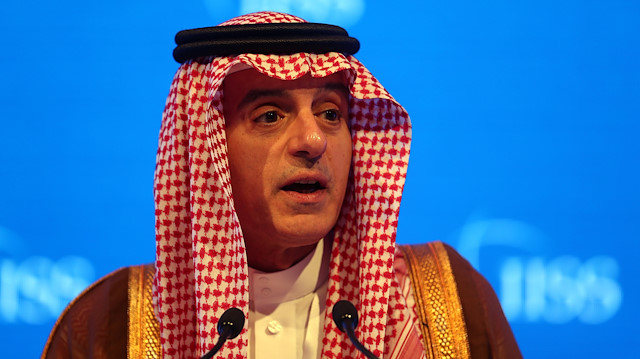
Saudi Arabia's Foreign Minister Adel bin Ahmed Al-Jubeir
Saudi Arabia and key ally Bahrain said on Saturday that Gulf states are playing a critical role in maintaining stability in the Middle East by combating Iran's "vision of darkness", as Riyadh faces its worst political crisis in decades.
Saudi Arabia is the lynchpin of a U.S.-backed regional bloc against growing Iranian influence in the Middle East but the murder of journalist Jamal Khashoggi at its consulate in Istanbul on Oct. 2. has prompted a global outcry and strained Riyadh's ties with the West.
"We are now dealing with two visions in the Middle East. One is a (Saudi) vision of light ... One is a (Iranian) vision of darkness which seeks to spread sectarianism throughout the region," Foreign Minister Adel al-Jubeir told a security summit in Bahrain.
"History tells us that light always wins out against the dark ... The question is how do we defeat them."
U.S. Defense Secretary Jim Mattis said on Saturday that the killing of Khashoggi, a prominent critic of Saudi policy, undermined regional stability and that Washington would take additional measures against those responsible after announcing visa bans on 21 suspects in the case.
"Failure of any one nation to adhere to international norms and the rule of law undermines regional stability at a time when it is needed most," Mattis told a separate session of the annual Manama Dialogue security conference.
The long-planned event has been the focus of greater scrutiny this year after the killing of Khashoggi, with Jubeir questioned about how the case would affect Saudi Arabia's credibility on foreign policy and security matters.
He reiterated that Riyadh would bring to justice those responsible for Khashoggi's death, saying they would be prosecuted in the kingdom, a day after Turkey demanded the extradition of 18 Saudis suspected of involvement in his murder.
Jubeir said ties between Saudi Arabia, the world's top oil exporter, and the United States are "ironclad" and praised what he described as the "rational, realistic" foreign policy of the current U.S. administration.
President Donald Trump has said he wants to get to the bottom of the Khashoggi case, while also highlighting Riyadh's role as an ally against Iran and Islamist militants, as well as a major purchaser of U.S. arms.
Sunni Muslim Saudi Arabia and Shi'ite Muslim Iran, which was not represented in the Manama conference agenda, have long been locked in a proxy war, competing for regional supremacy from Iraq to Syria and Lebanon to Yemen.
Trump, who in May withdraw the United States from a 2015 international nuclear accord with Tehran, has strongly backed Saudi Arabia in its efforts to counter Iran's influence. The next wave of U.S. sanctions against Iran are due to come into effect on Nov 4.
Iran, for its part, accuses Saudi Arabia and the United Arab Emirates of funding gunmen who attacked a military parade in Iran last month, killing 25 people, 12 of them members of the elite Revolutionary Guards. Saudi Arabia and the UAE have denied any involvement.
The Guards accused them of creating "plots and tensions".
Turkey is a friendly country to Saudi Arabia, Saudi Foreign Minister Adel al-Jubeir said on Saturday."Turkey is a friendly country and we have good trade and investment relations with it," al-Jubeir said in reply to a question during the Manama Dialogue security conference in Bahrain.The remarks came amid a Turkish investigation into the killing of Saudi journalist Jamal Khashoggi inside the Saudi Consulate in Istanbul. Khashoggi, a columnist for The Washington Post, had gone missing since entering the consulate on Oct. 2.Call by Khashoggi’s fiancée caused Saudi hit squad to panic, dump journo’s remains in wellAfter weeks of denying any knowledge of his whereabouts, Saudi officials last week admitted that Khashoggi had died inside the consulate building.Turkish President Recep Tayyip Erdogan said 18 suspects arrested in Saudi Arabia over Khashoggi’s killing should be extradited to Turkey to face the trial.“The Kingdom will hold those involved in the case accountable,” al-Jubeir said in reply to a question about the Turkish request to extradite the suspects for trial.Commenting on a German decision to stop arms sales to Saudi Arabia over the case, al-Jubeir said Riyadh has stopped buying weapons from Germany for some time, without giving further details.On Friday evening, German Chancellor Angela Merkel renewed her pledge to stop selling arms to Saudi Arabia until the circumstances surrounding Khashoggi's death were revealed.Mattis to stress US-Mideast security ties amid Khashoggi strainsMacron slams calls to halt arms sales to Saudi as populistKhashoggi's fiancee says journalist was 'worried' before entering Saudi consulateMeanwhile, al-Jubeir said the Gulf crisis did not impact military coordination among members of the Gulf Cooperation Council (GCC), including Qatar.The GCC "will remain the most important institution for the Gulf States," he said, underlining keenness to spare the GCC the impact of differences among members, particularly in the military side.A six-nation bloc of oil-rich Arab Gulf states, the GCC is composed of Saudi Arabia, Kuwait, the UAE, Oman, Bahrain and Qatar.Last month, Qatar attended a meeting of the GCC chiefs of staff for the first time since the outbreak of the Gulf crisis in mid-2017 to discuss ways to strengthen military and defense cooperation.In June of last year, Saudi Arabia, Egypt, the United Arab Emirates (UAE) and Bahrain collectively severed ties with Doha, accusing it of supporting terrorism.The Saudi-led axis also imposed an air/land/sea embargo on Qatar, which continues to vociferously deny the terror allegations.
Turkey is a ‘friendly country’: Saudi foreign minister
Security Alliance
Bahrain's foreign minister, Shiekh Khalid bin Ahmed Al Khalifa, told the conference the Gulf bloc would remain a "pillar" of regional security and that a proposed security alliance grouping the United States, Gulf states, Jordan and Egypt would be activated next year.
The Middle East Strategic Alliance (MESA) is meant to serve as a bulwark against Iran and extremism, Washington says. But there has been uncertainty about how it can get off the ground given a protracted dispute between Qatar and four Arab states led by Saudi Arabia who launched a boycott of Doha in 2017.
Saudi Arabia, the Emirates, Bahrain and Egypt cut off travel and trade ties with Qatar in June 2017, accusing it of backing their archrival, Iran, and supporting terrorism. Qatar denies the charges and says the boycott impinges on its sovereignty.
Mattis said that it was important to end the 16-month-old Arab dispute with Qatar that analysts say has weakened regional coordination against Iran.
Jubeir said recent discussions in Saudi Arabia about a framework for MESA included Qatari officials and that the proposed alliance would not be affected by the diplomatic row.
"It (MESA) is an alliance for security and prosperity for the region and will be open to those who accept its principles," Sheikh Khalid said, adding that the alliance would also cooperate on economic issues.
Gulf Arab foreign ministers also touched on Middle East peace initiatives, with Sheikh Khalifa lauding efforts by Oman, which hosted Israeli Prime Minister Benjamin Netanyahu on Friday in a rare visit.
Oman's foreign minister, Yousuf bin Alawi bin Abdullah, told the forum that Muscat was offering ideas to help Israel and the Palestinians to come together but was not acting as mediator.
Defence Secretary Jim Mattis will stress the U.S. commitment to Middle East security at the weekend, officials said, amid Western concern that any loosening of U.S. ties to Riyadh after Jamal Khashoggi's murder could allow Russia to fill the vacuum.Mattis will give a speech at the annual Manama Dialogue security conference in Bahrain on Saturday on the United States' policy in the Middle East which will be closely watched in capitals around the region.Katie Wheelbarger, the principal deputy assistant secretary of defense for international security affairs, said that Mattis' speech would emphasize that the United States was committed to help allies "re-instill stability in a chaotic region.""So continue to look to the United states as your security partner of choice because you can rely on us and depend on us to be there long term," Wheelbarger told reporters travelling with Mattis.Macron slams calls to halt arms sales to Saudi as populistThere is increasing concern that if Washington abandons the region, countries like Russia will fill the vacuum.Nowhere will the speech be watched more closely then in Riyadh, after Saudi Arabia's public prosecutor said the murder of journalist Jamal Khashoggi in the kingdom's Istanbul consulate this month was premeditated.The death of Khashoggi, a Washington Post columnist and critic of de facto Saudi ruler Crown Prince Mohammed bin Salman, has sparked global outrage and mushroomed into a crisis for the world's top oil exporter and strategic ally of the West.Merkel says no arms to Saudi Arabia until Khashoggi killing explainedRiyadh is expected to be watching how far, if at all, Mattis goes in censuring the kingdom in his speech.After Saudi King Salman spoke to Russian President Vladimir Putin on Thursday about the killing, the Kremlin said Russia had no reason to doubt the statements of the king and crown prince that the royal family was not involved.Dozens of Western officials, bankers, and executives shunned a big investment conference in Riyadh this week.Khashoggi's fiancee says journalist was 'worried' before entering Saudi consulateRussia sent the head of its Russian sovereign wealth fund RDIF, who said Saudi Arabia's Public Investment Fund would become a new partner in a joint Russia-China Investment Fund.Saudi Arabia is the lynchpin of a U.S.-backed regional bloc against Iran but the crisis has strained Riyadh's relations with the West.Experts believe that Washington will have to take some measures to make clear to Saudi Arabia that Khashoggi's killing is unacceptable."I think the key here is that if the administration wants to shift the focus back onto Iran the only way to do that is by taking some steps to respond to what the Saudis have done," Dennis Ross, who served as top Middle East adviser to President Barack Obama, said.Austria calls on EU to halt arms sales to Saudi ArabiaRoss said the increased global pressure on Riyadh may also present an opportunity for Washington to push the kingdom to end a 16-month-old dispute between Qatar and four Arab states that analysts say has weakened regional coordination against Iran.Saudi Arabia, the Emirates, Bahrain and Egypt cut off travel and trade ties with Qatar in June 2017, accusing it of backing their arch-rival, Iran, and supporting terrorism. Qatar denies the charges and says the boycott impinges on its sovereignty.The United States has tried, without success, to mediate in the dispute. It is an ally of the six-nation Gulf Cooperation Council, and Qatar is home to a major U.S. air base."This might not be a bad time for the administration to try to go back in and mediate that dispute, this might be a point where the Saudis will want to be more responsive to us," Ross said. 
Mattis to stress US-Mideast security ties amid Khashoggi strains
U.S. Defense Secretary Jim Mattis said on Saturday that incidents like the killing of a Saudi journalist undermined Middle Eastern stability and that the United States would take additional measures against those responsible.The killing of Jamal Khashoggi, a Saudi national and Washington Post columnist, has sparked outrage among Riyadh's Western allies and mushroomed into a crisis for Saudi Arabia, the world’s top oil exporter and strategic ally of the West.Saudi Arabia is the lynchpin of a U.S.-backed regional bloc against the growing Iranian influence in the Middle East but the Khashoggi crisis has strained Riyadh's relations with the West.U.S. President Donald Trump has said he wants to get to the bottom of the case, while also highlighting Riyadh's role as an ally against Iran and Islamist militants, as well as a major purchaser of U.S. arms.Nigerian journalists protest Khashoggi’s killing"With our collective interests in peace and unwavering respect for human rights in mind, the murder of Jamal Khashoggi in a diplomatic facility must concern us all," Mattis said in prepared remarks which he will give at the annual Manama Dialogue security conference in Bahrain."Failure of any nation to adhere to international norms and the rule of law undermines regional stability at a time when it is needed most," Mattis said. He did not mention de facto Saudi ruler Crown Prince Mohammed bin Salman by name in his prepared remarks.Saudi Arabia's public prosecutor said Khashoggi's killing was premeditated, contradicting a previous official statement that it happened accidentally during a tussle in the Saudi consulate in Istanbul.Khashoggi had his own 'objective stance': FianceeSaudi officials have also said he was accidentally killed in a botched security operation to return him to the kingdom.In his remarks, Mattis went through a long list of what he described as disruptive Iranian behavior - a message most Gulf allies will view positively since they share similar concerns about Iran's increasing influence in Syria and Iraq.While these were some of the sharpest comments Mattis has made on the Khashoggi killing, he said the incident would not diminish ties with Saudi Arabia.Macron slams calls to halt arms sales to Saudi as populist"It's hard to imagine that this administration in particular is going to change fundamentally how it views the role of the Saudis in terms of counterterrorism, in terms of counter Iran," said Dennis Ross, who served as top Middle East adviser to President Barack Obama in his first term.Secretary of State Mike Pompeo this week announced moves against 21 Saudis to either revoke their visas or make them ineligible for U.S. visas after the Khashoggi killing."Our Secretary of State has already revoked visas and will be taking additional measures," Mattis said.Mattis warned that Russia's presence in the Middle East -- where it is a major ally of Syrian President Bashar al-Assad -- could not be a replacement for the United States.Merkel says no arms to Saudi Arabia until Khashoggi killing explainedHe said that it was important to end a 16-month-old dispute between Qatar and four Arab states that analysts say has weakened regional coordination against Iran.Saudi Arabia, the Emirates, Bahrain and Egypt cut off travel and trade ties with Qatar in June 2017, accusing it of backing their archrival, Iran, and supporting terrorism. Qatar denies the charges."The solving of internal debates among our GCC partners is vital for realizing this vision. Without it, we weaken our security," he said, referring to the Gulf Cooperation Council nations.
Mattis: US to take additional measures against those behind Khashoggi killing
The murder of Saudi journalist Jamal Khashoggi undermines stability in the Middle East region, U.S. Defense Secretary James Mattis said Saturday.“With our collective interests in peace and unwavering respect for human rights in mind, the murder of Jamal Khashoggi in a diplomatic facility must concern us all,” Mattis said in remarks to the annual Manama Dialogue security conference in Bahrain.“Failure of any one nation to adhere to international norms and the rule of law undermines regional stability at a time when it is needed most," Mattis said.Khashoggi, a Saudi journalist and columnist for The Washington Post, had gone missing since entering the Saudi Consulate in Istanbul on Oct. 2.After weeks of denying any knowledge of his whereabouts, Saudi officials last week admitted that Khashoggi had died inside the consulate building.Turkish police have been investigating the Khashoggi’s murder. Turkish President Recep Tayyip Erdogan said 18 suspects arrested in Saudi Arabia over the killing should be extradited to Turkey to face the trial.Mattis said he will continue to consult with U.S. President Donald Trump and Secretary of State Mike Pompeo to consider the implications of the Khashoggi issue.He said that the U.S. State Department plans to take "further action in response to the killing".As for relations with Saudi Arabia, Mattis said the U.S. respect for the Saudi people was "undiminished", stressing that respect "must come with transparency and trust."Mattis to stress US-Mideast security ties amid Khashoggi strains
Mattis said Khashoggi’s murder undermines Mideast stability
U.S. Defense Secretary Jim Mattis said on Saturday that the United States was in close contact with allies in Europe about the INF treaty and its implications for the region."We are in close collaboration with our European allies... and we will continue to collaborate very closely with the treaty and its implications for European security," Mattis said in a speech in Bahrain."Eventually we have to look reality in the eye, that is not to mean that we are walking away from arms control. But arms control must be more than words on a paper, it must be actions," Mattis added.U.S. President Donald Trump said on Oct. 20 that Washington planned to quit the Intermediate-Range Nuclear Forces (INF) treaty which Mikhail Gorbachev, the last Soviet leader, and Ronald Reagan had signed in 1987.EU shows no sign of heeding US threat over derivatives clearingThe pact eliminated all short- and intermediate-range land-based nuclear and conventional missiles held by both countries in Europe.Washington has cited Russia's alleged violation of the treaty as its reason for leaving it, a charge Moscow denies. Russia in turn accuses Washington of breaking the pact.Gorbachev has denounced the U.S. decision to leave the INF that helped end the Cold War, saying it would heralded a new arms race which increased the risk of nuclear conflict. 
Mattis says in close contact with European allies on INF treaty