

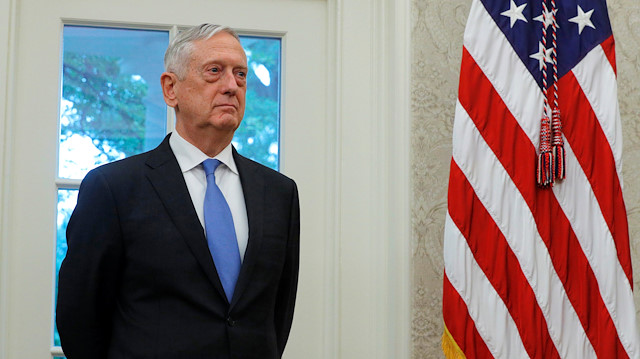
U.S. Secretary of Defense Jim Mattis
U.S. Defense Secretary Jim Mattis said on Saturday that the United States was in close contact with allies in Europe about the INF treaty and its implications for the region.
"We are in close collaboration with our European allies... and we will continue to collaborate very closely with the treaty and its implications for European security," Mattis said in a speech in Bahrain.
"Eventually we have to look reality in the eye, that is not to mean that we are walking away from arms control. But arms control must be more than words on a paper, it must be actions," Mattis added.
U.S. President Donald Trump said on Oct. 20 that Washington planned to quit the Intermediate-Range Nuclear Forces (INF) treaty which Mikhail Gorbachev, the last Soviet leader, and Ronald Reagan had signed in 1987.
The European Union is proposing to give the European Central Bank sweeping powers over foreign clearing houses in times of market stress, an EU document showed, as the bloc shows little sign of heeding U.S. calls to water down the plans.The bloc has proposed changing the ECB’s statute to give it a broad role in the oversight of EU and foreign clearing houses that handle large amounts of euro-denominated securities. That would include those in London, which will lie outside the EU in five months’ time.Now the current EU president Austria has proposed fleshing out the role with detailed powers, such as being able to force foreign clearing houses to “submit information, cooperate in the assessment of their resilience to adverse market conditions, and open overnight deposit accounts”, the document said.The EU wants the changes approved in time for Britain’s departure from the bloc next March. LCH, a unit of the London Stock Exchange (LSE.L), dominates clearing of euro-denominated interest rate swaps and will be outside the EU.Austria calls on EU to halt arms sales to Saudi ArabiaIn exceptional situations, the ECB could force a foreign clearing house to comply with temporary requirements on how much margin customers should post to back trades, the level of collateral, and how frequent intraday margins should be collected, tasks normally supervised by the home regulator.Financial lawyers say this would, for example, give the ECB power to stop a foreign clearing house raising margins on euro-denominated positions in times of market stress.The ECB has long been concerned that so much euro-denominated trade is already conducted outside the euro zone in London, and appears keen to bring this under its supervision after Brexit.Some policymakers had wanted to stop a clearing house from increasing margins during the euro zone debt crisis, saying this amplified stress in markets.The United States is unhappy about the EU plans.Christopher Giancarlo, chairman of the U.S. Commodity Futures Trading Commission which regulates the American derivatives market, has threatened retaliation against EU financial firms if the bloc does not water down what he sees as overly intrusive proposals affecting U.S. clearers such as CME and ICE. The European Commission has dismissed this as “blackmail” and a working group of EU member state representatives could give the proposals the green light next Tuesday. Member states would then thrash out a final text with the European Parliament, which has already backed similar proposals.
EU shows no sign of heeding US threat over derivatives clearing
The pact eliminated all short- and intermediate-range land-based nuclear and conventional missiles held by both countries in Europe.
Washington has cited Russia's alleged violation of the treaty as its reason for leaving it, a charge Moscow denies. Russia in turn accuses Washington of breaking the pact.
Gorbachev has denounced the U.S. decision to leave the INF that helped end the Cold War, saying it would heralded a new arms race which increased the risk of nuclear conflict.