

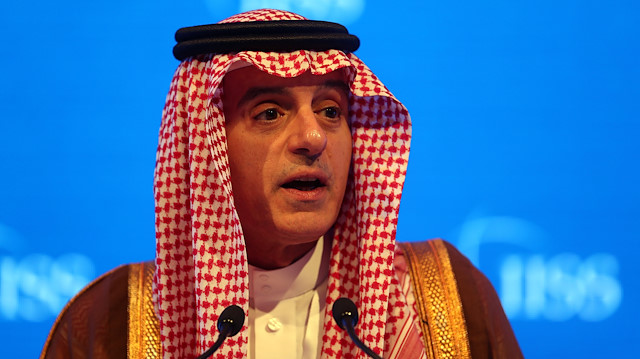
Saudi Arabia's Foreign Minister Adel bin Ahmed Al-Jubeir
Saudi Arabia's Foreign Minister Adel al-Jubeir said on Saturday that those behind the killing of journalist Jamal Khashoggi would be prosecuted in the kingdom.
The investigation would take time, Jubeir told a security summit in Bahrain.
Khashoggi, a Saudi national and columnist for The Washington Post, was last seen entering the his country's consulate in Istanbul on Oct. 2 to get documents related to his forthcoming marriage with Cengiz.
After days of denying any knowledge of his whereabouts, Saudi officials last week admitted that the journalist had been killed inside the consulate.
Saudi-U.S. ties
Jubeir said that Riyadh's relations with the United States were "ironclad" amid what he described as "media hysteria" over the killing of Khashoggi at the Saudi consulate in Istanbul on Oct. 2, which sparked a global outcry and strained the kingdom's ties with the West.
The minister also said the administration of U.S. President Donald Trump has a "rational, realistic" foreign policy that all Gulf Arab states can support. He said Saudi Arabia was combating Iran's vision of "darkness" in the Middle East.
Turkish President Recep Tayyip Erdoğan discussed the murder of journalist Jamal Khashoggi with Canadian Prime Minister Justin Trudeau via telephone Friday.Erdoğan and Trudeau stressed the need to shed light on the killing and the importance of punishing the culprits, said a source from Turkish presidency, who asked not to be named due to restrictions on speaking to the media.Both agreed “all aspects of the murder” must be made public so that the killers, believed to be Saudi Arabians, could be held accountable for the crime.Trudeau said he might cut off any arms export permits that allow Canadian manufacturers of military equipment to ship their goods to Saudi Arabia.Turkey's foreign minister speaks with US counterpartKhashoggi's fiancee says journalist was 'worried' before entering Saudi consulateAustria calls on EU to halt arms sales to Saudi ArabiaThe prime minister, however, did not say if he would stop the export of (CAN)$15 billion in armored vehicles to the Kingdom under a deal signed in 2014.The deal was negotiated under the previous Stephen Harper Conservative government.Khashoggi went missing Oct. 2 after entering the Saudi Arabia consulate in Istanbul.After weeks of denying any knowledge of the crime, Saudi officials last week said the journalist was killed during a brawl in the building.Turkish police have been investigating the case and Erdoğan said he wants 18 suspects extradited to Turkey from Saudi Arabia to stand trial.Mattis to stress US-Mideast security ties amid Khashoggi strainsMacron slams calls to halt arms sales to Saudi as populistMerkel says no arms to Saudi Arabia until Khashoggi killing explained
Turkish president, Canadian PM discuss Khashoggi case
Turkey will officially demand from Saudi Arabia the extradition of 18 suspects in the killing of journalist Jamal Khashoggi, Turkish Justice Ministry said on Friday.In a statement, the ministry said Istanbul prosecutors have prepared a requisition for 18 suspects on charges of planned and deliberate murder with monstrosity and torture.The ministry referred the extradition request for the suspects - all of whom are Saudi nationals - to Turkish Foreign Ministry, the statement said.Turkey’s Justice Minister Abdulhamit Gül also told reporters that he expects that the extradition will be carried out as the murder occurred in Turkey.“Turkish authorities are both determined and competent to shed light on this case,” Gül said.Khashoggi, a Saudi journalist and columnist for The Washington Post, had gone missing since entering the Saudi Consulate in Istanbul on Oct. 2.After weeks of denying any knowledge of his whereabouts, Saudi officials last week admitted that Khashoggi had died inside the consulate building.Turkish police have been investigating the case, and Turkish President Recep Tayyip Erdoğan has said 18 people arrested in Saudi Arabia over the killing should be sent to Turkey to face the trial.Mattis to stress US-Mideast security ties amid Khashoggi strainsMacron slams calls to halt arms sales to Saudi as populistMerkel says no arms to Saudi Arabia until Khashoggi killing explained
Turkey to demand extradition of 18 Saudi suspects
A group of Nigerian journalists and activists on Friday held a protest against the killing of Saudi journalist Jamal Khashoggi.The crowd gathered at a square in the capital Abuja and marched to the Saudi Consulate in the city.The group carried placard reading “Justice for Khashoggi,” “Journalism is not a crime,” “Stop violence against journalists,” and chanted slogans against Saudi Arabia.Abdulaziz Abdulaziz, a local journalist, told Anadolu Agency that the murder of Khashoggi was “horrifying act of Saudi Arabia.”Turkey's foreign minister speaks with US counterpartKhashoggi's fiancee says journalist was 'worried' before entering Saudi consulate“Turkey has shown it stands by justice,” he said, adding Ankara is doing its best to reveal the truth.“Whoever has a hand in [this murder] should be brought to justice,” Abdulaziz said.Khashoggi, a Saudi journalist and columnist for The Washington Post, had gone missing since entering the Saudi Consulate in Istanbul on Oct. 2.After weeks of denying any knowledge of his whereabouts, Saudi officials last week admitted that Khashoggi had died inside the consulate building.Turkish police have been investigating the case. Turkish President Recep Tayyip Erdogan has said 18 suspects arrested in Saudi Arabia over the killing should be extradited to Turkey to face the trial.Mattis to stress US-Mideast security ties amid Khashoggi strainsMacron slams calls to halt arms sales to Saudi as populistMerkel says no arms to Saudi Arabia until Khashoggi killing explained
Nigerian journalists protest Khashoggi’s killing
The killing of Saudi journalist Jamal Khashoggi served as an obstacle to the economic endeavors of Crown Prince Mohammed bin Salman, the New York Times wrote.The newspaper said the crisis over the murder of the journalist happened at a time when Saudi Arabia was already struggling financially, with low oil prices and difficulty lifting up its private sector in a country with an "increasingly youthful population".“It is both a political and an economic crisis,” a scholar at the American Enterprise Institute, Karen Young, told the Times on Thursday. “The economic reform agenda is somewhat derailed. I don’t think it’s over, but this is a clear stall, mostly because it’s so dependent on foreign investment and this is the worst timing.”Khashoggi, a Saudi national and columnist for The Washington Post, was last seen entering the his country's consulate in Istanbul on Oct. 2. After initially denying involvement, Saudi authorities admitted he had died in a fist-fight at the consulate.The aftermath of the killing led to many prominent executives in business and finance, including U.S. Treasury Secretary Steven Mnuchin and billionaire Richard Branson, to pull out of the second annual Future Investment Initiative in Riyadh, an attempt by the crown prince to diversity the oil-based economy.Khashoggi's fiancee says journalist was 'worried' before entering Saudi consulateAustria calls on EU to halt arms sales to Saudi ArabiaIran MP calls for ‘trying’ Riyadh over Khashoggi murderThe conference ended on Thursday and "served as a litmus test of sorts for where the prince’s vast reform efforts stand."The Saudi energy minister said deals worth around $56 billion were still made at the conference, many of them with U.S. companies.Some world leaders still attended the conference as well, such as Pakistan's Imran Khan and Jordan's King Abdullah II. However, both came in relation to financial aid packages that the former was asking for, and the latter had already received.The newspaper added that while Khashoggi's killing may have been a setback in Saudi's economic plans, overall it may not have an impact in the long term."Critics have long blasted Saudi Arabia over human rights issues with little effect on the kingdom’s oil industry or ability to buy arms from countries like the United States. And many business people won’t hesitate to work in authoritarian states if the price is right," the Times wrote.Mattis to stress US-Mideast security ties amid Khashoggi strainsMacron slams calls to halt arms sales to Saudi as populistMerkel says no arms to Saudi Arabia until Khashoggi killing explained
Khashoggi killing hazes Saudi economic reform
Hatice Cengiz, the fiancee of the slain Saudi journalist Jamal Khashoggi, spoke to Habeturk TV and spoke about what she had been going through since Khashoggi's disappearance.Cengiz said that the U.S. Secretary of State Mike Pompeo called her following the U.S. President Donald Trump invited her to visit the country.When asked if Khashoggi was an dissident author, Cengiz said: "I don't know how accurate it would be to evaluate Mr. Jamal's stance [...] He had his own objective stance. There are points he backed and criticized. I'm talking about the new practices, reforms and the crown prince [Mohammad bin Salman]. He was watching the transforming structure with great concern and enthusiasm."Khashoggi, a Saudi national and columnist for The Washington Post, was last seen entering the his country's consulate in Istanbul on Oct. 2 to get documents related to his forthcoming marriage with Cengiz.Norway wealth fund plans to double Saudi investmentsKremlin says no reason to doubt Saudi statements on Khashoggi murderAfter days of denying any knowledge of his whereabouts, Saudi officials last week admitted that the journalist had been killed inside the consulate.Noting that they wanted to live in the U.S. and Turkey after their marriage, Cengiz said that Khashoggi loved Istanbul where he frequently visited. In addition, she pointed out that Khashoggi had previously met Turkish President Recep Tayyip Erdoğan and he had many friends in Turkey.She went on to note that they first went to the Saudi Consulate on Sept. 28. Cengiz said both of them were nervous when they first went to the consulate, fearing of a possible interrogation.However, contrary to their fear, Khashoggi left the diplomatic building happily as the consulate employees were nice to him, according to Cengiz.Before their second visit to the consulate on Oct. 2, she noted that the Khashoggi told her to go to school, and he would go to the consulate alone."Although he said he would go alone, I had this feeling that I shouldn't let him do so," she said, adding that he was encouraged by the first visit to the consulate.She said she was irritated as Khashoggi hadn't left the building and then frightened after learning that working hours of the consulate were over.Iran MP calls for ‘trying’ Riyadh over Khashoggi murderTurkish FM discusses Khashoggi case with Saudi counterpart"Then, a Turkish official told me that everyone had left the building and there was no one inside," she said, adding that she felt the greatest fear of losing him at that time.Cengiz said she handed Khashoggi's computer, phones and private belongings to the prosecutor 3-4 days following the incident. "The situation has both political and judicial and humanitarian aspects," she said.She said she "died every day" until Saudi Arabia made an official statement regarding Khashoggi’s murder."All government authorities, particularly Turkish President Recep Tayyip Erdoğan, were closely interested in the issue. They have supported me in this period," she said.Trump’s invitationCalling Donald Trump's statements on the murder as "contradicting", she said that she perceived Trump's statements as an attempt to gain public sympathy."In my article, I stated that I would go to the White House if they took a step towards solving the issue. A couple of days after Trump's invitation, the U.S. Secretary of State Mike Pompeo called me and I told him what I wanted to tell Donald Trump."When asked whether she would go to the U.S., she responded: "I won't, at this stage.”She applauded the Washington Post editor for keeping the issue on the newspaper’s agenda.Khashoggi's fiancee says journalist was 'worried' before entering Saudi consulateAustria calls on EU to halt arms sales to Saudi ArabiaCengiz expressed hope that all those involved in the crime were tried and punished.Noting that Khashoggi had told his family and friends that he wanted to be buried near Medina, she said it wasn't appropriate to talk about this as the body was still missing.Nonetheless, Cengiz said Khashoggi's will would be fulfilled if the body was found.Cengiz several times broke into tears during the live interview.Amid the ongoing furor over Khashoggi’s death, Saudi King Salman has sacked the deputy head of the Saudi intelligence agency -- and a top aide -- while also ordering the arrest of 18 suspects in the case.Meanwhile, world leaders continue to urge the Saudi authorities to clarify the circumstances of the journalist’s killing.Turkish police have been investigating the case, and Turkish President Recep Tayyip Erdoğan has said 18 people arrested in Saudi Arabia over the killing should be sent to Turkey to face the trial.Mattis to stress US-Mideast security ties amid Khashoggi strainsMacron slams calls to halt arms sales to Saudi as populistMerkel says no arms to Saudi Arabia until Khashoggi killing explained
Khashoggi had his own 'objective stance': Fiancee
U.S. Defense Secretary Jim Mattis said on Saturday that incidents like the killing of a Saudi journalist undermined Middle Eastern stability and that the United States would take additional measures against those responsible.The killing of Jamal Khashoggi, a Saudi national and Washington Post columnist, has sparked outrage among Riyadh's Western allies and mushroomed into a crisis for Saudi Arabia, the world’s top oil exporter and strategic ally of the West.Saudi Arabia is the lynchpin of a U.S.-backed regional bloc against the growing Iranian influence in the Middle East but the Khashoggi crisis has strained Riyadh's relations with the West.U.S. President Donald Trump has said he wants to get to the bottom of the case, while also highlighting Riyadh's role as an ally against Iran and Islamist militants, as well as a major purchaser of U.S. arms.Nigerian journalists protest Khashoggi’s killing"With our collective interests in peace and unwavering respect for human rights in mind, the murder of Jamal Khashoggi in a diplomatic facility must concern us all," Mattis said in prepared remarks which he will give at the annual Manama Dialogue security conference in Bahrain."Failure of any nation to adhere to international norms and the rule of law undermines regional stability at a time when it is needed most," Mattis said. He did not mention de facto Saudi ruler Crown Prince Mohammed bin Salman by name in his prepared remarks.Saudi Arabia's public prosecutor said Khashoggi's killing was premeditated, contradicting a previous official statement that it happened accidentally during a tussle in the Saudi consulate in Istanbul.Khashoggi had his own 'objective stance': FianceeSaudi officials have also said he was accidentally killed in a botched security operation to return him to the kingdom.In his remarks, Mattis went through a long list of what he described as disruptive Iranian behavior - a message most Gulf allies will view positively since they share similar concerns about Iran's increasing influence in Syria and Iraq.While these were some of the sharpest comments Mattis has made on the Khashoggi killing, he said the incident would not diminish ties with Saudi Arabia.Macron slams calls to halt arms sales to Saudi as populist"It's hard to imagine that this administration in particular is going to change fundamentally how it views the role of the Saudis in terms of counterterrorism, in terms of counter Iran," said Dennis Ross, who served as top Middle East adviser to President Barack Obama in his first term.Secretary of State Mike Pompeo this week announced moves against 21 Saudis to either revoke their visas or make them ineligible for U.S. visas after the Khashoggi killing."Our Secretary of State has already revoked visas and will be taking additional measures," Mattis said.Mattis warned that Russia's presence in the Middle East -- where it is a major ally of Syrian President Bashar al-Assad -- could not be a replacement for the United States.Merkel says no arms to Saudi Arabia until Khashoggi killing explainedHe said that it was important to end a 16-month-old dispute between Qatar and four Arab states that analysts say has weakened regional coordination against Iran.Saudi Arabia, the Emirates, Bahrain and Egypt cut off travel and trade ties with Qatar in June 2017, accusing it of backing their archrival, Iran, and supporting terrorism. Qatar denies the charges."The solving of internal debates among our GCC partners is vital for realizing this vision. Without it, we weaken our security," he said, referring to the Gulf Cooperation Council nations.
Mattis: US to take additional measures against those behind Khashoggi killing