

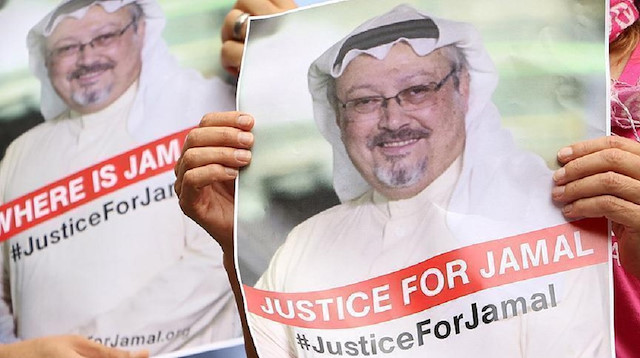
Saudi Journalist Jamal Khashoggi
The killing of Saudi journalist Jamal Khashoggi served as an obstacle to the economic endeavors of Crown Prince Mohammed bin Salman, the New York Times wrote.
The newspaper said the crisis over the murder of the journalist happened at a time when Saudi Arabia was already struggling financially, with low oil prices and difficulty lifting up its private sector in a country with an "increasingly youthful population".
“It is both a political and an economic crisis,” a scholar at the American Enterprise Institute, Karen Young, told the Times on Thursday. “The economic reform agenda is somewhat derailed. I don’t think it’s over, but this is a clear stall, mostly because it’s so dependent on foreign investment and this is the worst timing.”
Khashoggi, a Saudi national and columnist for The Washington Post, was last seen entering the his country's consulate in Istanbul on Oct. 2. After initially denying involvement, Saudi authorities admitted he had died in a fist-fight at the consulate.
The aftermath of the killing led to many prominent executives in business and finance, including U.S. Treasury Secretary Steven Mnuchin and billionaire Richard Branson, to pull out of the second annual Future Investment Initiative in Riyadh, an attempt by the crown prince to diversity the oil-based economy.
The fiancee of slain Saudi journalist Jamal Khashoggi, Hatice Cengiz, on Friday said that the journalist was "worried" before he entered the Consulate of Saudi Arabia on Oct. 2.She told Turkish broadcaster Habertürk that Khashoggi had mentioned there could be some issues with him going to the consulate.He assumed Saudi authorities would not interrogate or arrest him in Turkey, although he was concerned tensions would arise when he visited the consulate in Istanbul, added Cengiz.Merkel says no arms to Saudi Arabia until Khashoggi killing explainedShe said that she did not accept U.S. President Donald Trump's invitation to visit the White House because she thought it was aimed at influencing public opinion in his favour.She added that she would not go to the White House until the United States was sincere in its efforts to solve Khashoggi's killing, demanding that all those responsible be tried and punished.Khashoggi had said he was treated well during his first visit to the Saudi consulate in Istanbul on Sept. 28, his fiancee Cengiz said.Austria calls on EU to halt arms sales to Saudi ArabiaShe added that Khashoggi did not tell her to call anyone in case anything happened to him during his second visit on Oct. 2 but that he had previously told her to contact Yasin Aktay, an adviser of Turkish President Tayyip Erdoğan, if he faced any trouble in Turkey. Khashoggi was a U.S. resident who wrote columns for the Washington Post and a critic of the Saudi government, calling for reforms.Turkish officials suspect Saudi security agents killed Khashoggi, 59, inside the consulate and dismembered his body. Turkish sources say authorities have an audio recording purportedly documenting the murder.Saudi Arabia’s public prosecutor said on Thursday the killing of Khashoggi, a Washington Post columnist, was premeditated, reversing a previous official statement that it happened accidentally during a tussle in the consulate.Iran MP calls for ‘trying’ Riyadh over Khashoggi murderTurkey takes statements of 38 Saudi Consulate employeesTurkey only allowed to take water sample from well at Saudi consulateSaudi crown prince presides over committee to restructure intel agencyKhashoggi affair ‘won’t drive wedge’ between Saudi, Turkey
Khashoggi's fiancee says journalist was 'worried' before entering Saudi consulate
Austria has called on EU member states on Friday to stop arms exports to Saudi Arabia after the killing of journalist Jamal Khashoggi.Foreign Minister Karin Kneissl, whose country holds the EU’s rotating presidency, said the killing of Khashoggi at the Saudi Consulate in Istanbul was an “unprecedented breach of law”.She accused Saudi Arabia of practicing massive human rights violations at home, and their controversial policies in the Middle East region.“Especially the horrible war in Yemen and the Qatar crisis should be reason enough for European Union members to adopt a common stance towards Saudi Arabia,” Kneissl told Die Welt newspaper.Iran MP calls for ‘trying’ Riyadh over Khashoggi murder“If we all, the entire European Union, would stop arms deliveries to Saudi Arabia, this can contribute to ending these conflicts,” she added.Khashoggi, a columnist for the Washington Post, was last seen on Oct. 2 when he entered the Saudi Consulate in Istanbul.After weeks of denying involvement in his disappearance, Saudi Arabia on Saturday announced that he died in a fight inside the consulate.On Sunday, Saudi Foreign Minister Adel al-Jubeir admitted that Khashoggi had been killed inside the consulate, but insisted that Mohamed bin Salman -- Saudi Arabia’s high-profile crown prince -- had been unaware of a plot to murder the journalist.Turkish FM discusses Khashoggi case with Saudi counterpartNorway wealth fund plans to double Saudi investmentsCall by Khashoggi’s fiancée caused Saudi hit squad to panic, dump journo’s remains in well
Austria calls on EU to halt arms sales to Saudi Arabia
An Iranian member of parliament has called for “trying” Saudi Arabia in an international court for its alleged role in the Oct. 2 murder of journalist Jamal Khashoggi in Istanbul, according to the Iranian Students News Agency (ISNA).“Saudi Arabia has shown its true face with the killing of this journalist and political activist,” ISNA quoted Alaeddin Boroujerdi, a member of parliament’s foreign relations committee, as saying.Boroujerdi described Khashoggi’s death -- exact circumstances of which remain unknown -- as “a scandal of historic proportions”.The lawmaker went on to assert that the Saudi leadership should be tried before an international tribunal for its alleged role in the murder.Kremlin says no reason to doubt Saudi statements on Khashoggi murderCall by Khashoggi’s fiancée caused Saudi hit squad to panic, dump journo’s remains in wellA columnist for the Washington Post, Khashoggi was last seen on Oct. 2 when he entered the Saudi Consulate in Istanbul.After days of denying any knowledge of his whereabouts, Saudi officials last week admitted that Khashoggi had died inside the consulate building.In hopes of defusing the international furor over the journalist’s demise, Saudi King Salman sacked the deputy head of the Saudi intelligence agency (and a top aide), while also ordering the arrest of 18 individuals suspected of involvement in the case.On Sunday, Saudi Foreign Minister Adel al-Jubeir admitted that Khashoggi was killed inside the consulate, but insisted that Mohamed bin Salman -- Saudi Arabia’s high-profile crown prince -- had been unaware of it.Erdoğan asks Saudi Arabia to reveal whereabouts of Khashoggi's bodyWashington Post starts Khashoggi truth ad campaign
Iran MP calls for ‘trying’ Riyadh over Khashoggi murder
The conference ended on Thursday and "served as a litmus test of sorts for where the prince’s vast reform efforts stand."
The Saudi energy minister said deals worth around $56 billion were still made at the conference, many of them with U.S. companies.
Some world leaders still attended the conference as well, such as Pakistan's Imran Khan and Jordan's King Abdullah II. However, both came in relation to financial aid packages that the former was asking for, and the latter had already received.
The newspaper added that while Khashoggi's killing may have been a setback in Saudi's economic plans, overall it may not have an impact in the long term.
"Critics have long blasted Saudi Arabia over human rights issues with little effect on the kingdom’s oil industry or ability to buy arms from countries like the United States. And many business people won’t hesitate to work in authoritarian states if the price is right," the Times wrote.
Defence Secretary Jim Mattis will stress the U.S. commitment to Middle East security at the weekend, officials said, amid Western concern that any loosening of U.S. ties to Riyadh after Jamal Khashoggi's murder could allow Russia to fill the vacuum.Mattis will give a speech at the annual Manama Dialogue security conference in Bahrain on Saturday on the United States' policy in the Middle East which will be closely watched in capitals around the region.Katie Wheelbarger, the principal deputy assistant secretary of defense for international security affairs, said that Mattis' speech would emphasize that the United States was committed to help allies "re-instill stability in a chaotic region.""So continue to look to the United states as your security partner of choice because you can rely on us and depend on us to be there long term," Wheelbarger told reporters travelling with Mattis.Macron slams calls to halt arms sales to Saudi as populistThere is increasing concern that if Washington abandons the region, countries like Russia will fill the vacuum.Nowhere will the speech be watched more closely then in Riyadh, after Saudi Arabia's public prosecutor said the murder of journalist Jamal Khashoggi in the kingdom's Istanbul consulate this month was premeditated.The death of Khashoggi, a Washington Post columnist and critic of de facto Saudi ruler Crown Prince Mohammed bin Salman, has sparked global outrage and mushroomed into a crisis for the world's top oil exporter and strategic ally of the West.Merkel says no arms to Saudi Arabia until Khashoggi killing explainedRiyadh is expected to be watching how far, if at all, Mattis goes in censuring the kingdom in his speech.After Saudi King Salman spoke to Russian President Vladimir Putin on Thursday about the killing, the Kremlin said Russia had no reason to doubt the statements of the king and crown prince that the royal family was not involved.Dozens of Western officials, bankers, and executives shunned a big investment conference in Riyadh this week.Khashoggi's fiancee says journalist was 'worried' before entering Saudi consulateRussia sent the head of its Russian sovereign wealth fund RDIF, who said Saudi Arabia's Public Investment Fund would become a new partner in a joint Russia-China Investment Fund.Saudi Arabia is the lynchpin of a U.S.-backed regional bloc against Iran but the crisis has strained Riyadh's relations with the West.Experts believe that Washington will have to take some measures to make clear to Saudi Arabia that Khashoggi's killing is unacceptable."I think the key here is that if the administration wants to shift the focus back onto Iran the only way to do that is by taking some steps to respond to what the Saudis have done," Dennis Ross, who served as top Middle East adviser to President Barack Obama, said.Austria calls on EU to halt arms sales to Saudi ArabiaRoss said the increased global pressure on Riyadh may also present an opportunity for Washington to push the kingdom to end a 16-month-old dispute between Qatar and four Arab states that analysts say has weakened regional coordination against Iran.Saudi Arabia, the Emirates, Bahrain and Egypt cut off travel and trade ties with Qatar in June 2017, accusing it of backing their arch-rival, Iran, and supporting terrorism. Qatar denies the charges and says the boycott impinges on its sovereignty.The United States has tried, without success, to mediate in the dispute. It is an ally of the six-nation Gulf Cooperation Council, and Qatar is home to a major U.S. air base."This might not be a bad time for the administration to try to go back in and mediate that dispute, this might be a point where the Saudis will want to be more responsive to us," Ross said. 
Mattis to stress US-Mideast security ties amid Khashoggi strains
French President Emmanuel Macron on Friday dismissed as "demagoguery" the calls by several European countries including Germany to suspend arms sales to Saudi Arabia following the murder of journalist Jamal Khashoggi."What's the link between arms sales and Mr Khashoggi's murder? I understand the connection with what's happening in Yemen, but there is no link with Mister Khashoggi," Macron told a news conference in Slovakia."That's pure demagoguery to say 'we must stop arms sales'. It's got nothing to do with Mr Khashoggi," he added.Austrian Foreign Minister Karin Kneissl told a German newspaper the European Union should halt arms sales to Saudi Arabia following the killing of Khashoggi, saying it could also help end "the terrible war in Yemen".The comments from Austria, the current president of the EU, came after Germany said it would stop approving weapons exports to Saudi Arabia until Khashoggi's death at the Saudi consulate in Istanbul is cleared up. Merkel says no arms to Saudi Arabia until Khashoggi killing explainedAustria calls on EU to halt arms sales to Saudi Arabia
Macron slams calls to halt arms sales to Saudi as populist
German Chancellor Angela Merkel vowed again on Friday to halt all German arms exports to Saudi Arabia until the killing of journalist Jamal Khashoggi was explained."It is necessary to clarify the background of this horrible incident," she said in Prague during a news conference with Czech Prime Minister Andrej Babis. "And if that does not happen, we will not deliver any arms to Saudia Arabia."Khashoggi's fiancee says journalist was 'worried' before entering Saudi consulateIran MP calls for ‘trying’ Riyadh over Khashoggi murderTurkish FM discusses Khashoggi case with Saudi counterpartCall by Khashoggi’s fiancée caused Saudi hit squad to panic, dump journo’s remains in well
Merkel says no arms to Saudi Arabia until Khashoggi killing explained