

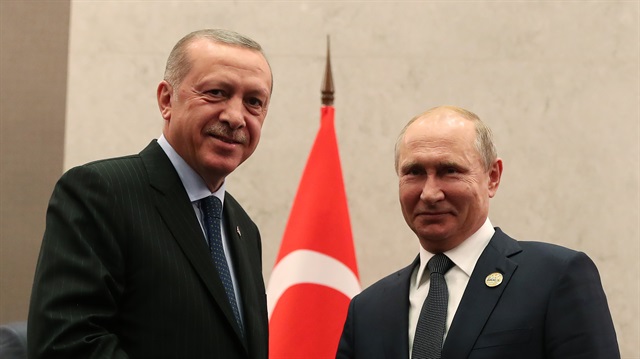
Recep Tayyip Erdoğan and Vladimir Putin
Turkish President Recep Tayyip Erdoğan and his Russian counterpart Vladimir Putin met on the sidelines of a Syria summit in the Iranian capital Tehran on Friday.
The meeting came before the trilateral summit between Erdoğan, Putin and Iranian President Hassan Rouhani at the Sadabad Palace.
The closed-door meeting between Erdoğan and Putin lasted for over 45 minutes.
Turkish President Recep Tayyip Erdoğan and his Iranian counterpart Hassan Rouhani met Friday ahead of a summit on Syria in the capital Tehran.The bilateral meeting came before the start of the trilateral summit between leaders of Turkey, Russia, and Iran.The closed-door meeting among Erdoğan and Rouhani at the Sadabad Palace lasted around 45 minutes.Galeri: Erdoğan meets Rouhani, Putin on sidelines of Syria summitErdoğan was accompanied by Turkish Foreign Minister Mevlut Cavusoglu, National Defense Minister Hulusi Akar, Treasury and Finance Minister Berat Albayrak, and Hakan Fidan, chief of the National Intelligence Organization (MIT) during the meeting.Before the meeting, Erdoğan said: "Today is a really important and meaningful day... We will hold an important meeting in Tehran following Sochi and Turkey."Rouhani said the three countries will hold a summit to solve regional issues.Assad regime, Russia shell Syria’s Idlib"This meeting is also an opportunity to discuss and confer issues between the two countries," he added.The first tripartite summit was held in Russia’s Black Sea resort of Sochi on Nov. 22 to discuss progress made in the Astana peace talks and changes in de-escalation zones across Syria.The second trilateral meeting was hosted by Erdoğan in April in the Turkish capital Ankara.Turkey’s Erdoğan arrives in Tehran for trilateral summitDuring the trilateral meeting, Erdoğan, Rouhani, and Russia's Vladimir Putin will discuss joint efforts as part of the Astana process and political efforts for finding a lasting solution to the Syrian conflict.Following the summit, the leaders will hold a joint news conference.‘Assad tries to sabotage Tehran summit with help of US’Top Turkish, Iranian diplomats meet in Tehran
Turkish, Iranian presidents meet in Tehran
Erdoğan was accompanied by Turkish Foreign Minister Mevlut Cavusoglu, National Defense Minister Hulusi Akar, Treasury and Finance Minister Berat Albayrak, Hakan Fidan, chief of the National Intelligence Organization (MIT), and presidential spokesman Ibrahim Kalin during the meeting.
Before having met with Putin, Erdoğan also had a separate closed-door meeting with Rouhani.
During a trilateral summit, the leaders will discuss joint efforts as part of the Astana process and political efforts for finding a lasting solution to the Syrian conflict.
Turkish President Recep Tayyip Erdoğan met separately with Iranian President Hassan Rouhani and Russian President Vladimir Putin on the sidelines of the of a Syria summit in the Iranian capital Tehran on Friday.Erdoğan meets Rouhani, Putin on sidelines of Syria summit

Show All
The first tripartite summit was held in Russia’s Black Sea resort of Sochi on Nov. 22 to discuss progress made in the Astana peace talks and changes in de-escalation zones across Syria.
The second trilateral meeting was hosted by Erdoğan in April in the Turkish capital Ankara.
Turkish aid officials have warned of a fresh wave of mass migration in case of any possible offensive in Syria’s Idlib.“Migration would increase dramatically […],” Turkish Red Crescent head Kerem Kınık said.“We took our measures; to buffer this possible migration wave in Syria, to meet human needs, health, protection and housing needs," he added."We even don’t want to think about here (Idlib). There is no place for this migration wave if there are massacres and civilian movements like the ones happened in Eastern Ghouta, Aleppo, Daraa and Hama," Kinik added."Idlib is now the largest province in Syria. It had 150,000 population in 2011 but now it holds 3.5 million people. We hope there is no attack on civilians,” he said.Idlib offensive could trigger new wave of migration to Europe, TurkeyUN aid chief fears worst humanitarian crisis in IdlibKınık, who is also the vice president responsible for the European region of the International Federation of Red Cross and Red Crescent Societies (IFRC), said: “No matter who they are, we are standing with the oppressed people and no matter who the oppressors are we are standing against them.”Meanwhile, a board member of the Humanitarian Relief Foundation (IHH), an Istanbul-based aid agency, also warned of high casualties in case of an attack on Idlib.“In case of a possible attack on Idlib, the number of people to be killed due to the density of people will be much higher than before,” Izzet Sahin told Anadolu Agency."If this worst scenario happens those people who are dependent on humanitarian assistance from Turkey for their daily life will no longer be able to get help. They could face death and hunger. There will be a huge and dramatic migration movement,” he added.Video: Brush, cut and braid: Turkey gives hair makeover to over 500 Syrian orphans
Turkish aid officials fear mass migration from Idlib
The Syrian regime and Russia on Friday shelled parts of the Idlib region in northwest Syria, the country's last major opposition stronghold.According to preliminary reports, two Assad regime warplanes and three Russian jets conducted airstrikes in Idlib’s Kafr, Zeyte, Hobait and Abdin regions.At least 10 civilians were killed and 20 wounded in the west and south-west of Idlib during the last three days by Russian warplanes. Russian, Turkish and Iranian leaders met on Friday in Iran’s Tehran and to discuss the situation in northwestern Syria.Turkish President Recep Tayyip Erdoğan called for a joint stance over Syria’s territorial integrity and unity, and said that he believes the results of trilateral summit in Tehran will contribute to peace in Syria.Erdoğan says Idlib assault would be ‘a grave massacre’Turkey’s Erdoğan arrives in Tehran for trilateral summit‘Assad tries to sabotage Tehran summit with help of US’
Assad regime, Russia shell Syria’s Idlib
Yasser Farhan, a member of the political committee of the National Coalition for Syrian Revolutionary and Opposition Forces who was also present at the Astana talks, told Yeni Şafak daily in an exclusive interview that the Assad regime was trying to sabotage the Tehran summit with the help of the United States.“Secret meetings between the U.S. and the Assad regime can be summarized as negotiations to guarantee the PKK’s pirate structure. The regime wants to sabotage the Idlib process with the help of the U.S. The attacks that started before the Sept. 7 summit were a clear provocation. Assad’s aim is to forge the new constitution without including the opposition in the process. This is why he is trying to end our presence on the field. Our requests have been clear since the first Astana talks. These are: de-escalation zones, stability, the release of captives, a new constitution and a free election,” Farhan said.The Syrian regime has recently announced plans to launch a major military offensive in Idlib, which is controlled by various armed opposition groups.The leaders of Russia, Turkey and Iran are due to meet on Friday in Iran and are expected to discuss the situation in northwestern Syria. Turkey, which backs the opposition against Assad, has said an offensive on Idlib would be disastrous. Ankara is sheltering 3.5 million Syrian refugees.Turkish president heads to Iran for trilateral summitAssad constantly violates international laws“We presented a list of 65,000 arrested people to the regime. A decision was reached to release these people in stages, however, one year later, not one captive was freed. We also know that in the span of the seven-year war, 450,000 people were unofficially arrested and a great number of them were killed by torture. An international committee was formed and decisions were made. However, Assad continues to disregard all international laws,” he added.U.S. and allies only offer conditional protectionWhile the United States and its allies have warned of a bloodbath in Idlib, they have made clear they would only intervene should they deem that chemical weapons have been used.“The U.S. and its allies have stated that they will strike Syria if the regime uses chemical weapons in Syria. So will these massacres be legitimate if chemical weapons aren’t used?” Farhan said.Children of Idlib roam streets with makeshift gas maskIn preparation for a chemical attack, the children of Idlib have started to make improvised gas masks. They poked holes in the bottom of paper cups stuck to the bottom of plastic bags. Some of the children also help their fathers during practice drills. They spend their time in makeshift shelters in underground caves in order to protect themselves from air raids by Russia and the Syrian regime.U.S. prioritizes the PKK and Israel“The U.S.’s unofficial priorities is for the PKK to gain legitimacy in Syria, the reduction of Iranian presence in Syria to protect Israel, and the weakening of the regime’s air and land forces. Idlib is just an excuse. The regime and U.S. officials held two meetings in Damascus and Aleppo. The main item on the agenda of these meetings was to provide the PKK constitutional protection. MP and Intelligence Chief Ali Memlük met with a U.S. delegation in Damascus on behalf of Assad. Regime undersecretaries met with the Americans in Aleppo,” Farhan said.U.S. delivered Golan Heights to IsraelThe U.S. ambassador to Israel said in remarks published on Thursday that he expected Israel to keep the Golan Heights in perpetuity, in an apparent nod towards its claim of sovereignty over the strategic plateau captured from Syria in a 1967 war.Foreign governments, including the United States, do not recognize Israel's claim and President Donald Trump's national security adviser has said Washington's policy is unchanged.However, U.S. Ambassador David Friedman suggested that Israel was there to stay and said it was possible the United States would consider recognizing Israeli sovereignty over the Golan Heights in the future.US envoy sees Israel keeping Golan Heights forever"I personally cannot imagine a situation in which the Golan Heights will be returned to Syria. I frankly cannot imagine a situation in which the Golan Heights is not part of Israel forever," he told the right-wing Israel Hayom newspaper.Friedman said there was "no one more undeserving of this prize" - control of the Golan Heights - than Syrian President Bashar al-Assad.The Golan Heights form a buffer between Israel and Syria of about 1,200 square kilometers (460 square miles). Israel captured most of it from Syria in the 1967 Middle East war. Israel annexed the territory in 1981, a move not recognized internationally.Top Turkish, Iranian diplomats meet in TehranWhite Helmets: Syria's savior angelsSyria's Idlib residents concerned about new attacksChemical weapons 'being prepared' in Syria: US envoy
‘Assad tries to sabotage Tehran summit with help of US’