

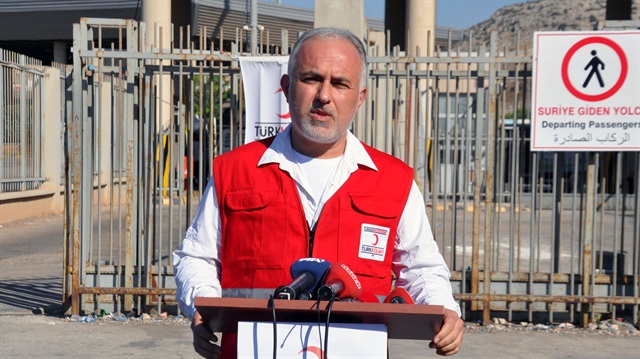
Turkish Red Crescent head Kerem Kınık
Turkish aid officials have warned of a fresh wave of mass migration in case of any possible offensive in Syria’s Idlib.
“Migration would increase dramatically […],” Turkish Red Crescent head Kerem Kınık said.
“We took our measures; to buffer this possible migration wave in Syria, to meet human needs, health, protection and housing needs," he added.
"We even don’t want to think about here (Idlib). There is no place for this migration wave if there are massacres and civilian movements like the ones happened in Eastern Ghouta, Aleppo, Daraa and Hama," Kinik added.
"Idlib is now the largest province in Syria. It had 150,000 population in 2011 but now it holds 3.5 million people. We hope there is no attack on civilians,” he said.
As the Assad regime and Russia shell the last opposition-held stronghold of Syria’s Idlib, humanitarian agencies are worried about internally displaced citizens and refugees flocking to Turkey and Europe.Speaking to Yeni Şafak daily, head of the Turkish Red Crescent Kerem Kınık emphasized that if a battle breaks out in Syria’s opposition-held Idlib, hundreds of thousands of civilians would flee to Turkey and Europe, which would spell the start of a “new immigration wave.”On Tuesday, Russian warplanes bombed several areas in the last opposition-held stronghold of Idlib, raising worries of a major assault by the Assad regime forces and its allies.Stressing the importance of the international community’s need to gain the trust of Syrian civilians, he said: “The immigration issue is not a threat to Turkey alone, it can turn into an immigration wave toward Europe. This issue must be resolved at the [diplomacy] table. However, we have taken every precaution both in Turkey and Syria.”The Turkish Red Crescent has been providing humanitarian aid to Syrians since March 15, 2011.'White Helmets saved 115,000 lives in Syria' Migration issue must be solved by diplomacyStating that seven million civilians were internally displaced in Syria, “2.5 million of these people are in Idlib. A wave of fear could mobilize them. We witnessed this in Ghouta. It is impossible to govern this many people. This problem must be solved at the table.” “Civilians in Idlib trust Turkey, not Russia or Iran,” he concluded.Idlib, located in northwestern Syria on the Turkish border, has faced intense attacks by the Bashar al-Assad regime after a vicious civil war broke out in 2011. Since March 2015, Idlib is no longer under the control of the Assad regime and has been overrun by opposition groups.New refugee camps to be establishedThe Turkish Red Crescent is continuing to take measures against a possible new migration wave from Syria’s Idlib and to manage the process efficiently they will implement the “help on the ground” strategy.“We will increase the capacity of the designated refugee camps in the event of a new migration wave in the areas within the scope of the Euphrates Shield and Olive Branch operations. We will establish new camps if needed,” Kınık said.He added that the organization has been supporting Syrians accommodated in 40 separate camps with 30,000 tents.“We continue to dispatch tents and provide humanitarian relief. Mobile health vehicles will be added to our regular services in the near future. These healthcare vehicles will be used in the case of a possible emergency. Aid for the disabled, orphans, elders and widows will be increased. We will reach our goal by helping as many people as possible, Kınık said.Syria has been locked in a vicious civil war since early 2011 when the Assad regime cracked down on pro-democracy protests with unexpected ferocity.Since then, hundreds of thousands of people have been killed and more than 10 million others were displaced, according to UN officials.Assad regime shells Syria's IdlibRussia says in contact with Turkey regarding northern SyriaSyrian opposition head calls on world to ‘stop the massacre’ in Idlib
Idlib offensive could trigger new wave of migration to Europe, Turkey
A large-scale Syrian regime offensive in the opposition stronghold of Idlib could lead to the “worst humanitarian catastrophe in the 21st century”, the UN’s humanitarian chief warned on Tuesday.Mark Lowcock, under-secretary-general for Humanitarian Affairs and Emergency Relief Coordinator, has expressed alarm over the military preparations of the Bashar al-Assad regime, after his talks in Damascus last week.Galeri: Civilians killed in Russian airstrikes against Syria’s Idlib“This has the potential to be the worst humanitarian catastrophe in the world in the 21st century,” he told Anadolu Agency, and called for diplomatic efforts to avoid it.Lowcock underlined that around 4 million people living in and around Idlib, among them more than one million children, were in an extremely vulnerable situation.“Many of them have been displaced multiple times. Many of them are living under tents, they have no shelter, they are extremely vulnerable,” he stressed.Located near the Turkish border, Idlib has long been controlled by various armed opposition groups. It was designated as a “de-escalation zone” during the Astana peace talks.Lowcock recalled that in the past years, many fighters from Aleppo and Eastern Ghouta were relocated to Idlib, as part of agreements.“The Eastern Ghouta and the Aleppo situations were ultimately resolved by fighters and their families and others being relocated …and they were relocated in Idlib. But now there is nowhere else to be to go,” he said.“For the sake of those millions and millions of people, and a million children in Idlib, there needs to be a solution which does not involve enormous massacres, and there needs to be a dialogue, just as there was in the south of Syria, over the last few weeks,” he added.Lowcock called for diplomatic efforts involving regional actors to avoid a great, bloody battle for Idlib.On Tuesday, Russian warplanes bombed several areas in Idlib, raising worries of a major assault by the Assad regime forces and its allies.A trilateral summit of Turkey, Russia and Iran on Syria is scheduled for Friday, with the participation of Turkish President Recep Tayyip Erdogan, Russian President Vladimir Putin and Iranian President Hassan Rouhani.
UN aid chief fears worst humanitarian crisis in Idlib
Kınık, who is also the vice president responsible for the European region of the International Federation of Red Cross and Red Crescent Societies (IFRC), said: “No matter who they are, we are standing with the oppressed people and no matter who the oppressors are we are standing against them.”
Meanwhile, a board member of the Humanitarian Relief Foundation (IHH), an Istanbul-based aid agency, also warned of high casualties in case of an attack on Idlib.
“In case of a possible attack on Idlib, the number of people to be killed due to the density of people will be much higher than before,” Izzet Sahin told Anadolu Agency.
"If this worst scenario happens those people who are dependent on humanitarian assistance from Turkey for their daily life will no longer be able to get help. They could face death and hunger. There will be a huge and dramatic migration movement,” he added.
The Turkish IHH Humanitarian Relief Foundation, in collaboration with Human Movie Team and For Children carried out a project dubbed “Braids for the hair and the heart,” which provides hair care to Syrian girls in the refugee camps of Azaz, Syria.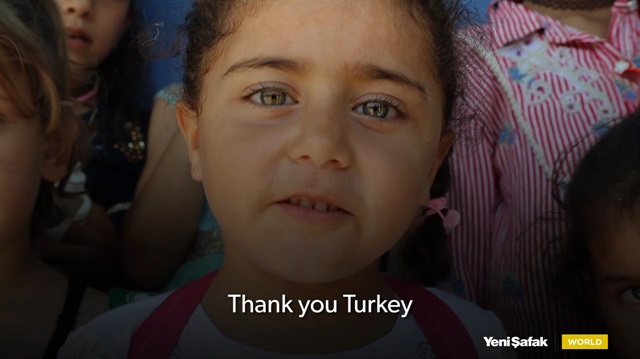
Brush, cut and braid: Turkey gives hair makeover to over 500 Syrian orphans