

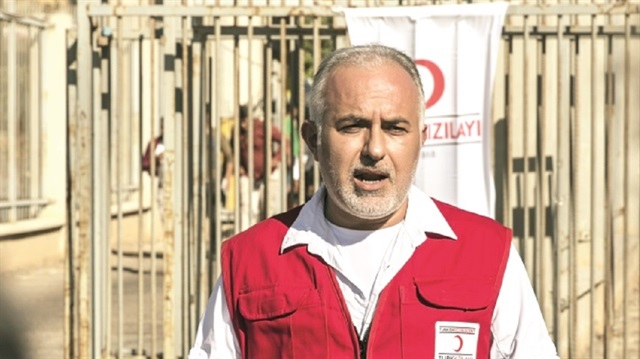
Head of the Turkish Red Crescent Kerem Kınık
As the Assad regime and Russia shell the last opposition-held stronghold of Syria’s Idlib, humanitarian agencies are worried about internally displaced citizens and refugees flocking to Turkey and Europe.
Speaking to Yeni Şafak daily, head of the Turkish Red Crescent Kerem Kınık emphasized that if a battle breaks out in Syria’s opposition-held Idlib, hundreds of thousands of civilians would flee to Turkey and Europe, which would spell the start of a “new immigration wave.”
On Tuesday, Russian warplanes bombed several areas in the last opposition-held stronghold of Idlib, raising worries of a major assault by the Assad regime forces and its allies.
Stressing the importance of the international community’s need to gain the trust of Syrian civilians, he said: “The immigration issue is not a threat to Turkey alone, it can turn into an immigration wave toward Europe. This issue must be resolved at the [diplomacy] table. However, we have taken every precaution both in Turkey and Syria.”
The Turkish Red Crescent has been providing humanitarian aid to Syrians since March 15, 2011.
The Syrian Civil Defense, also known as the White Helmets, remains committed to providing humanitarian relief in Syria since the country has been locked in a vicious civil war from the beginning of 2011 when the Assad regime cracked down on pro-democracy protests with unexpected ferocity.Speaking to Yeni Şafak daily, head of the Syrian White Helmets Raed Saleh underlined that they are not a part of the fight between U.S. and Russia, and that their only goal is to save innocent lives.“We have a single aim: to help as many innocent people as possible after the bombardments that target civilians. In addition, we support the reconstruction process of parks, roads, bridges, water-treatment plants and orphanages,” he said. “We have saved 115,000 lives in Syria in seven years,” Saleh added.Regime forces set ground for a major massacre in Idlib “The forces that shelled mosques, schools, bazaars, hospitals and thousands of civilian houses since 2011 are in preparation for the last and biggest bloodbath in Idlib. We were the ones who reported all the violations of the Assad regime and its allies, notably chemical weapons, to independent international organizations. Attacks against us stem from the fact that we have provided evidence of their massacres,” Saleh said. Idlib, located in northwestern Syria on the Turkish border, has faced intense attacks by the Bashar al-Assad regime after a vicious civil war broke out in 2011. Since March 2015, Idlib is no longer under the control of the Assad regime and has been overrun by opposition groups.The Assad regime is currently preparing for an offensive against the last opposition-held stronghold of Syria’s Idlib.Over 250 aid volunteers martyred in Syria “65,000 people are currently ready for duty as an emergency volunteers at the areas we remain in. Two hundred and twenty-seven of them are women. We have lost 225 martyrs in this war and 700 of our volunteers were wounded. Organizations such as Doctors Without Borders, the Turkish Disaster and Emergency Management Authority (AFAD) supported us the most. The biggest support we received was, without a doubt, from Syrian civilians.”Regime forces target our headquarters “Assad forces are in preparations to attack our headquarters in Idlib, Lattakia, Homs and Aleppo. They want to repeat the massacres in Khan Sheikhoun and Eastern Ghouta. Turkey is the most powerful country in the Syrian issue, and in the upcoming process, the prominent role of Turkey will be grasped better. We follow the efforts of Turkish President Recep Tayyip Erdoğan and the Turkish government that are conducted in the region to prevent fresh massacres. At least 100 people were killed and hundreds of others injured in the chemical attack in April 2017 in Khan Sheikhoun in western Idlib province. The United Nations called on Russia, Iran and Turkey to forestall a battle in Idlib which would affect millions of civilians and could see the government potentially using chlorine as a chemical weapon.
'White Helmets saved 115,000 lives in Syria'
Migration issue must be solved by diplomacy
Stating that seven million civilians were internally displaced in Syria, “2.5 million of these people are in Idlib. A wave of fear could mobilize them. We witnessed this in Ghouta. It is impossible to govern this many people. This problem must be solved at the table.”
“Civilians in Idlib trust Turkey, not Russia or Iran,” he concluded.
Idlib, located in northwestern Syria on the Turkish border, has faced intense attacks by the Bashar al-Assad regime after a vicious civil war broke out in 2011. Since March 2015, Idlib is no longer under the control of the Assad regime and has been overrun by opposition groups.
New refugee camps to be established
The Turkish Red Crescent is continuing to take measures against a possible new migration wave from Syria’s Idlib and to manage the process efficiently they will implement the “help on the ground” strategy.
“We will increase the capacity of the designated refugee camps in the event of a new migration wave in the areas within the scope of the Euphrates Shield and Olive Branch operations. We will establish new camps if needed,” Kınık said.
He added that the organization has been supporting Syrians accommodated in 40 separate camps with 30,000 tents.
“We continue to dispatch tents and provide humanitarian relief. Mobile health vehicles will be added to our regular services in the near future. These healthcare vehicles will be used in the case of a possible emergency. Aid for the disabled, orphans, elders and widows will be increased. We will reach our goal by helping as many people as possible, Kınık said.
Syria has been locked in a vicious civil war since early 2011 when the Assad regime cracked down on pro-democracy protests with unexpected ferocity.
Since then, hundreds of thousands of people have been killed and more than 10 million others were displaced, according to UN officials.
The Assad regime shelled Syria's northwestern Idlib province on Wednesday after Russia resumed air strikes the previous day.Syrian President Bashar al-Assad has sworn to recapture every inch of Syria and has made big gains against the opposition since Russia joined his war effort in 2015.Last week, a source close to Damascus said the government was preparing a phased offensive to recover Idlib province, but Turkey, whose army has a string of observation posts around the edge of the opposition area, has warned against such an assault.Russian air raids ceased in and around Idlib on August 15, but pro-Syrian government forces have maintained an aerial bombardment and shelling.Russia says in contact with Turkey regarding northern SyriaUN envoy urges Erdoğan, Putin to discuss IdlibUN aid chief fears worst humanitarian crisis in Idlib
Assad regime shells Syria's Idlib
Russia’s ambassador to Turkey’s Ankara Aleksey Yerhov on Wednesday said that the two countries were in communication regarding the developments in northern Syria.“We are in contact with Turkey regarding the situation in northern Syria,” Yerhov said, adding that the Syria summit to be held in Iran’s Tehran on Sept. 7 was an opportunity to reach a solution for the war-torn country.The summit held in Tehran will be attended by the leaders of Iran, Russia and Turkey. Idlib, which is the last major opposition-stronghold, will be on the agenda.UN envoy urges Erdoğan, Putin to discuss IdlibOn Tuesday, Russian warplanes bombed several areas in Idlib, raising worries of a major assault by the Assad regime forces and its allies.Located near the Turkish border, Idlib is home to more than 3 million Syrians, many of whom fled from other cities following attacks by regime forces.In May, Idlib was designated a “de-escalation zone” -- in which acts of aggression are expressly forbidden -- as part of ongoing peace talks in the Kazakh capital of Astana.UN aid chief fears worst humanitarian crisis in IdlibUS Turkish embassy voices concern over Idlib offensive
Russia says in contact with Turkey regarding northern Syria
Syrian opposition head Jawad Abu Hatab has called on Turkey and the international community to stop the massacre in Idlib after Russian bombardment struck 18 targets in the northwestern opposition stronghold. Speaking exclusively to Yeni Şafak daily, the prime minister of Syria’s Interim Government described the Russian attack that precedes a planned summit in Tehran on Sept. 7 as “surprising,” noting that over 30 missiles struck the Idlib town of Jisr al-Shughour, then Hama’s Sahl al-Ghab region.A trilateral summit of Turkey, Russia and Iran on Syria is scheduled for Friday, with the participation of Turkish President Recep Tayyip Erdoğan, Russian President Vladimir Putin and Iranian President Hassan Rouhani.Assad regime shells Syria's IdlibOn Tuesday, Russian warplanes bombed several areas in the last opposition-held stronghold of Idlib, raising worries of a major assault by the Assad regime forces and its allies.Located near the Turkish border, Idlib is home to more than 3 million Syrians, many of whom fled from other cities following attacks by regime forces.“A serious ground mobilization can be seen on the regime front, but any ground bombing or advance has not started yet,” noted Abu Hatab.UN aid chief fears worst humanitarian crisis in IdlibUS Turkish embassy voices concern over Idlib offensiveAbu Hatab pointed that the Assad regime grew emboldened by international indifference toward Syria, pointing that the aim of pro-Assad forces is to control the opposition-held towns of Ariha, Khan Sheikhun, Saraqib, Jisr al-Shughour, Qalaat al-Madiq and the M4- M5 highway. In May 2017, Idlib was designated a “de-escalation zone” -- in which acts of aggression are expressly forbidden -- as part of ongoing peace talks in the Kazakh capital of Astana.Ghost townsAbu Hatab also warned that the northwestern opposition-held regions would turn into “ghost towns” if the regime manages to seize control over them, which would successfully secure the western leg of Assad’s project after the PKK-U.S. alliance largely completed the same mission in the eastern parts of the country.A large-scale Syrian regime offensive in the opposition stronghold of Idlib could lead to the “worst humanitarian catastrophe in the 21st century,” the UN’s humanitarian chief warned on Tuesday.Erdoğan says Idlib assault would be ‘a grave massacre’Russia says in contact with Turkey regarding northern Syria
Syrian opposition head calls on world to ‘stop the massacre’ in Idlib