

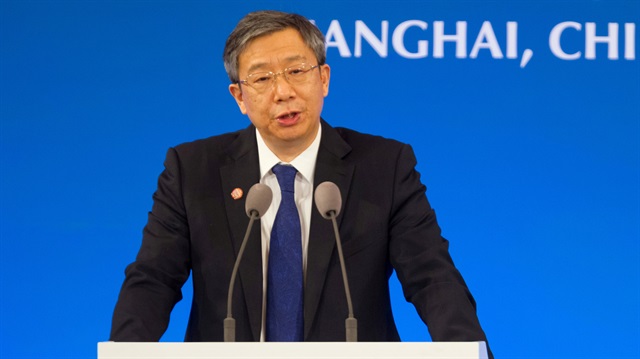
People's Bank of China (PBOC) Governor Yi Gang
China's central bank governor Yi Gang said the government would continue to let the market play a decisive role in establishing its currency exchange rate, refraining from using it as a weapon, amid an escalating trade war with the United States.
"We will not engage in competitive devaluation, and will not use the exchange rate as a tool to deal with trade frictions," Yi said in an International Monetary and Financial Committee (IMFC) statement posted on Saturday during the IMF and World Bank annual meetings in Indonesia's resort island of Bali.
Yi said the government would keep the exchange rate "broadly stable", and China's monetary policy would remain neutral with more focus on guiding expectations.
U.S. Treasury Secretary Steven Mnuchin said Chinese officials had told him that further yuan depreciation was not in China's interest.
China's top central banker on Saturday pledged to keep the yuan currency's value "broadly stable," a sign that Beijing may be trying to prevent a bruising trade dispute with the United States from spilling over into a currency war.People's Bank of China Governor Yi Gang's statement at the International Monetary Fund and World Bank annual meetings in Bali came as U.S. Treasury Secretary Steven Mnuchin said Chinese officials had told him that further yuan depreciation was not in China's interest.Mnuchin has reiterated his concerns that a major drop in the yuan's value this year against the dollar could be part of an effort to gain a trade advantage for Chinese exports or to offset the impact of U.S. tariffs.The yuan has fallen more than 8 percent against the dollar since the end of April to about 6.91 on Friday, close to the psychologically important 7.0 level not seen in a decade."China will continue to let the market play a decisive role in the formation of the RMB exchange rate," Yi said in an International Monetary and Financial Committee (IMFC) statement posted on Saturday. "We will not engage in competitive devaluation, and will not use the exchange rate as a tool to deal with trade frictions."His statement echoes currency pledges made in a communique issued by the IMF's member countries on Saturday to step up their trade dialogue as rising tariff frictions, and higher borrowing costs threaten to knock global growth.In the statement from the IMF's steering committee, the member countries also agreed to debate ways to improve the World Trade Organization so it can better address trade disputes."We acknowledge that free, fair, and mutually beneficial goods and services trade and investment are key engines for growth and job creation," the IMFC said in the statement."We will refrain from competitive devaluations and will not target our exchange rates for competitive purposes," it added.IMF chief says China faces balancing act as it seeks to maintain growthChina exerting 'unprecedented' influence campaign in USRate Hike WorriesOn Thursday, IMF Managing Director Christine Lagarde warned countries against engaging in currency and trade wars, which would hurt global growth as well as "innocent bystander" nations, including emerging markets that supply commoditiesSome of these countries, including Indonesia, the host of the IMF and World Bank meetings, are already struggling to contain capital outflows prompted by higher U.S. interests rates.Fears that rates could spike sharply higher - and the international trade tensions - touched off a searing sell-off in global stock markets over the past week.European Central Bank Governor Mario Draghi warned on Saturday that a "snap back" in rates and a sharp repricing of asset prices were the biggest risks to the economic outlook.Blaming the Sino-U.S. trade dispute, the IMF this week cut global growth forecasts for 2018 and 2019."The recovery is increasingly uneven, and some previously identified risks have partially materialised," the IMFC communique said, referring to threatened tariffs and outflow pressures.The United States and China have slapped tit-for-tat tariffs on hundreds of billions of dollars of each other's goods over the past few months, sparked by U.S. President Donald Trump's demands for sweeping changes to China's intellectual property, industrial subsidy and trade policies.Trump has frequently accused China of cheapening its currency to gain a trade advantage, claims Beijing has consistently rejected. The U.S. Treasury is due to release a key report on currency manipulation next week.Despite reassurances from China's central bank on currency policy, some analysts say yuan weakness will persist, as there is no clear path towards resolving the U.S.-China trade dispute and higher tariff rates loom in January."Clients in China remain unwilling to call a bottom in the yuan," NatWest Markets head of foreign exchange strategy Mansoor Mohi-uddin said in a research note. "This in turn makes us cautious about calling for a peak in the dollar globally."Further Federal Reserve rate hikes are expected to underpin the dollar's strength and increase capital outflow pressures on emerging market economiesBut Bank of Japan Governor Haruhiko Kuroda said the Fed's rate hikes were "basically good" for the world economy, though he was more cautious about escalating trade tensions due to their "rather unusual" scale.China opposes Malaysia's release of 11 Uighur MuslimsJapan's Abe pursues China thaw as US-Beijing ties in deep freezeUS STOCKS-Futures dip ahead of producer price data
China echoes IMF pledges to avoid using currency as trade war tool
Mnuchin has reiterated his concerns that a major drop in the yuan's value this year against the dollar could be part of an effort to gain a trade advantage for Chinese exports or to offset the impact of U.S. tariffs.
In a separate interview with domestic media published on Saturday, Yi said the central bank did not follow a rate hike by the Fed in September with one of its, as he felt China's market-based rate levels were appropriate and the yuan remained steady judging by its performance.
He said decision to stay put was not an easy one, but the benefits of a non-move still trumped the potential setbacks.
"We still insist on prioritising domestic economic conditions when it comes to deciding on monetary policies," he was quoted as saying by Chinese financial magazine Caixin.
As Hong Kong's government hews closer to Beijing, officials are taking a tough line on perceived national security threats, even deploying an elite police unit for political monitoring and surveillance - a sharp escalation in rhetoric and action.In just the last few months, the special administrative region has banned the Hong Kong National Party, which espouses separation from China, and barred some activists from standing in local elections.The Education Bureau sent all secondary schools in the Special Administrative Region letters on Sept 24 saying they must prohibit "the penetration" of the National Party or risk prosecution.And this month, Hong Kong refused to renew the work visa of Victor Mallet, Asia news editor for the British-based Financial Times newspaper, after he hosted a speech by an independence activist."We can see them (the government) being much more assertive in using these powers and in shaping their policy decisions to reflect the national interests," said Professor Simon Young of the University of Hong Kong's law school, saying the courts may be a last line of defence against government overreach.Serving and retired police officers, lawyers and lawmakers describe intensifying political operations by the police force's Security Wing, an elite unit that officially handles sensitive tasks including VIP protection and counter-terrorism investigations.Sources familiar with the wing's work say it led surveillance and monitoring operations against the National Party and more than a dozen other groups.The Hong Kong Journalists Association recently described the prospect of tougher national security enforcement as "a sword dangled above the heads" of reporters.The Financial Times said it was appealing the decision denying Mallet a work visa. In his role as first vice president of the Foreign Correspondents' Club of Hong Kong, Mallet in August hosted Andy Chan, head of the National Party.The party was banned last month as an "imminent threat to national security" as the government invoked little-known clauses of a law regulating private groups and societies.Authorities have so far refused to explain their decision on Mallet, except to say that no independence advocacy will be tolerated.Chan, a bespectacled 28-year-old interior decorator, says that his ideology springs from China's broken promises towards Hong Kong and that claims he might destabilise China are preposterous.But Hong Kong's government is treating even the consideration of independence as a vital threat."Worryingly, they have been parroting the ideological and authoritarian line of Beijing ... irreparably undermining their reputation," one diplomat said of the city's government.In the letter to schools last month, the Education Bureau said, "should students have erroneous and extreme thoughts, principals and teachers should correct them with facts." Some teachers described this to Reuters as a "gagging order."That appears to run contrary to Hong Kong's mini-constitution, known as the Basic Law, which stresses freedoms of speech and assembly.Some youths who drove the pro-democracy "Umbrella Revolution" street demonstrations in 2014 say there is a growing sense of despair at the pressure on civil society and individual rights.Daniel Cheung, a 29-year-old photographer who worked on "Chronicle of a Summer," a documentary on activists such as jailed independence leader Edward Leung, said the situation was worsening fast."Put simply, if you see Hong Kong as a house built by the British, this house is now crumbling and leaking. It has been hit by a typhoon and close to toppling over," Cheung said.Back To The FutureThe Basic Law requires the city to create laws against treason, secession and subversion of the national government, effectively updating those from the colonial era.The laws from British rule, while broad, do not outlaw calls for independence or self-determination.Previous attempts to draft a harsher new national security law, known as Article 23, were met with mass protests and abandoned. Chief Executive Carrie Lam, who took office last year, has not yet proposed a new version, a reflection in part of lingering public concern.But many observers say the government is using the Security Wing to tighten its grip even without Article 23.The wing's officers were deeply involved in producing the 700-page dossier the government used to justify banning the National Party. The document tracked its statements, public appearances and activities.For some, that has echoes of the colonial-era Special Branch, which monitored potentially subversive Chinese and Russian communist activity across Hong Kong during the Cold War. The agency was disbanded in 1995, two years before Britain handed Hong Kong back to China."It is clear it (Security Wing) is doing much more political work now," said James To, a veteran democracy advocate who has spent much of his 27 years in the city's parliament scrutinizing the government's security policies."My worry is that when you monitor people's political life and thoughts you are going against the spirit of the human rights provisions of the Basic Law. There is a need for balance," To said.To said the government had repeatedly refused requests by Hong Kong's legislators to discuss the Security Wing's operations in detail.Headed by an assistant commissioner, the Wing has over 700 staff, according to government information provided to lawmakers in recent years, some of whom have close ties with mainland Chinese counterparts as well as foreign diplomats based in Hong Kong.One former senior officer familiar with the branch's work said he was witnessing a sea change in the government's previously hands-off approach."It is back to the future," he said. "It is eerie to see them embark on the same kind of monitoring and control operations that we used to do with an entirely new generation."Police declined to comment on whether other activists or groups, including those calling for greater autonomy in the longer term such as Joshua Wong, were being targeted, saying the department wouldn't "disclose details of operations and investigations."Some observers see an expanding clampdown as inevitable given the political climate."They (the police) are clear what China's thinking is on this issue," said a senior police source, who declined to be named given the sensitivity of the issue.Rising sea levels, storm surges pose risks for Hong Kong's artificial island projectRising sea levels, storm surges pose risks for Hong Kong's artificial island project
Heeding China's call, Hong Kong tightens grip on dissent
The International Monetary Fund said on Saturday its members pledged to refrain from competitive currency devaluations and step up dialogue on trade, as escalating trade frictions and higher borrowing costs threatened to knock global growth.The agreement came as U.S. Treasury Secretary Steve Mnuchin reiterated his concern over the yuan's weakening against the dollar - a drop that Washington suspects may be aimed at giving Chinese exports a trade advantage and offsetting U.S. tariffs.In a communique issued by the IMF's steering committee, the member countries also agreed to debate ways to improve the World Trade Organization so it can better address trade disputes."We acknowledge that free, fair, and mutually beneficial goods and services trade and investment are key engines for growth and job creation," the International Monetary and Financial Committee (IMFC) said in the statement."We will refrain from competitive devaluations and will not target our exchange rates for competitive purposes," it added.IMF to launch financial assistance talks with Pakistan: LagardeIMF chief says China faces balancing act as it seeks to maintain growthFears that escalating global trade tensions and rising U.S. interest rates could dent growth have roiled global markets in recent days and prompted warnings of heightened risks by finance leaders gathering for the IMF and World Bank annual meetings in the Indonesian resort island of Bali."The recovery is increasingly uneven, and some previously identified risks have partially materialised," the communique said, referring to threatened tariffs.The United States and China have slapped tit-for-tat tariffs on hundreds of billions of dollars of each other's goods over the past few months, sparked by U.S. President Donald Trump's demands for sweeping changes to China's intellectual property, industrial subsidy and trade policies.The bilateral tensions have flared over to currencies with the United States voicing concern about a weakening of the yuan to close to 7 to the dollar in recent months, a level not seen in a decade.Trump has frequently accused China of cheapening its currency to gain a trade advantage, claims Beijing has consistently rejected.Mnuchin on Saturday said Chinese officials told him at the Bali meetings this week that a further depreciation of China's yuan currency was not in the country's interests."And as I've said, the currency issue is an important issue for us in trade and will be part of our trade discussions," he told a news conference. "We want to make sure that depreciation is not being used for competitive purposes in trade."The comments come after Mnuchin expressed concern about the yuan slide, as the Treasury prepares to release a much-anticipated report next week on currency manipulation.Mnuchin also said he was "not losing any sleep" over the prospect that China could sell U.S. Treasury debt amid rising trade tension between the world's two largest economies.Mnuchin said no decision had been made on whether Trump would meet Chinese President Xi Jinping at the G20 leaders summit in Argentina at the end of November. No formal talks to try to resolve the trade dispute have taken place since Aug. 23.Tomato squeeze: US sanctions begin to distort Iran's economyIMF chief defends Powell after Trump says Fed has 'gone crazy'
IMF members pledge to avoid using currencies as trade weapon