

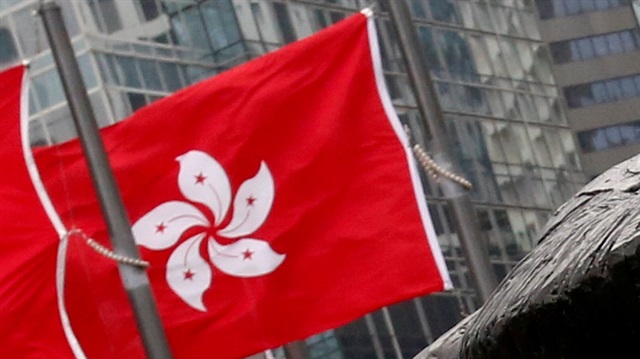
File Photo
As Hong Kong's government hews closer to Beijing, officials are taking a tough line on perceived national security threats, even deploying an elite police unit for political monitoring and surveillance - a sharp escalation in rhetoric and action.
In just the last few months, the special administrative region has banned the Hong Kong National Party, which espouses separation from China, and barred some activists from standing in local elections.
The Education Bureau sent all secondary schools in the Special Administrative Region letters on Sept 24 saying they must prohibit "the penetration" of the National Party or risk prosecution.
And this month, Hong Kong refused to renew the work visa of Victor Mallet, Asia news editor for the British-based Financial Times newspaper, after he hosted a speech by an independence activist.
"We can see them (the government) being much more assertive in using these powers and in shaping their policy decisions to reflect the national interests," said Professor Simon Young of the University of Hong Kong's law school, saying the courts may be a last line of defence against government overreach.
Serving and retired police officers, lawyers and lawmakers describe intensifying political operations by the police force's Security Wing, an elite unit that officially handles sensitive tasks including VIP protection and counter-terrorism investigations.
Sources familiar with the wing's work say it led surveillance and monitoring operations against the National Party and more than a dozen other groups.
The Hong Kong Journalists Association recently described the prospect of tougher national security enforcement as "a sword dangled above the heads" of reporters.
The Financial Times said it was appealing the decision denying Mallet a work visa. In his role as first vice president of the Foreign Correspondents' Club of Hong Kong, Mallet in August hosted Andy Chan, head of the National Party.
The party was banned last month as an "imminent threat to national security" as the government invoked little-known clauses of a law regulating private groups and societies.
Authorities have so far refused to explain their decision on Mallet, except to say that no independence advocacy will be tolerated.
Chan, a bespectacled 28-year-old interior decorator, says that his ideology springs from China's broken promises towards Hong Kong and that claims he might destabilise China are preposterous.
But Hong Kong's government is treating even the consideration of independence as a vital threat.
"Worryingly, they have been parroting the ideological and authoritarian line of Beijing ... irreparably undermining their reputation," one diplomat said of the city's government.
In the letter to schools last month, the Education Bureau said, "should students have erroneous and extreme thoughts, principals and teachers should correct them with facts." Some teachers described this to Reuters as a "gagging order."
That appears to run contrary to Hong Kong's mini-constitution, known as the Basic Law, which stresses freedoms of speech and assembly.
Some youths who drove the pro-democracy "Umbrella Revolution" street demonstrations in 2014 say there is a growing sense of despair at the pressure on civil society and individual rights.
Daniel Cheung, a 29-year-old photographer who worked on "Chronicle of a Summer," a documentary on activists such as jailed independence leader Edward Leung, said the situation was worsening fast.
"Put simply, if you see Hong Kong as a house built by the British, this house is now crumbling and leaking. It has been hit by a typhoon and close to toppling over," Cheung said.
Back To The Future
The Basic Law requires the city to create laws against treason, secession and subversion of the national government, effectively updating those from the colonial era.
The laws from British rule, while broad, do not outlaw calls for independence or self-determination.
Previous attempts to draft a harsher new national security law, known as Article 23, were met with mass protests and abandoned. Chief Executive Carrie Lam, who took office last year, has not yet proposed a new version, a reflection in part of lingering public concern.
But many observers say the government is using the Security Wing to tighten its grip even without Article 23.
The wing's officers were deeply involved in producing the 700-page dossier the government used to justify banning the National Party. The document tracked its statements, public appearances and activities.
For some, that has echoes of the colonial-era Special Branch, which monitored potentially subversive Chinese and Russian communist activity across Hong Kong during the Cold War. The agency was disbanded in 1995, two years before Britain handed Hong Kong back to China.
"It is clear it (Security Wing) is doing much more political work now," said James To, a veteran democracy advocate who has spent much of his 27 years in the city's parliament scrutinizing the government's security policies.
"My worry is that when you monitor people's political life and thoughts you are going against the spirit of the human rights provisions of the Basic Law. There is a need for balance," To said.
To said the government had repeatedly refused requests by Hong Kong's legislators to discuss the Security Wing's operations in detail.
Headed by an assistant commissioner, the Wing has over 700 staff, according to government information provided to lawmakers in recent years, some of whom have close ties with mainland Chinese counterparts as well as foreign diplomats based in Hong Kong.
One former senior officer familiar with the branch's work said he was witnessing a sea change in the government's previously hands-off approach.
"It is back to the future," he said. "It is eerie to see them embark on the same kind of monitoring and control operations that we used to do with an entirely new generation."
Police declined to comment on whether other activists or groups, including those calling for greater autonomy in the longer term such as Joshua Wong, were being targeted, saying the department wouldn't "disclose details of operations and investigations."
Some observers see an expanding clampdown as inevitable given the political climate.
"They (the police) are clear what China's thinking is on this issue," said a senior police source, who declined to be named given the sensitivity of the issue.
As Hong Kong recovers from one of the strongest typhoons in decades, a controversial plan to build a vast artificial island is facing intense scrutiny from environmental groups, lawmakers and academics who say it will be vulnerable to rising sea levels and storms.The East Lantau Metropolis plan, backed by powerhouse property developers including New World Development and Henderson Land, is the government's favoured option to address a chronic housing shortage in one of the world's most expensive property markets.But the project, which envisions housing more than 1 million people across 1,700 hectares of reclaimed land, is probably the worst choice, said Lam Chiu-ying, a former director of Hong Kong's weather bureau."Unfathomable climate risk, destruction of 22 square kilometres of natural marine habitat, extremely costly - with the cost comparable to the total government reserves - and strategically vulnerable transport-wise," he said.Local media have estimated the cost at up to HK$500 billion ($63.80 billion), while environmental groups estimate the cost at HK$700 billion or more.With a population of more than seven million, the former British colony is one of the world's densest places.The city is largely adept at dealing with typhoons, which occur regularly in southern China, yet the authorities underestimate the impact of rising sea levels and more extreme future weather, environmentalists say.Hong Kong saw unprecedented flooding and damage during September's Typhoon Mangkhut, with seawater swallowing roads and enveloping residential and office buildings, while public transport networks were largely paralysed.Walton Li of Greenpeace said it was one of the world's most vulnerable port cities. As it faces stronger typhoons and higher storm surges, the risk of flooding will dramatically increase, he added.Our Hong Kong Foundation, a think tank backed by property developers and former chief executive Tung Chee-hwa, is the driving force behind the Lantau reclamation project.The group has deployed a glitzy marketing campaign, including an emotive video starring local celebrity Andy Lau this month. Its message: reclamation is the best solution considering "cost effectiveness, environmental conservation, planning and infrastructure, and the preservation of property rights."The project could be built higher to address rising sea levels and heavy tropical storms, a foundation representative told Reuters, adding that waves during typhoons were not estimated to exceed two meters where the island would be built. The Hong Kong government has said the development would be built to standards that accounted for climate change. Chief Executive Carrie Lam said in her policy address on Wednesday that the government was studying the planned reclamation, with the first phase of the development to start in 2025.Temperatures are likely to rise by 1.5 degrees Celsius between 2030 and 2052 if global warming continues at its current pace, a U.N. report said this week."The government has a head-in-the-sand approach," said Hong Kong-based environmentalist Martin Williams.Williams pointed to Osaka's Kansai airport, which was flooded after Typhoon Jebi in September, as an example of how the island project could go badly.Ngai Hok Yan, a senior civil engineer in Hong Kong, said that the development could be built to handle massive storms but that there would always be uncertainties in predicting the size of the waves.Tom Yam, a member of Hong Kong's Citizens Task Force on Land Resources, said that although some reclamation should be considered, the huge cost of the East Lantau project would exhaust half of Hong Kong's fiscal reserves."The extremely high cost, complexity risks and environmental consequences of large-scale reclamation in the middle of the ocean make the planned reclamation a wholly different animal," he said. Such a development, he added, would benefit only property tycoons and construction companies.The Citizens Task Force said the foundation's plans were based on an inflated estimate of population growth and demand for land.A better alternative would be to develop more than 1,000 hectares Hong Kong property developers already own in the city's verdant New Territories. "Affordability, not land shortage, is the core housing issue faced by Hong Kong people. It is shocking to see how land supply continues to be moderated by government to maintain high land premium revenues," the group said in September. ($1 = 7.8372 Hong Kong dollars) 
Rising sea levels, storm surges pose risks for Hong Kong's artificial island project
As Hong Kong recovers from one of the strongest typhoons in decades, a controversial plan to build a vast artificial island is facing intense scrutiny from environmental groups, lawmakers and academics who say it will be vulnerable to rising sea levels and storms.The East Lantau Metropolis plan, backed by powerhouse property developers including New World Development and Henderson Land, is the government's favoured option to address a chronic housing shortage in one of the world's most expensive property markets.But the project, which envisions housing more than 1 million people across 1,700 hectares of reclaimed land, is probably the worst choice, said Lam Chiu-ying, a former director of Hong Kong's weather bureau."Unfathomable climate risk, destruction of 22 square kilometres of natural marine habitat, extremely costly - with the cost comparable to the total government reserves - and strategically vulnerable transport-wise," he said.Local media have estimated the cost at up to HK$500 billion ($63.80 billion), while environmental groups estimate the cost at HK$700 billion or more.With a population of more than seven million, the former British colony is one of the world's densest places.The city is largely adept at dealing with typhoons, which occur regularly in southern China, yet the authorities underestimate the impact of rising sea levels and more extreme future weather, environmentalists say.Hong Kong saw unprecedented flooding and damage during September's Typhoon Mangkhut, with seawater swallowing roads and enveloping residential and office buildings, while public transport networks were largely paralysed.Walton Li of Greenpeace said it was one of the world's most vulnerable port cities. As it faces stronger typhoons and higher storm surges, the risk of flooding will dramatically increase, he added.Our Hong Kong Foundation, a think tank backed by property developers and former chief executive Tung Chee-hwa, is the driving force behind the Lantau reclamation project.The group has deployed a glitzy marketing campaign, including an emotive video starring local celebrity Andy Lau this month. Its message: reclamation is the best solution considering "cost effectiveness, environmental conservation, planning and infrastructure, and the preservation of property rights."The project could be built higher to address rising sea levels and heavy tropical storms, a foundation representative told Reuters, adding that waves during typhoons were not estimated to exceed two meters where the island would be built. The Hong Kong government has said the development would be built to standards that accounted for climate change. Chief Executive Carrie Lam said in her policy address on Wednesday that the government was studying the planned reclamation, with the first phase of the development to start in 2025.Temperatures are likely to rise by 1.5 degrees Celsius between 2030 and 2052 if global warming continues at its current pace, a U.N. report said this week."The government has a head-in-the-sand approach," said Hong Kong-based environmentalist Martin Williams.Williams pointed to Osaka's Kansai airport, which was flooded after Typhoon Jebi in September, as an example of how the island project could go badly.Ngai Hok Yan, a senior civil engineer in Hong Kong, said that the development could be built to handle massive storms but that there would always be uncertainties in predicting the size of the waves.Tom Yam, a member of Hong Kong's Citizens Task Force on Land Resources, said that although some reclamation should be considered, the huge cost of the East Lantau project would exhaust half of Hong Kong's fiscal reserves."The extremely high cost, complexity risks and environmental consequences of large-scale reclamation in the middle of the ocean make the planned reclamation a wholly different animal," he said. Such a development, he added, would benefit only property tycoons and construction companies.The Citizens Task Force said the foundation's plans were based on an inflated estimate of population growth and demand for land.A better alternative would be to develop more than 1,000 hectares Hong Kong property developers already own in the city's verdant New Territories. "Affordability, not land shortage, is the core housing issue faced by Hong Kong people. It is shocking to see how land supply continues to be moderated by government to maintain high land premium revenues," the group said in September. ($1 = 7.8372 Hong Kong dollars) Rising sea levels, storm surges pose risks for Hong Kong's artificial island project