

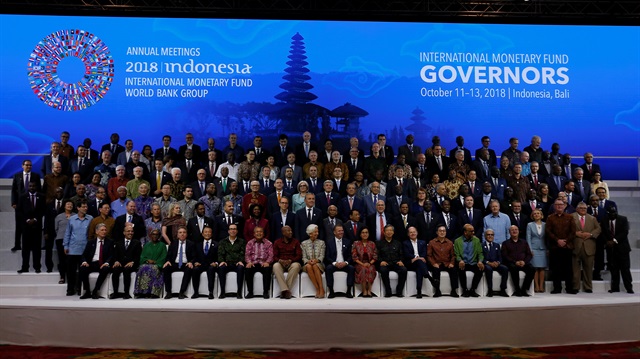
International Monetary and Financial Committee pledged to refrain from competitive currency devaluations and step up dialogue on trade
The International Monetary Fund said on Saturday its members pledged to refrain from competitive currency devaluations and step up dialogue on trade, as escalating trade frictions and higher borrowing costs threatened to knock global growth.
The agreement came as U.S. Treasury Secretary Steve Mnuchin reiterated his concern over the yuan's weakening against the dollar - a drop that Washington suspects may be aimed at giving Chinese exports a trade advantage and offsetting U.S. tariffs.
In a communique issued by the IMF's steering committee, the member countries also agreed to debate ways to improve the World Trade Organization so it can better address trade disputes.
"We acknowledge that free, fair, and mutually beneficial goods and services trade and investment are key engines for growth and job creation," the International Monetary and Financial Committee (IMFC) said in the statement.
"We will refrain from competitive devaluations and will not target our exchange rates for competitive purposes," it added.
Pakistan has requested financial assistance from the International Monetary Fund to address its economic challenges, IMF Managing Director Christine Lagarde said on Thursday.Lagarde said in a statement that the request came during her meeting with Pakistani Finance Minister Asad Umar, and central bank governor Tarik Bajwa on the sidelines of the IMF and World Bank annual meetings in Bali."An IMF team will visit Islamabad in the coming weeks to initiate discussions for a possible IMF-supported economic program," Lagarde said. "We look forward to our continuing partnership." 
IMF to launch financial assistance talks with Pakistan: Lagarde
International Monetary Fund Managing Director Christine Lagarde said on Thursday that she believes Chinese authorities are trying to maintain growth and stability in the face of a trade conflict with the United States, but added that this is a "complicated" balancing act."The Chinese authorities are certainly looking at options, I would think, in order to maintain a level of growth that would keep the economy under control, and we are seeing recent decisions from the PBOC to that effect," Lagarde said during a discussion at the IMF and World Bank annual meetings in Bali."I think that it's a complicated equation, where they have to both use the flexibility that is available, but at the same time be very attentive to their fiscal position," she added.
IMF chief says China faces balancing act as it seeks to maintain growth
Fears that escalating global trade tensions and rising U.S. interest rates could dent growth have roiled global markets in recent days and prompted warnings of heightened risks by finance leaders gathering for the IMF and World Bank annual meetings in the Indonesian resort island of Bali.
"The recovery is increasingly uneven, and some previously identified risks have partially materialised," the communique said, referring to threatened tariffs.
The United States and China have slapped tit-for-tat tariffs on hundreds of billions of dollars of each other's goods over the past few months, sparked by U.S. President Donald Trump's demands for sweeping changes to China's intellectual property, industrial subsidy and trade policies.
The bilateral tensions have flared over to currencies with the United States voicing concern about a weakening of the yuan to close to 7 to the dollar in recent months, a level not seen in a decade.
Trump has frequently accused China of cheapening its currency to gain a trade advantage, claims Beijing has consistently rejected.
Mnuchin on Saturday said Chinese officials told him at the Bali meetings this week that a further depreciation of China's yuan currency was not in the country's interests.
"And as I've said, the currency issue is an important issue for us in trade and will be part of our trade discussions," he told a news conference. "We want to make sure that depreciation is not being used for competitive purposes in trade."
The comments come after Mnuchin expressed concern about the yuan slide, as the Treasury prepares to release a much-anticipated report next week on currency manipulation.
Mnuchin also said he was "not losing any sleep" over the prospect that China could sell U.S. Treasury debt amid rising trade tension between the world's two largest economies.
Mnuchin said no decision had been made on whether Trump would meet Chinese President Xi Jinping at the G20 leaders summit in Argentina at the end of November. No formal talks to try to resolve the trade dispute have taken place since Aug. 23.
Tomato paste is not the most obvious economic indicator, but in Iran, where it is a staple that some people have started panic-buying, it says a lot about the impact of renewed U.S. sanctions.While Iran makes its own paste from an abundant crop of locally grown tomatoes, sanctions reimposed by U.S. President Donald Trump since August have played havoc with supply.A 70 percent slide in the rial this year has prompted a scramble for foreign currency that has made exports much more valuable in local terms than selling produce at home.Some shops are limiting purchases of tomato paste, which is used in many Persian dishes, and some lines have sold out as people buy up existing stock.The government has responded by banning tomato exports, one of a raft of interventions to try to limit economic instability that has fuelled public protests and criticism of the government this year.But the tomato policy is not working. An industry representative said tomatoes were being smuggled abroad."We have heard that trucks full of tomatoes are still leaving the country, especially to Iraq," Mohammad Mir-Razavi, head of the Syndicate of Canning Industry, said by telephone."They put boxes of greenhouse tomatoes on top and hide normal tomatoes at the bottom," he said, referring to an exemption for hot-house grown tomatoes that left a loophole.It is one of many ways in which the sanctions are hurting ordinary Iranians while benefiting those with access to hard currency.Washington reintroduced steps against Iran's currency trade, metals and auto sectors in August after the U.S. withdrawal from a deal that lifted sanctions in return for limits on Iran's nuclear programme. Trump said the deal was not strict enough.With U.S. curbs on Iran's oil exports set to come into force next month, some Iranians fear their country is entering an economic slump that may prove worse than the period from 2012 to 2015, when it last faced major sanctions."There is an emerging consensus that the economy will go through a period of austerity similar to that recorded during the Iran-Iraq war," said Mehrdad Emadi, an Iranian economist who heads energy risk analysis at London's Betamatrix consultancy."COMING SOON"Jumps in prices are occurring in a range of goods -- particularly imports such as mobile telephones and other consumer electronics, but also some staples. A bottle of milk, 15,000 rials last year, now sells for 36,000.An 800-gramme (28-ounce) can of tomato paste was selling in Tehran stores for around 60,000 rials in March; it is now 180,000 rials, or $1.24 at the unofficial rate, prompting a scramble by households to stock up. The price of tomatoes has increased more than five-fold compared to last year.Signs on the shelves of some stores limit each customer to two cans. Iranian online shopping site Digikala lists the top nine tomato paste items as out of stock, and the rest as "coming soon". In supermarkets in Najaf in neighbouring Iraq, meanwhile, supplies of Iranian tomato paste are plentiful.Adding to the pressure is a fourfold rise in the price of cans, Mir-Razavi said. Traders importing material to make cans sought to buy dollars at a little-used official rate of 42,000 rials; authorities asked them to use a more expensive rate. The issue has delayed shipments of material to factories.The government is mounting a campaign against price-gouging, periodically ordering shopkeepers to sell at lower prices. But some shopkeepers respond by not selling at all, believing prices will eventually rise again as the sanctions bite.BANKS STABILISEDIran, a big oil producer with a diverse economy, has shown its farming, manufacturing and distribution sectors can ride out long periods of war and sanctions.The Tehran Stock Exchange index has soared 83 percent this year as shares of exporting companies have rocketed. Urban real estate prices have also risen as Iranians plough their savings into property rather than keeping them in depreciating rials.The rial's plunge, which in the unofficial market has taken it to around 145,000 against the dollar from 42,890 at the end of 2017, according to currency tracking website bonbast.com, may even have strengthened the financial system in one way.Banks and pension funds have been struggling with massive debts. Emadi said the rial's slide, to as low as 190,000 in late September, had given the government huge windfall profits on its dollar holdings; authorities appear to have injected some of those profits into insolvent banks to shore them up, he said.But while official data for the last few months has not yet been released, Emadi said he believed the economy was already in a recession that could deepen in coming months.GEOPOLITICSThe International Monetary Fund predicted this week that the economy would shrink 1.5 percent this year and 3.6 percent in 2019, before recovering slowly.That would make the slump less deep than the recession of 2012, when the economy shrank over 7 percent, and not nearly as damaging as the Iran-Iraq war of 1980-1988, when it shrank by about a quarter.The IMF also forecast the average inflation rate would jump to a peak above 34 percent next year, briefly returning to its level in 2013.How much the current recession resembles past periods of economic pain for Iran will depend on the extent to which Washington can use the sanctions to push other countries into cutting oil and non-oil trade with the Islamic Republic.U.S. officials have said the sanctions will be tougher than the steps in 2012-2015. They aim to reduce Iranian oil exports more sharply, and to disrupt exports to Iran from trading hubs such as Dubai more aggressively."I think the return of the sanctions has had a devastating effect on their economy and I think it's going to get worse," Trump's national security adviser John Bolton told Reuters in late August.But Emadi said that if European nations succeeded in creating a special payments system permitting trade with Iran to continue, and if Tehran cracked down on endemic corruption, the economy might start recovering gradually a year from now.In the meantime, many Iranians may continue to struggle with surging prices and an unstable currency.Peyman Mohammadian, 28, an unemployed university graduate in the western city of Andimeshk, said he had tried to protect 5 billion rials in savings by converting them into dollars last month at a rate of 183,000.Since then, the rial has partially rebounded as authorities have sold dollars to support it and threatened currency speculators with arrest. Mohammadian said this left him in a quandary.“On one hand, I want the dollar to rise so I don't lose my money. But on the other hand, I want it to drop below 100,000 -- otherwise inflation will be so high that I won't be able to get married for 10 years.”
Tomato squeeze: US sanctions begin to distort Iran's economy
International Monetary Fund Managing Director Christine Lagarde said she "would not associate" Federal Reserve Chairman Jerome Powell "with craziness" after U.S. President Donald Trump commented that the central bank, which has been raising U.S. interest rates, had "gone crazy," CNBC reported on Thursday.Powell and other policy makers are extremely serious, solid and certainly keen to base their decisions on actual information, Lagarde told CNBC in an interview, adding that central banks should remain independent in their functioning.Fed's Bullard hopes for more trade deals like NAFTA 2.0 to reduce uncertaintyIMF to launch financial assistance talks with Pakistan: Lagarde
IMF chief defends Powell after Trump says Fed has 'gone crazy'