

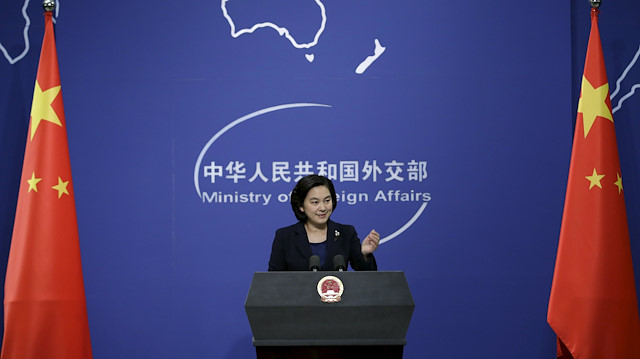
Hua Chunying, spokeswoman of China's Foreign Ministry
China said on Monday its lawful trade cooperation with Iran should be respected and expressed regret that the United States re-imposed sanctions on the Middle Eastern country.
Speaking at a daily news briefing in Beijing, foreign ministry spokeswoman Hua Chunying did not directly comment on whether China had been granted exemption from the Iran sanctions by the United States.
The restoration of U.S. sanctions on Monday targeting Iran's oil sales and banking sector is part of an effort by U.S. President Donald Trump to force Iran to halt its nuclear and ballistic missile programmes outright, as well as its support for proxy forces in conflicts across the Middle East.
Asian stocks skidded on Monday as fears of faster rate hikes in the United States and uncertainty around the Sino-U.S. trade war deterred investment in riskier assets, while sterling briefly jumped to a two-week high on hopes of an orderly Brexit.Markets are expected to be skittish ahead of U.S. congressional midterm elections on Tuesday.Opinion polls show a strong chance that the Democratic Party could win control of the House of Representatives after two years of wielding no practical political power in Washington, with President Donald Trump's Republican Party likely to hold the Senate.Spreadbetters point to a subdued start for Europe with both London's FTSE and Germany Dax seen opening lower.U.S. stock futures slipped 0.3 percent after Wall Street closed lower on Friday amid concerns a trade deal between the United States and China may not be struck soon."We expect U.S.-China trade tensions to get worse before they get better," Citi analysts said in a note."Although trade growth has held steady, concerns are rising in business surveys," they added."Equity markets do not seem to be fully incorporating the risks of an escalation of tensions yet, which could have an effect on investment, sentiment, inflation, and growth."MSCI's broadest index of Asia-Pacific shares outside Japan lost 1.4 percent on Monday, slipping back towards last week's 1-1/2 year trough of 505.61 points.Japan's Nikkei stumbled 1.6 percent while South Korea's KOSPI index fell 1.4 percent.Chinese shares opened in the red with blue-chip stocks off 1.2 percent as President Xi Jinping acknowledged conditions abroad had created some challenges for the Chinese economy.Xi, however, promised to lower import tariffs and continue to broaden market access.Also clouding the outlook for world shares is the prospect of even tighter monetary policy in the United States, given robust economic data in recent months.The United States reported solid jobs growth for October, with annual wage gains at 9-1/2-year highs, further boosting expectations for a December rate rise.A similarly upbeat number back in February had sent global financial markets in a tailspin with a massive sell-off in bonds and equities, particularly in emerging markets, and a strong rally in the U.S. dollar. Markets are now pricing in a higher probability of a December rate hike with further tightening to 2.75-3.00 percent seen through 2019."The U.S. employment report supports our view that the Federal Reserve will raise rates three more times from now until mid-2019," Capital Economics said in a note."After that, we suspect that the cumulative effect of monetary policy tightening will start taking a toll on the US economy, forcing the Fed to end its tightening cycle and pulling Treasury yields, the US stock market, and the dollar down."Sterling ShinesSterling briefly jumped to a two-week high on Monday on growing hopes of a smooth Brexit.With just five months to go until Britain exits the European Union divorce talks are at an impasse, a Sunday Times report that an all-UK customs deal will be written into the agreement governing Britain's withdrawal from the European Union was enough to send the pound to $1.3062, its highest since Oct. 22.May's office said the Sunday Times report was speculative, but added that 95 percent of the withdrawal agreement was settled and negotiations were ongoing.The pound pared gains to be last up 0.1 percent at $1.2989 after UK's Telegraph newspaper reported significant hurdles still remain in the Brexit negotiation process.The U.S. dollar struggled on Friday. The dollar index , which measures the greenback against a basket of major currencies, was last off 0.1 percent at 96.459.Against the safe haven yen, the dollar held at 113.25 . The euro was flat at $1.1389.In commodities, oil prices fell as the start to U.S. sanctions against Iran's fuel exports was softened by waivers that will allow some countries to still import Iranian crude, at least temporarily.U.S. crude fell 36 cents to $62.78 per barrel and Brent was last at $72.49, down 34 cents.China's boulevard to nowhere: The battle for influence in APEC's Pacific hostTrade war, spy claims cloud horizon for China airshowData leak affects thousands of wealthy Moscow residents
Asian shares sell-off as risk sentiment sours, pound pares gains
China will lower import tariffs and continue to broaden market access, President Xi Jinping said on Monday at the opening of a week-long trade expo seen as an attempt by Beijing to counter mounting criticism of its trade and business practices.Xi also promised to accelerate opening of the education, telecommunications and cultural sectors, while protecting foreign companies' interests and enhancing punitive enforcement for infractions of intellectual property rights.Xi's remarks come at a time of heightened tension between China and some of its biggest trade partners, particularly the United States, which has imposed tariffs on $250 billion worth of Chinese goods so far. China has retaliated with $110 billion worth of tariffs on U.S. goods.The Nov. 5-10 China International Import Expo, or CIIE, brings thousands of foreign companies together with Chinese buyers in a bid to demonstrate the importing potential of the world's second biggest economy.Activists urge deep scrutiny of China at UN rights gathering this week"CIIE is a major initiative by China to pro-actively open up its market to the world," Xi said.U.S. President Donald Trump has railed against China for what he sees as intellectual property theft, entry barriers to U.S. business and a gaping U.S. trade deficit. No senior U.S. officials were set to attend the Shanghai event.Xi said the import expo showed China's desire to support global free trade, adding that countries of the world must pursue open policies and oppose protectionism.He said "economic globalization is facing setbacks, multilateralism and the free trade system is under attack, factors of instability and uncertainty are numerous, and risks and obstacles are increasing."China, Pakistan vow to safeguard economic corridor planChina expects to import $30 trillion worth of goods and $10 trillion worth of services in the next 15 years, Xi said.China imported $1.84 trillion of goods in 2017, up 16 percent, or $255 billion, from a year earlier. Of that total, China imported about $130 billion of goods from the United States.The Chinese government's top diplomat, State Councillor Wang Yi, said in March that China would import $8 trillion of goods in the next five years.Expectations had been low that Xi would announce bold new policies of the kind that many foreign governments and businesses have been seeking from Beijing.Instead, people involved in planning meetings have said they were anticipating an event long on symbolism and short on substance meant to signal China's willingness to narrow trade deficits and openness.The European Union, which shares U.S. concerns over China's trade practices if not Trump's tariff strategy to address them, on Thursday called for China to take concrete steps to further open its market to foreign firms and provide a level playing field, adding that it would not sign up to any political statement at the forum.Trump is expected to meet Xi this month, but has said that if a deal is not made with China, he could impose tariffs on another $267 billion in Chinese imports into the United States.FOR SHOWPresidents or prime ministers from 17 countries were set to attend the expo, ranging from Russia and Pakistan to the Cook Islands, though none from major Western nations. Government ministers from several other countries were also coming.Swiss President Alain Berset did not make the trip to China, despite being announced as among attendees by China's foreign ministry last week. The Swiss government said in a statement to Reuters on Sunday that his visit had never been confirmed, and that Secretary of State Marie-Gabrielle Ineichen-Fleisch would represent Switzerland.Some Western diplomats and businesses have been quietly critical of the expo, arguing it is window dressing to what they see as Beijing's long-standing trade abuses.Exhibitors from around 140 countries and regions will be on hand, including 404 from Japan, the most of any country. From the United States, some 136 exhibitors will attend, including Google, Dell Inc, Ford and General Electric.A handful of countries are being represented by a single exhibitor selling one product.For Iraq, it's crude oil. Iran, saffron. Jamaica will be marketing its famed blue mountain coffee and Chad is selling bauxite. Tiny São Tomé is selling package holidays. 
China's Xi Jinping promises lower tariffs, more imports