

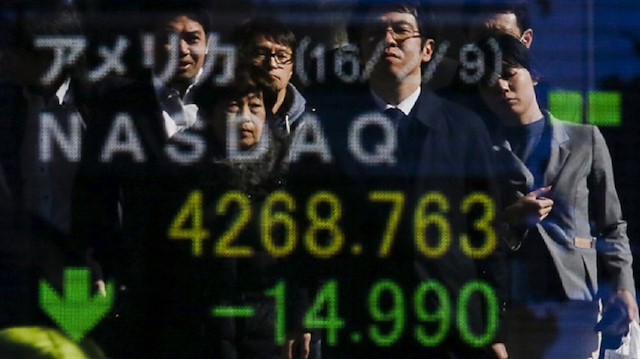
Asian shares sell-off as risk sentiment sours, pound pares gains
Asian stocks skidded on Monday as fears of faster rate hikes in the United States and uncertainty around the Sino-U.S. trade war deterred investment in riskier assets, while sterling briefly jumped to a two-week high on hopes of an orderly Brexit.
Markets are expected to be skittish ahead of U.S. congressional midterm elections on Tuesday.
Opinion polls show a strong chance that the Democratic Party could win control of the House of Representatives after two years of wielding no practical political power in Washington, with President Donald Trump's Republican Party likely to hold the Senate.
Spreadbetters point to a subdued start for Europe with both London's FTSE and Germany Dax seen opening lower.
U.S. stock futures slipped 0.3 percent after Wall Street closed lower on Friday amid concerns a trade deal between the United States and China may not be struck soon.
"We expect U.S.-China trade tensions to get worse before they get better," Citi analysts said in a note.
"Although trade growth has held steady, concerns are rising in business surveys," they added.
"Equity markets do not seem to be fully incorporating the risks of an escalation of tensions yet, which could have an effect on investment, sentiment, inflation, and growth."
MSCI's broadest index of Asia-Pacific shares outside Japan lost 1.4 percent on Monday, slipping back towards last week's 1-1/2 year trough of 505.61 points.
Japan's Nikkei stumbled 1.6 percent while South Korea's KOSPI index fell 1.4 percent.
Chinese shares opened in the red with blue-chip stocks off 1.2 percent as President Xi Jinping acknowledged conditions abroad had created some challenges for the Chinese economy.
Xi, however, promised to lower import tariffs and continue to broaden market access.
Also clouding the outlook for world shares is the prospect of even tighter monetary policy in the United States, given robust economic data in recent months.
The United States reported solid jobs growth for October, with annual wage gains at 9-1/2-year highs, further boosting expectations for a December rate rise.
A similarly upbeat number back in February had sent global financial markets in a tailspin with a massive sell-off in bonds and equities, particularly in emerging markets, and a strong rally in the U.S. dollar. Markets are now pricing in a higher probability of a December rate hike with further tightening to 2.75-3.00 percent seen through 2019.
"The U.S. employment report supports our view that the Federal Reserve will raise rates three more times from now until mid-2019," Capital Economics said in a note.
"After that, we suspect that the cumulative effect of monetary policy tightening will start taking a toll on the US economy, forcing the Fed to end its tightening cycle and pulling Treasury yields, the US stock market, and the dollar down."
Sterling Shines
Sterling briefly jumped to a two-week high on Monday on growing hopes of a smooth Brexit.
With just five months to go until Britain exits the European Union divorce talks are at an impasse, a Sunday Times report that an all-UK customs deal will be written into the agreement governing Britain's withdrawal from the European Union was enough to send the pound to $1.3062, its highest since Oct. 22.
May's office said the Sunday Times report was speculative, but added that 95 percent of the withdrawal agreement was settled and negotiations were ongoing.
The pound pared gains to be last up 0.1 percent at $1.2989 after UK's Telegraph newspaper reported significant hurdles still remain in the Brexit negotiation process.
The U.S. dollar struggled on Friday. The dollar index , which measures the greenback against a basket of major currencies, was last off 0.1 percent at 96.459.
Against the safe haven yen, the dollar held at 113.25 . The euro was flat at $1.1389.
In commodities, oil prices fell as the start to U.S. sanctions against Iran's fuel exports was softened by waivers that will allow some countries to still import Iranian crude, at least temporarily.
U.S. crude fell 36 cents to $62.78 per barrel and Brent was last at $72.49, down 34 cents.
Workers are putting the finishing touches on a Beijing-funded boulevard designed to showcase Papua New Guinea’s (PNG) capital to visiting world leaders at this month’s Asia-Pacific Economic Cooperation forum.Critics say the six-lane road - complete with wide, illuminated footpaths - is emblematic of a regional power play whereby donor countries vie for influence with show-stopper gifts, even as deeper problems plague the Pacific nation.Australia, PNG’s traditional partner and a close Washington ally, is lifting aid and has plowed more than A$120 million ($86.5 million) into APEC, seeking to keep its sway over its neighbor.Allan Bird, a parliamentarian and governor of PNG’s second largest province, said the boulevard outside parliament house had little practical benefit.“Whatever the Chinese government spent on it, it could have been better spent somewhere else, buying medicine or building a school,” Bird told Reuters.Amid trade war, China premier says Sino-US ties can improvePakistani premier to pay official visit to ChinaAustralia to help PNG build a navy base to fend-off ChinaBird said such gifts put pressure on traditional partners such as Australia to place less restrictions around donated funds and refrain from criticizing PNG’s own spending, which controversially includes buying 40 Maseratis and three Bentleys for APEC.“There is no transparency around the use of public finances,” Bird said.“The government can turn to other donors and tell them to ‘toe the line or else we’ll be quite happy to take Chinese money’. They use it as leverage.”The PNG government did not respond to questions on funding for the boulevard project or other aspects of APEC. PNG has previously thanked China for its infrastructure funding and aid, and denied Beijing had asserted any diplomatic pressure.Chinese Foreign Ministry spokesman Lu Kang said people should be supportive of the PNG government’s efforts to promote regional economic integration by hosting the summit.“At the request of the Papua New Guinea side, China has proactively provided support and help for the hosting, which I can tell you has been warmly welcomed by the Papua New Guinea government and people,” Lu told reporters in response to Reuters questions, without providing a figure.Speaking in Port Moresby on Wednesday, the Chinese government’s top diplomat, State Councillor Wang Yi, said in recent years his country had helped build more than 100 projects in PNG and other Pacific island nations, including schools and hospitals, which these countries had greatly appreciated.“Whether China’s aid is good or not, the governments and people of those countries being aided have the most right to speak,” Wang said, according to China’s Foreign Ministry.China says Xi-Trump call was quite positiveTrump asks officials to draft possible trade deal with ChinaTrump says had good talk with China's Xi on trade, North KoreaAiding And IndebtingIf the region - pivotal in the Pacific battles of World War II - is a strategic treasure, PNG is one of its jewels.It controls large swaths of ocean, is rich in mineral resources and is close to both U.S. military bases on the island of Guam and to Australia.Formerly administered by Canberra, PNG has in recent years turned increasingly to China for financing as Beijing becomes a bigger player in the region.PNG has the largest debt to China in the South Pacific, at almost $590 million, representing about one-quarter of its total external debt.When world leaders arrive in the capital of Port Moresby for APEC, the contributions of donors will be obvious.Australia will provide security personnel, naval patrol boats and a helicopter-docking ship; and the city will have an upgraded sewerage system care of the Japanese government.Beijing has refurbished the show-piece convention center and gifted coaches, mini-buses and fire-engines.China also rebuilt city’s main highway, which according to Moresby-based think tank the Institute of National Affairs, didn’t really need an upgrade.The institute’s executive director, Paul Barker, said the resurfaced streets and new boulevard had little public benefit.“It’s hard to imagine the boulevard will have any use other than marches or grand displays from time to time,” he said.“It’s not really a road that goes from anywhere to anywhere.”While the exact cost of each project is unclear, a Reuters analysis of PNG government announcements shows China’s total bill would be several tens of millions of dollars.Australia’s A$120 million contribution to the event represents nearly a third of what Canberra spent when hosting world leaders for G20 in 2014.Australian foreign aid to PNG is budgeted to hit a record A$572 million this year as Canberra diverts more capital to the Pacific at the expense of other regions.On Thursday, Australia announced it would help fund a PNG navy base that China had expressed an interest in funding.“Over the last year, we have seen Australia and New Zealand aggressively expand their focus on the Pacific, which is something we are very pleased about,” said a senior U.S. official, who spoke on condition of anonymity.Australia’s Minister for Foreign Affairs Marise Payne declined to comment on Canberra’s funding for APEC. Australia has previously said it was “partnering” with PNG to showcase trade, tourism and investment opportunities.US official denies report of possible China trade dealTesla seeks to reduce tariff impact for Model 3 by making cars in ChinaChina promises Pakistan support as Khan tells of 'very difficult' economyThe Fast And The Furious“(PNG Prime Minister) Peter O’Neill sees APEC as putting PNG on the world stage,” a British official told Reuters. “If a donor wants to win favor with O’Neill, assisting with APEC is the way to do it.”Yet, while gifts pour in, parts of PNG are still struggling to recover after a massive earthquake in February killed more than 100 people, destroying crops and infrastructure.Polio, a potentially deadly and highly infectious viral disease almost eradicated globally, also re-emerged in PNG in recent weeks.Faced with such challenges, the purchase by the PNG government of a fleet of luxury vehicles has sparked public protests.Retailing in Australia at more than A$200,000 ($141,560), a Maserati is well beyond the reach of a typical PNG local, who earns on average $2,400 each year, according to U.N. data.PNG’s government has said it has agreements in place to sell the cars immediately after APEC and taxpayers will bare no financial loss.Diplomatic sources told Reuters nearly all leaders attending the event would travel in special armored vehicles, making it unclear what the sports cars will be used for.Donors have so far largely refrained from public comment.“Some are worried about rocking the boat and don’t want to threaten bilateral relations by publicly criticizing O’Neill for buying luxury cars,” said the senior British diplomatic source.Chinese chip firm Fujian Jinhua denies stealing IP from MicronTrump says 'I think we'll make a deal with China' on tradeChina says more talks needed on economic aid for Pakistan
China's boulevard to nowhere: The battle for influence in APEC's Pacific host
Trade frictions with the United States and accusations of industrial espionage are set to cast a cloud over China's largest aerospace meeting this week, as suppliers consider what the country's slowing economy could mean for booming jet demand.The biennial Airshow China, to be held in the coastal city of Zhuhai during Nov 6-11, is traditionally an event for Beijing to parade its growing aviation prowess in front of aerospace executives, diplomats and arms buyers from over 40 countries.But analysts say they are not expecting many headline announcements or big deals this year as a bruising trade war between Beijing and Washington and a slowing Chinese economy cause companies to be cautious.While the tarmac will be filled with planes from the likes of Airbus SA and Embraer, the main symbol of China's own commercial aviation ambitions, the Commercial Aircraft Corp of China's (COMAC) C919 narrowbody jet, will not be there. A senior executive said it was undergoing test flights.Boeing Co, which is opening a 737 completion plant in China, will not display any of its planes but only models at its exhibition stand."We're not expecting a big turnout this year," said Chinese aviation expert Li Xiaojin. "As you know the Chinese economy is not doing great this year, so companies that would normally send 10 people will only send five instead."China has become a key hunting ground for foreign firms to do deals as its airlines have expanded fleets to keep up with surging travel demand, putting the country in a position to overtake the United States as the world's top aviation market in the next decade.But China's economic growth has weakened to its slowest pace since the financial crisis and its relations with other countries have been tested by Beijing's ambitions to grow its own domestic champions in industries such as aviation.And while U.S.-made aircraft have so far escaped Beijing's tariffs, analysts said they were still waiting to see what the trade war would spell for U.S. companies such as Boeing, Honeywell and Gulfstream, who face fierce competition in China from the likes of Airbus and other suppliers.The United States exported $16.3 billion of civilian aircraft to China in 2017, the biggest category of goods it exported to China, according to a paper published by the Federal Reserve Bank of St. Louis."It is not unlikely that China might strategically steer future aircraft purchases to Airbus rather than Boeing," said Marc Szepan, a China aviation expert at the University of Oxford and former industry executive.""In addition, there might be a re-evaluation of the relative attractiveness of industrial partners for China's future aircraft programmes such as the CR929 which might favour European over U.S. component and structures suppliers."US official denies report of possible China trade dealTesla seeks to reduce tariff impact for Model 3 by making cars in ChinaChina promises Pakistan support as Khan tells of 'very difficult' economyShow Of StrengthSo far, Beijing has avoided showing its hand in either direction as deals by Chinese leasing firms to buy foreign aircraft are either pushed back or kept private.Recent U.S. allegations in court filings that Chinese intelligence attempted to steal information on a French-U.S. turbofan engine developed for commercial jetliners - a clear reference to the Safran-General Electric LEAP - could further fray relations, analysts said.Beijing has also criticised the U.S. decision not to send senior officials to a Shanghai import expo that takes place in the same week as the airshow and counts as one of China's most important foreign policy events for the year."Right now the political winds are quite concerning," said aerospace analyst Richard Aboulafia of the Teal Group.U.S. President Donald Trump said on Friday that he will likely make a deal with China on trade, adding that a lot of progress had been made to resolve the two countries' differences but warning that he still may impose more tariffs on Chinese goods.China is expected to put on a show of strength in space and defence, with self-developed fighter training FTC-2000 aircraft, a historically high number of weapons as well as its latest unmanned aerial vehicles among the kit on display.China's air force said on Friday that a number of Chengdu J-20 stealth fighters would perform demo flights, after having debuted at the show two years ago with a 60-second flypast.Kelvin Wong, senior Asia Pacific defence technology expert at IHS Markit, said this would be part of the deliberate messaging often associated with the closely watched show."It appears the PLA (People's Liberation Army) is definitely showcasing its growing confidence in the latest J-20 combat aircraft," said Wong.Chinese chip firm Fujian Jinhua denies stealing IP from MicronAustralia trade minister to visit China in sign of thawTrump says 'I think we'll make a deal with China' on trade
Trade war, spy claims cloud horizon for China airshow
Thousands of wealthy Moscow residents who subscribed to a regional internet provider have had personal data including names, home addresses and mobile numbers posted online.People affected by the high-profile data leak are all clients of Moscow-based internet provider Akado Telecom, a large telecommunications network owned by billionaire businessman Viktor Vekselberg, which said it had opened an inquiry into the incident.Russian authorities have been paying close attention to such incidents following leaks that led to the publication of information about military intelligence agents accused of links to an attack on former Russian spy Sergei Skripal in Britain.Reuters saw several hundred records on an international database and identified data including the mobile phone numbers and addresses of a high-ranking Russian government official, a well-known film director and a leading businessman's relative.The data was uploaded to the database of RIPE NCC, a not-for-profit regional internet registry for Europe, the Middle East and parts of Central Asia, said IT specialist Vladislav Zdolnikov, founder of the TgVPN service, which offers VPNs for users of the Telegram messaging application.RIPE NCC operates a public database listing which IP addresses have been allocated to different internet service providers. It should not, however, identify individual customers by name or other personal information.Companies that are members of the registry, which include Akado Telecom, are responsible for loading data onto the database, said Aleksei Semenyaka, a RIPE NCC communications director.He said Akado Telecom must have uploaded the customer details, which he confirmed could be accessed freely.Akado Telecom said it had launched an internal investigation, but did not say whether it knew the private data of its clients had been published or whether the company had provided the information."We always respond to criticism with attention and gratitude and conduct thorough analyses to uncover vulnerabilities in our information systems in order to prevent possible data leaks," it said in a statement.Akado Telecom operates three subnetworks with 24,500 IP addresses in total, Zdolnikov said.All of those individual users, most of whom live in the capital's wealthiest districts, could have been affected.The database also listed information about banks and government agencies that use Akado Telecom, as well as their staff's contact details.In Russia, it has been illegal to make personal data publicly available since 2006 and companies breaking the law face fines of up to 50,000 roubles ($756). 
Data leak affects thousands of wealthy Moscow residents