

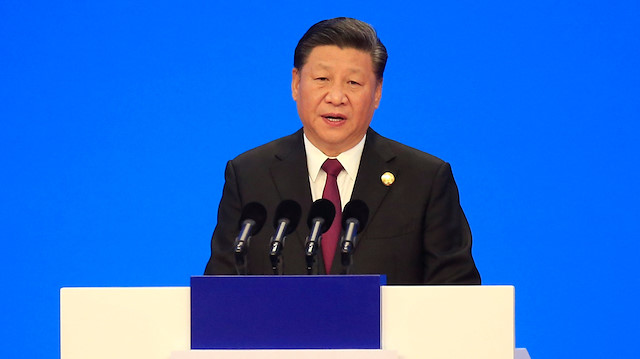
Chinese President Xi Jinping
China will lower import tariffs and continue to broaden market access, President Xi Jinping said on Monday at the opening of a week-long trade expo seen as an attempt by Beijing to counter mounting criticism of its trade and business practices.
Xi also promised to accelerate opening of the education, telecommunications and cultural sectors, while protecting foreign companies' interests and enhancing punitive enforcement for infractions of intellectual property rights.
Xi's remarks come at a time of heightened tension between China and some of its biggest trade partners, particularly the United States, which has imposed tariffs on $250 billion worth of Chinese goods so far. China has retaliated with $110 billion worth of tariffs on U.S. goods.
The Nov. 5-10 China International Import Expo, or CIIE, brings thousands of foreign companies together with Chinese buyers in a bid to demonstrate the importing potential of the world's second biggest economy.
Activists called for U.N. member states to pressure China this week to account for alleged human rights violations, including the suspected mass detention of one million Muslim Uighurs in far-western Xinjiang province.China's record will be examined by the U.N. Human Rights Council on Tuesday, the first time since 2013, in a regular review expected to focus on its treatment of ethnic minorities, especially Uighurs and Tibetans.China says Xinjiang faces a threat from Islamist militants and separatists. It rejects all accusations of mistreatment in an area where hundreds have been killed in unrest between Uighurs and members of the ethnic Han Chinese majority.While denying the allegations of arbitrary detentions and political re-education across a network of secret camps, however, officials have recently said some citizens guilty of minor offences were being sent to vocational centres to provide employment opportunities.Activists sharply criticised Beijing's rights record."In the last five years, generally the human rights situation in China has been getting worse, particularly in east Turkestan (Xinjiang) and Tibet, there has been an unimagineable deterioration," said Dolkun Isa, president of the Munich-based World Uighur Congress."That's why we expect that the countries should be speaking loudly and strongly," he told Reuters in an interview at an activist forum on China held in Geneva on Friday.Xinjiang has become a "police state" where his mother died in a "concentration camp" in May, Isa said, adding: "We have never heard of people coming out from the camps."Sharon Hom, executive director of Human Rights in China, told Reuters at the event: "The detention of over a million ethnic Uighurs is a tipping point for the international community. They really can't look the other way now..."Le Yucheng, Vice Minister of Foreign Affairs, will lead China's delegation to the session."Unequivocal Message""The Human Rights Council must send an unequivocal message to the Chinese government that their campaign of systematic repression in the XUAR (Xinjiang Uighur autonomous region), including the arbitrary detention of up to one million people, must end," Patrick Poon, China researcher at Amnesty International, said in a statement.Lobsang Sangay, head of the Tibetan government in exile, took a swipe at Chinese President Xi Jinping's mantra of "Socialism with Chinese Characteristics for a New Era"."Socialism with Chinese characteristics means no democracy, one party dictatorship and essentially no human rights," Sangay said in a keynote speech at the Geneva event."If the U.N. Human Rights Council cannot make China accountable for human rights violations, then who will?"Golog Jigme, a Tibetan monk dressed in crimson robes, gave testimony about three jail terms he served before escaping and gaining political asylum in Switzerland in 2015."I still have scars on my hands and feet from torture sustained in prison," he told the forum."Please review the human rights situation in China carefully, critically. If the UN fails to make China accountable this time, it failed all humanity."China denies accusations of human rights abuses in Tibet.
Activists urge deep scrutiny of China at UN rights gathering this week
"CIIE is a major initiative by China to pro-actively open up its market to the world," Xi said.
U.S. President Donald Trump has railed against China for what he sees as intellectual property theft, entry barriers to U.S. business and a gaping U.S. trade deficit. No senior U.S. officials were set to attend the Shanghai event.
Xi said the import expo showed China's desire to support global free trade, adding that countries of the world must pursue open policies and oppose protectionism.
He said "economic globalization is facing setbacks, multilateralism and the free trade system is under attack, factors of instability and uncertainty are numerous, and risks and obstacles are increasing."
China and Pakistan on Sunday dismissed the growing propaganda against the multi-billion-dollar economic corridor project and vowed to safeguard it from all threats.Pakistan’s Ministry of Foreign Affairs issued a joint statement following meetings of the country’s Prime Minister Imran Khan with his Chinese counterpart Li Keqiang and President Xi Jinping in Beijing.China-Pakistan Economic Corridor (CPEC), the $64 billion project, which is the part of Beijing’s most ambitious foreign economic initiative -- One Belt One Road -- aims to connect northwest China to Pakistan's southwestern Gwadar port through a network of roads, railways and pipelines to transport cargo, oil and gas.Pakistan's slain religious scholar laid to restLife back to normal after protests end in PakistanChina says more talks needed on economic aid for PakistanChinese reiterated its full support to Pakistan's commitments and counter-terrorism efforts and commended the sacrifices made by the Pakistani nation in fight against terrorism, the statement said.“The Chinese side recognized Pakistan's efforts in actively strengthening financial regulations to combat terrorism financing and called on all relevant parties to view Pakistan's counter-terrorism efforts in an objective and fair manner,” it added.Meanwhile, Pakistan also reaffirmed its “unwavering support” for one-China policy and reiterated its opposition to any attempt to undermine China's sovereignty.Chinese leadership noted the growing volume of bilateral trade and agreed to take concrete measure to address trade imbalance with Pakistan.To resolve the imbalance and trade deficit issue, the two sides agreed to conclude the second phase of the China-Pakistan free trade agreement “as early as possible” and continue discussion on the Pakistan-China agreement on trade in Service.Chinese chip firm Fujian Jinhua denies stealing IP from MicronAustralia trade minister to visit China in sign of thawTrump says 'I think we'll make a deal with China' on trade
China, Pakistan vow to safeguard economic corridor plan
China expects to import $30 trillion worth of goods and $10 trillion worth of services in the next 15 years, Xi said.
China imported $1.84 trillion of goods in 2017, up 16 percent, or $255 billion, from a year earlier. Of that total, China imported about $130 billion of goods from the United States.
The Chinese government's top diplomat, State Councillor Wang Yi, said in March that China would import $8 trillion of goods in the next five years.
Expectations had been low that Xi would announce bold new policies of the kind that many foreign governments and businesses have been seeking from Beijing.
Instead, people involved in planning meetings have said they were anticipating an event long on symbolism and short on substance meant to signal China's willingness to narrow trade deficits and openness.
The European Union, which shares U.S. concerns over China's trade practices if not Trump's tariff strategy to address them, on Thursday called for China to take concrete steps to further open its market to foreign firms and provide a level playing field, adding that it would not sign up to any political statement at the forum.
Trump is expected to meet Xi this month, but has said that if a deal is not made with China, he could impose tariffs on another $267 billion in Chinese imports into the United States.
FOR SHOW
Presidents or prime ministers from 17 countries were set to attend the expo, ranging from Russia and Pakistan to the Cook Islands, though none from major Western nations. Government ministers from several other countries were also coming.
Swiss President Alain Berset did not make the trip to China, despite being announced as among attendees by China's foreign ministry last week. The Swiss government said in a statement to Reuters on Sunday that his visit had never been confirmed, and that Secretary of State Marie-Gabrielle Ineichen-Fleisch would represent Switzerland.
Some Western diplomats and businesses have been quietly critical of the expo, arguing it is window dressing to what they see as Beijing's long-standing trade abuses.
Exhibitors from around 140 countries and regions will be on hand, including 404 from Japan, the most of any country. From the United States, some 136 exhibitors will attend, including Google, Dell Inc, Ford and General Electric.
A handful of countries are being represented by a single exhibitor selling one product.
For Iraq, it's crude oil. Iran, saffron. Jamaica will be marketing its famed blue mountain coffee and Chad is selling bauxite. Tiny São Tomé is selling package holidays.