

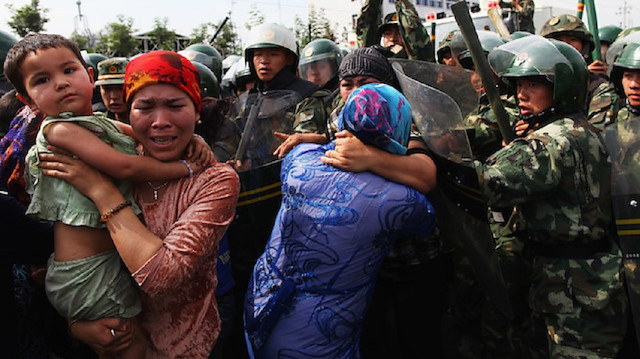
The Turkic Muslim group which makes up around 45 percent of the population of Xinjiang, has long accused China’s authorities for cultural, religious and economic discrimination
China’s ruling Communist Party has dispatched 1.1 million local government workers to infiltrate and spy on ethnic minorities in Xinjiang.
The initiative, dubbed “Pair Up and Become Family,” aims to monitor the living rooms, dining areas, Muslim prayer areas, weddings, funerals and other intimate events of ethnic minorities as part of a homestay program.
Government workers live with assigned families every two months for five days at a time.
“The government is trying to destroy that last protected space in which Uighurs have been able to maintain their identity,” said Joanne Smith Finley, an ethnographer at England’s Newcastle University.
Germany’s human rights commissioner Baerbel Kofler has criticized China over repressive policies against Uighur Muslims in northwestern Xinjiang, an autonomous region of the country.“I am shocked by reports of the treatment of the Turkic Uighur minority, more than one million of whom are estimated to be imprisoned in internment camps in Xinjiang,” she said in a statement, ahead of German-Chinese Human Rights Dialogue meeting set to start on Thursday.“Unfortunately, my request to travel to Xinjiang in the context of the dialogue was refused. I would have liked to have gained a first-hand impression of the situation there and will continue to push for permission to visit Xinjiang soon,” she said.Kofler is visiting China this week for the annual German-Chinese Human Rights Dialogue meeting.Following her talks in Beijing, she is scheduled to travel to Lhasa, Tibet, to chair the meeting on December 6-7.Xinjiang region is home to around 10 million Uyghurs. The Turkic Muslims have long accused China’s authorities of cultural, religious and economic discrimination.China stepped up its restrictions on the region in the past two years, banning men from growing beards and women from wearing veils, and introducing what many experts regard as the world’s most extensive electronic surveillance program, according to the Wall Street Journal.Up to one million people, or about seven percent of the Muslim population in China’s Xinjiang region, have now been incarcerated in an expanding network of “political re-education” camps, according to U.S. officials and United Nations experts.
Germany concerned of human rights situation in Xinjiang
Uyghurs who have taken refuge in Turkey believe the initiative aims to push them into distancing themselves from Islam toward a more secular lifestyle.
Any deviation from the lifestyle prescribed by Chinese President Xi Jinping can be dubbed by authorities as extremism.
Persons in the presence of these spies posing as faux relatives cannot pray or wear religious dress.
Abdulahir Yunus, who lives in China’s Urumqi city, said: “They cannot pray. Praying at home, or even reading the Quran, could put the whole family at risk.”
“Their aim is to assimilate Uyghurs. The Chinese want us to eat like them, sleep like them and dress like them.”
Xinjiang region is home to around 10 million Uyghurs. The Turkic Muslim group which makes up around 45 percent of the population of Xinjiang, has long accused China’s authorities for cultural, religious and economic discrimination.
A human rights activist and intellectual said he withdrew from a Beijing-sponsored forum in London to protest the detention of a million Uyghurs in China’s Xinjiang.“As a human rights activist, a Buddhist educator and a politically engaged scholar of genocide, racism and violence, I cannot, in clear conscience, participate in the three-day forum which is officially endorsed by the Government of China,” wrote Maung Zarni in his withdrawal letter on Friday.Zarni was scheduled to deliver a speech on his country Myanmar’s genocide on Dec. 7 at the 5th Global China Dialogue on Governance for Global Justice.“[…] the ruling Communist Party of China today stands credibly accused of commissioning a systematic and racially motivated persecution of Uyghur Muslims in Xinjiang Province,” he went onto say.Recalling an event, he attended in Geneva in September, Zarni said a Muslim Uyghur man delivered a speech which said his mother had died two weeks ago in one of the concentration camps and the man had not seen his mother for the last 20 years.“I was moved by this Uyghur exile – born and raised in what he and his fellow people call East Turkistan vis-à-vis China’s official name for his homeland, Xinjiang,” he said, sympathizing with the man as he also saw his mother for very brief times in the last 30 years before her death in February, “as a Burmese exile from military-controlled Burma, or Myanmar”.He also said he saw at the same event some evidence of “a vast complex of concentration camps” – as a German investigative journalist put it.“I saw photographic evidence of one complex encircled by a tall concrete wall, with watch towers, CCTV surveillance cameras and machine-gun-holding guards,” he noted.‘I begged them to kill me,’ says Uyghur woman who survived Chinese detention campChina supports Saudi Arabia in economic and social change: XiZarni recalled a statement of Gay McDougall, a member of the UN Committee, saying she was concerned about a UN report, which said China had "turned the Uighur autonomous region into something that resembles a massive internment camp".He also called on “China’s intellectuals and China-friendly global academics” to work towards reversing the “deeply troubling path” of the country.“Until then I have decided to boycott any public or private educational or cultural event that is officially backed by the Government of China.”Xinjiang region is home to around 10 million Uyghurs. The Turkic Muslims have long accused China’s authorities of cultural, religious and economic discrimination.China stepped up its restrictions on the region in the past two years, banning men from growing beards and women from wearing veils, and introducing what many experts regard as the world’s most extensive electronic surveillance program, according to the Wall Street Journal.Up to 1 million people, or about 7 percent of the Muslim population in China’s Xinjiang region, have now been incarcerated in an expanding network of “political re-education” camps, according to U.S. officials and United Nations experts.Trump, China's Xi poised for high-stakes summit over trade warChina’s ‘vocational camps’ employ draconian measures, use 360-degree surveillance in washrooms
Academic withdraws from China-backed event for Uyghurs
Mihrigul Tursun, a 29-year-old Uyghur Muslim, said the torture and abuse at one of the internment camps Chinese authorities use to detain 1.5 million people from religious minorities was so bad she begged for death.“I thought that I would rather die than go through this torture and begged them to kill me,” she said at the National Press Club in Washington.After her second arrest in 2017, Tursun said she was interrogated for four consecutive days without sleep, had her hair shaved, was electrocuted and also forced into an intrusive medical examination.Tursun moved from China to Egypt to study, and met her husband there. She had triplets and returned to China in 2015 to see her family.China’s ‘vocational camps’ employ draconian measures, use 360-degree surveillance in washroomsShe was immediately arrested and her children were taken from her. Three months later, she was released only to find that one of her triplets had died and the others had developed health issues.Two years later, she was arrested again and then released only to be arrested for a third time.Tursun said she shared a prison cell with 60 other women for three months, during which nine of her cellmates died. The women had to take turns sleeping and even use the bathroom while being watched by surveillance cameras. “The authorities put a helmet-like thing on my head, and each time I was electrocuted, my whole body would shake violently and I would feel the pain in my veins,” Tursun said, referring to an incident when she was made to sit a high chair and her legs and arms were shackled.“I don’t remember the rest. White foam came out of my mouth, and I began to lose consciousness. The last word I heard them saying is that you being a Uighur is a crime,” she added.Tursun said the facility employees forced the inmates, including herself, to take strange medication, some of which caused them to faint. The inmates were also made to drink a white liquid that caused some women to bleed and others to stop menstruating.Ultimately Tursun was freed so she could take her children to Egypt but she was directed to return to China. Once she arrived in Egypt, she reached out to the U.S. and has resided in Virginia since September.Scholars condemn China for mass detention of Muslim UighursMany refer to China’s Xinjiang Uighur Autonomous Region -- home to many ethnic minority groups, including Turkic Uighur people -- as East Turkestan.They believe that the Uighur are among a number of Turkic tribes that inhabit the region, and consider it to be part of Central Asia, not China.Established under the pretext of “political reeducation” for China’s Muslim population, Beijing has amped up its construction of detention camps in the past three months, expanding them by an additional 700,000 square meters, according to satellite imagery.China’s Muslim incarceration camps have attracted heavy criticism from the international community as Beijing continually denied their existence and repeatedly rejected allegations of abuses against the country’s Uighur minority for years, opting to call them “vocational camps” instead.Xinjiang region is home to around 10 million Uighurs. The Turkic Muslim group which makes up around 45 percent of the population of Xinjiang, has long accused China’s authorities for cultural, religious and economic discrimination.In rare coordinated move, Western envoys seek meeting on Xinjiang concernsHundreds in US march in solidarity for UyghursGermany cannot accept China’s camps for Uighur MuslimsSecurity spending soars in China's troubled Xinjiang region: report
‘I begged them to kill me,’ says Uyghur woman who survived Chinese detention camp
The 1.5 million “prisoners,” a million of whom are Uighur Muslims, locked up in China’s “vocational training centers” in Xinjiang are subject to such severe indoctrination and security measures that “some are tortured and die there,” the Bitter Winter online magazine reported on Monday.The report is based on a video published by Bitter Winter on Nov. 26 that delves inside one of the centers in the Yining area of Xinjiang.The video shows a complex with various buildings, each four stories tall. The windows are barred and also have netting. Each exit is monitored by three surveillance cameras. The inside of the buildings are highly reminiscent of typical prisons.“Each room has double iron doors, and the outermost iron door also has guard railing and a keypad lock. Up to 15 people can live in each dorm. Surveying has also revealed that each floor holds 28 dorm rooms and three classrooms,” the Bitter Winter reported. The building shown in the shocking video also reveals a surveillance room. “From the large-screen monitor, it is apparent that 360-degree surveillance cameras are installed in every corner of the building—including not only classrooms, dormitories and corridors, but even washrooms. Every move by the detainees is monitored, 24 hours a day. They are totally deprived of freedom and privacy.”The draconian security measures are used to keep people inside and prevent them from escaping. The building is also littered with propaganda aimed at assimilating those being held.“A slogan is written on the external walls of the buildings, which reads: ‘Heartfelt thanks for the cordial care of the [Chinese Communist] Party’s central committee, with comrade Xi Jinping as the core,’” the Bitter Winter reported. “Various slogans are written on the walls outside of the classrooms, such as: ‘Make a habit of studying Mandarin’ (intended for Uyghurs, who normally do not speak Mandarin but only their own Uyghur language) and ‘Follow the guidance of Xi Jinping’s thought on socialism with Chinese characteristics for a new era, and untiringly strive to achieve the dream of the people of China to bring about a great rejuvenation of the Chinese nation.’”Many refer to China’s Xinjiang Uighur Autonomous Region -- home to many ethnic minority groups, including Turkic Uighur people -- as East Turkestan.They believe that the Uighur are among a number of Turkic tribes that inhabit the region, and consider it to be part of Central Asia, not China. Established under the pretext of “political reeducation” for China’s Muslim population, Beijing has amped up its construction of detention camps in the past three months, expanding them by an additional 700,000 square meters, according to satellite imagery.China’s Muslim incarceration camps have attracted heavy criticism from the international community as Beijing continually denied their existence and repeatedly rejected allegations of abuses against the country’s Uighur minority for years, opting to call them “vocational camps” instead.Xinjiang region is home to around 10 million Uighurs. The Turkic Muslim group which makes up around 45 percent of the population of Xinjiang, has long accused China’s authorities for cultural, religious and economic discrimination.Scholars condemn China for mass detention of Muslim UighursIn rare coordinated move, Western envoys seek meeting on Xinjiang concernsGermany cannot accept China’s camps for Uighur MuslimsChina says world should ignore 'gossip' about XinjiangChina triples spending to expand detention camps for Uighur Muslims
China’s ‘vocational camps’ employ draconian measures, use 360-degree surveillance in washrooms
Countries must hit China with sanctions over the mass detention of ethnic Uighurs, hundreds of scholars said on Monday, warning that a failure to act would signal acceptance of "psychological torture of innocent civilians".Beijing has in recent months faced an outcry from activists, academics and foreign governments over mass detentions and strict surveillance of the Muslim Uighur minority and other ethnic groups in the restive western region of Xinjiang.In August, a U.N. human rights panel said it had received many credible reports that a million or more Uighurs and other minorities are being held in what resembles a "massive internment camp that is shrouded in secrecy" in the region.Representatives from a group of 278 scholars in various disciplines from dozens of countries called on China at a news briefing in Washington to end its detention policies, and for sanctions directed at key Chinese leaders and security companies linked to the abuses."This situation must be addressed to prevent setting negative future precedents regarding the acceptability of any state's complete repression of a segment of its population, especially on the basis of ethnicity or religion," the group said in a statement.Bangladesh to handle Rohingya resettlement after pollsCountries should expedite asylum requests from Xinjiang's Muslim minorities, as well as "spearhead a movement for U.N. action aimed at investigating this mass internment system and closing the camps", it said.China rejects criticism of its actions in Xinjiang, saying that it protects the religion and culture of minorities, and that its security measures are needed to combat the influence of "extremist" groups that incite violence there.The country's Foreign Minister Wang Yi has said the world should ignore "gossip" about Xinjiang and trust the government.But after initial denials about the detention camps, Chinese officials have said some people guilty of minor offences were being sent to "vocational" training centers, where they are taught work skills and legal knowledge aimed at curbing militancy.Chinese foreign ministry spokesman Geng Shuang said on Tuesday China's Xinjiang policies stemmed entirely from the need to combat terrorism."We resolutely oppose any foreign forces trying to interfere with Xinjiang affairs and China's domestic politics," he said at a regular news briefing in Beijing.Michael Clarke, a Xinjiang expert at Australian National University who signed the statement, told reporters that China sought international respect for its weight in global affairs."The international community needs to demonstrate to Beijing that it will not actually get that while it's doing this to a significant portion of its own citizenry," Clarke said.
Scholars condemn China for mass detention of Muslim Uighurs