

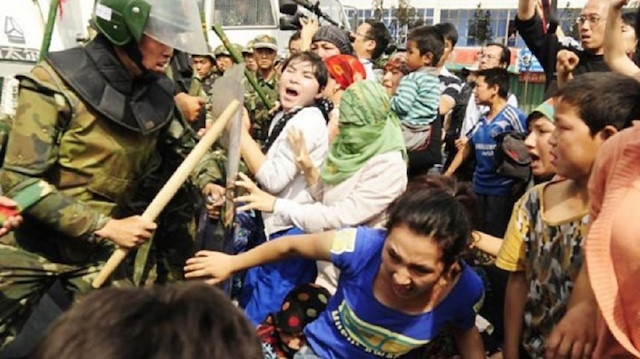
File photo
Countries must hit China with sanctions over the mass detention of ethnic Uighurs, hundreds of scholars said on Monday, warning that a failure to act would signal acceptance of "psychological torture of innocent civilians".
Beijing has in recent months faced an outcry from activists, academics and foreign governments over mass detentions and strict surveillance of the Muslim Uighur minority and other ethnic groups in the restive western region of Xinjiang.
In August, a U.N. human rights panel said it had received many credible reports that a million or more Uighurs and other minorities are being held in what resembles a "massive internment camp that is shrouded in secrecy" in the region.
Representatives from a group of 278 scholars in various disciplines from dozens of countries called on China at a news briefing in Washington to end its detention policies, and for sanctions directed at key Chinese leaders and security companies linked to the abuses.
"This situation must be addressed to prevent setting negative future precedents regarding the acceptability of any state's complete repression of a segment of its population, especially on the basis of ethnicity or religion," the group said in a statement.
Two big initiatives to resolve the Rohingya crisis -- repatriation since mid-November and resettlement since early October -- have been stalled for an indefinite period due to the persecuted refugees’ reluctance on the grounds of security and rights.Both issues are likely to be dealt with by the new government of Bangladesh following the year-end general election.Speaking on condition of anonymity, more than one high Bangladeshi government official confirmed to Anadolu Agency that before the Dec. 30 national election there is no possibility of working on the Rohingya crisis.More than 750,000 Rohingya people fled to Bangladesh and took shelter in makeshift camps at the southeastern coastal district of Cox’s Bazar since Aug. 25, 2017, when forces in neighboring Myanmar launched a crackdown on the minority Muslim community in Rakhine state.On the one hand, Rohingya Muslims have vowed not to go back to Myanmar -- their country of origin -- without citizenship rights, ethnic identity, guarantees of safety, and returning to their original homes and lands. On the other hand, most are afraid to move to Bhasan Char, a distant island reportedly prone to bad weather.Bangladeshi Prime Minister Sheikh Hasina was scheduled to open the new settlement for 100,000 Rohingya refugees at Bhashan Char on Oct. 3, but this has been postponed indefinitely.Under a consensus of the two countries -- Bangladesh and Myanmar -- in a first phase more than 2,200 Rohingya were planned to be repatriated on Nov. 15, although international NGOs and the United Nations have repeatedly urged Bangladesh to do it on voluntary basis, as tens of thousands of Rohingya in Myanmar are still confined to detention centers and Myanmar’s government still does not accept the Rohingya as citizens.Amid such uncertainty, the work on isolated Bhasan Char at an estuary of the Meghna River is close to being finished.South Africa's Gordhan files defamation complaint against left-wing party leadersWorking people are happyTens of thousands of low-income working people of riverine Bangladesh’s coastal area are happy about the resettlement project.Mohammad Rajib, 30, a mason and native of another remote island, Hatia, in the southern Noakhali district, now working at the Rohingya resettlement project for about six months, told Anadolu Agency that he is happy as his daily income is now 800 Bangladeshi taka (around $10), about twice his previous irregular income.Like Rajib, thousands of workers from all over Bangladesh are now working in the project at Bhasan Char, a muddy islet that emerged from the Bay of Bengal in 2006.In this remote coastal area, hundreds of construction workers and day laborers are on the move every day by trawler or engine boat to and from Bhasan Char. They are pleased with the opportunity to earn extra income.“I think that after completing the project, an extension will be started, as more than one million Rohingya are living in Cox’s Bazar and Teknaf areas [in southeastern Bangladesh] and they need a new location,” Abdur Rahim, a trader running a small hotel on Bashan Char, told Anadolu Agency.Excluding construction, many people from surrounding areas are also running small hotels and tea stalls on Bhasan Char and dream of better livelihoods from the project.South Africa's Ramaphosa signs minimum wage bill into lawNon-beneficiaries confusedLocals who do not benefit from the project, however, see things a bit different. They fear the long-term impact of the relocation of 100,000 outsiders.Abdul Khaleq, a businessman on Hatia, told Anadolu Agency that the resettlement on this distant island will never be temporary. It must turn permanent, as the Rohingya population growth rate is very high.“Some of the Rohingya must leave anyhow and try to get involved in criminal activities to earn money,” claimed Mohammad Momin, a bank employee on the island.So many Rohingya living on an isolated islet depending on relief aid and under the watchful eye of law enforcement is no laughing matter, said Hatia schoolteacher Abdul Hamid.Alternative developmentWhat will happen if the Rohingya are not relocated to Bhasan Char? A Navy commander seeking anonymity told Anadolu Agency that still, tens of thousands of local people in coastal areas are completely homeless due to river erosion.The Bangladeshi government has also prepared a list of the victims of river erosion. This project is for the permanent development of Bangladesh, and in case of failure of the Rohingya resettlement here, the government may rehabilitate its own homeless people, the Navy official said.The Bangladesh naval force can also use this settlement in many ways as it is the first permanent structure of its kind closest to the Bay of Bengal, another navy commander told Anadolu on condition of anonymity.Relocation in 4 phasesBangladesh's Disaster Management and Relief Minister Mofazzal Hossain Chowdhury said earlier this month that 25,000 Rohingya will be relocated to Bhasan Char in the first phase following the formal inauguration of the prime minister.Gradually, the remaining 75,000 Rohingya will be resettled in three phases in the shortest time possible, he added.The project includes arrangements of schools for children, hospitals with modern equipment and even mosques, he said, adding that Rohingya would have the opportunity to fish and farm cattle.Tunisians protest planned visit of Saudi crown princeRohingya PlightSince Aug. 25, 2017, nearly 24,000 Rohingya Muslims have been killed by Myanmar’s state forces, according to the Ontario International Development Agency (OIDA).In a recent report, Forced Migration of Rohingya; The Untold Experience, the OIDA raised the estimated number of murdered Rohingya to 23,962 (± 881) from a Doctors Without Borders figure of 9,400.More than 34,000 Rohingya were also thrown into fires, while over 114,000 others were beaten, the OIDA report said, adding that 17,718 (±780) Rohingya women and girls were raped by Myanmar’s army and police. Over 115,000 Rohingya houses were also burned down and 113,000 others vandalized, it added.According to Amnesty International, more than 750,000 Rohingya refugees, mostly children and women, have fled Myanmar and crossed into Bangladesh after Myanmar forces launched a crackdown on the minority Muslim community.The latest UN Fact-Finding Mission on Myanmar has found the country's military guilty of genocide and crimes against humanity including rape, gang rape, sexual slavery, forced nudity, mutilations, torture, persecution, and enslavement.Bangladesh faces refugee anger over term 'Rohingya', data collection
Bangladesh to handle Rohingya resettlement after polls
Countries should expedite asylum requests from Xinjiang's Muslim minorities, as well as "spearhead a movement for U.N. action aimed at investigating this mass internment system and closing the camps", it said.
China rejects criticism of its actions in Xinjiang, saying that it protects the religion and culture of minorities, and that its security measures are needed to combat the influence of "extremist" groups that incite violence there.
The country's Foreign Minister Wang Yi has said the world should ignore "gossip" about Xinjiang and trust the government.
But after initial denials about the detention camps, Chinese officials have said some people guilty of minor offences were being sent to "vocational" training centers, where they are taught work skills and legal knowledge aimed at curbing militancy.
Chinese foreign ministry spokesman Geng Shuang said on Tuesday China's Xinjiang policies stemmed entirely from the need to combat terrorism.
"We resolutely oppose any foreign forces trying to interfere with Xinjiang affairs and China's domestic politics," he said at a regular news briefing in Beijing.
Michael Clarke, a Xinjiang expert at Australian National University who signed the statement, told reporters that China sought international respect for its weight in global affairs.
"The international community needs to demonstrate to Beijing that it will not actually get that while it's doing this to a significant portion of its own citizenry," Clarke said.