

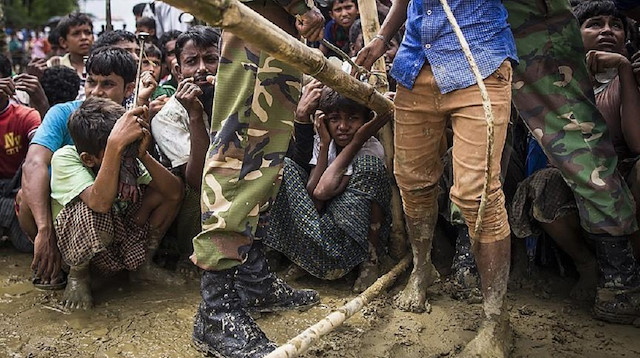
File Photo
Two big initiatives to resolve the Rohingya crisis -- repatriation since mid-November and resettlement since early October -- have been stalled for an indefinite period due to the persecuted refugees’ reluctance on the grounds of security and rights.
Both issues are likely to be dealt with by the new government of Bangladesh following the year-end general election.
Speaking on condition of anonymity, more than one high Bangladeshi government official confirmed to Anadolu Agency that before the Dec. 30 national election there is no possibility of working on the Rohingya crisis.
More than 750,000 Rohingya people fled to Bangladesh and took shelter in makeshift camps at the southeastern coastal district of Cox’s Bazar since Aug. 25, 2017, when forces in neighboring Myanmar launched a crackdown on the minority Muslim community in Rakhine state.
On the one hand, Rohingya Muslims have vowed not to go back to Myanmar -- their country of origin -- without citizenship rights, ethnic identity, guarantees of safety, and returning to their original homes and lands. On the other hand, most are afraid to move to Bhasan Char, a distant island reportedly prone to bad weather.
Bangladeshi Prime Minister Sheikh Hasina was scheduled to open the new settlement for 100,000 Rohingya refugees at Bhashan Char on Oct. 3, but this has been postponed indefinitely.
Under a consensus of the two countries -- Bangladesh and Myanmar -- in a first phase more than 2,200 Rohingya were planned to be repatriated on Nov. 15, although international NGOs and the United Nations have repeatedly urged Bangladesh to do it on voluntary basis, as tens of thousands of Rohingya in Myanmar are still confined to detention centers and Myanmar’s government still does not accept the Rohingya as citizens.
Amid such uncertainty, the work on isolated Bhasan Char at an estuary of the Meghna River is close to being finished.
South Africa's Public Enterprises Minister Pravin Gordhan on Monday filed a defamation complaint against radical leftist Economic Freedom Fighters (EFF) leaders who have accused him and his daughter of corruption.In a speech last week, EFF leader Julius Malema said Gordhan's daughter Anisha was awarded government contracts as a result of her father's position in government. Gordhan denies any wrongdoing, and also says his daughter is not corrupt.The case between Gordhan and Malema could open a new avenue of political jostling between the parties months before a national election, where the smaller EFF is trying to use an anti-corruption platform to challenge key figures in the ruling African National Congress party.At least thirty killed as boat capsized in UgandaKenya puts bounty on Italian aid worker abductorsGordhan, a former finance minister respected by international investors for standing up to former president Jacob Zuma, filed a complaint of crimen injuria and criminal defamation and asked the police to investigate any incitement to violence contained in Malema's speech.Crimen injuria is an act of unlawfully, intentionally and seriously impairing the dignity of another.Gordhan also laid another complaint at the Equality Court, seeking an apology from Malema and his deputy Floyd Shivambu, as well as damages of 150,000 rand ($11,000)."The determined defence of corruption and the corrupt, using personal attacks, racism and alleged hate speech is not acceptable and must be challenged," Gordhan said.34 pro-Biafran protesters held in Southern NigeriaCentral African Republic militia leader appears at ICC"I have not responded until now to the absolute nonsensical and unsubstantiated attacks, but extending these attacks to my family and threatening harmony amongst the people of South Africa was a step too far. Enough is enough."The EFF spokesman did not answer calls to his mobile phone seeking comment on Gordhan's complaint. An official at the party's headquarters said the EFF leaders were meeting and could issue a statement later.Malema tweeted that he would open a criminal case against Gordhan on Tuesday on charges ranging from money laundering, corruption, racketeering to fraud. He did not provide details.Malema made the allegations against Gordhan last week at an EFF rally held outside a building where Gordhan was giving testimony at a judicial inquiry into allegations of state corruption and influence-peddling in Zuma's administration.Zuma has denied the allegations. The allegations and other scandals surrounding Zuma's nine-year rule forced him out of office in February. ($1 = 13.8090 rand) (Reporting by Olivia Kumwenda-Mtambo; Editing by James Macharia and Alison Williams)Tunisians urge demonstrations ahead of bin Salman visitAfrican Union reveals list of abuses within commission
South Africa's Gordhan files defamation complaint against left-wing party leaders
Working people are happy
Tens of thousands of low-income working people of riverine Bangladesh’s coastal area are happy about the resettlement project.
Mohammad Rajib, 30, a mason and native of another remote island, Hatia, in the southern Noakhali district, now working at the Rohingya resettlement project for about six months, told Anadolu Agency that he is happy as his daily income is now 800 Bangladeshi taka (around $10), about twice his previous irregular income.
Like Rajib, thousands of workers from all over Bangladesh are now working in the project at Bhasan Char, a muddy islet that emerged from the Bay of Bengal in 2006.
In this remote coastal area, hundreds of construction workers and day laborers are on the move every day by trawler or engine boat to and from Bhasan Char. They are pleased with the opportunity to earn extra income.
“I think that after completing the project, an extension will be started, as more than one million Rohingya are living in Cox’s Bazar and Teknaf areas [in southeastern Bangladesh] and they need a new location,” Abdur Rahim, a trader running a small hotel on Bashan Char, told Anadolu Agency.
Excluding construction, many people from surrounding areas are also running small hotels and tea stalls on Bhasan Char and dream of better livelihoods from the project.
South Africa's President Cyril Ramaphosa has signed into law the national minimum wage bill, his office said on Monday, part of efforts by the government to tackle wage inequality in Africa's most industrialised economy.The National Minimum Wage Act sets South Africa's minimum wage at 20 rand ($1.45) an hour, equal to 3,500 rand per month. The law will come into force on a date to be determined by Ramaphosa, the presidency said.Supporters of the minimum wage say it will reduce inequality and stimulate economic growth as workers spend more.But critics say it could lead to increased unemployment, already at record highs, because some employers won't be able to afford higher wage bills.Thousands of union members protested against the proposed minimum wage in April, saying it was too low.Ramaphosa's office said in a statement that while the national minimum wage will not end income inequality, it was a first step towards adressing the clamour for a living wage. ($1 = 13.8072 rand) 
South Africa's Ramaphosa signs minimum wage bill into law
Non-beneficiaries confused
Locals who do not benefit from the project, however, see things a bit different. They fear the long-term impact of the relocation of 100,000 outsiders.
Abdul Khaleq, a businessman on Hatia, told Anadolu Agency that the resettlement on this distant island will never be temporary. It must turn permanent, as the Rohingya population growth rate is very high.
“Some of the Rohingya must leave anyhow and try to get involved in criminal activities to earn money,” claimed Mohammad Momin, a bank employee on the island.
So many Rohingya living on an isolated islet depending on relief aid and under the watchful eye of law enforcement is no laughing matter, said Hatia schoolteacher Abdul Hamid.
Alternative development
What will happen if the Rohingya are not relocated to Bhasan Char? A Navy commander seeking anonymity told Anadolu Agency that still, tens of thousands of local people in coastal areas are completely homeless due to river erosion.
The Bangladeshi government has also prepared a list of the victims of river erosion. This project is for the permanent development of Bangladesh, and in case of failure of the Rohingya resettlement here, the government may rehabilitate its own homeless people, the Navy official said.
The Bangladesh naval force can also use this settlement in many ways as it is the first permanent structure of its kind closest to the Bay of Bengal, another navy commander told Anadolu on condition of anonymity.
Relocation in 4 phases
Bangladesh's Disaster Management and Relief Minister Mofazzal Hossain Chowdhury said earlier this month that 25,000 Rohingya will be relocated to Bhasan Char in the first phase following the formal inauguration of the prime minister.
Gradually, the remaining 75,000 Rohingya will be resettled in three phases in the shortest time possible, he added.
The project includes arrangements of schools for children, hospitals with modern equipment and even mosques, he said, adding that Rohingya would have the opportunity to fish and farm cattle.
Tunisians took to the streets on Monday in protest of the planned visit of Saudi Arabia’s crown prince to their country.As part of his first overseas tour since the killing of Washington Post columnist Jamal Khashoggi in the Saudi Consulate in Istanbul, Mohammad bin Salman arrived in Egypt on Monday.Though the Saudi Royal Court did not name other countries that bin Salman is due to visit, the crown prince is also expected to visit Tunisia, Algeria, and Mauritania.Tunisia NGOs lead demos against bin Salman's visitTunisia activists to protest against Saudi Crown prince visitHundreds of demonstrators swarmed the central Habib Bourguiba Avenue in Tunis, protesting the arrival by the crown prince following the announcement of his planned visit by Tunisian presidential spokeswoman Saida Garrach.While Saudi Arabia has blamed the Oct. 2 killing of Khashoggi on a rogue hit squad, weeks of shifting explanations aroused suspicions. A CIA assessment earlier this month implicated bin Salman in the slaying.After initially saying he had left the consulate alive, the Saudi administration admitted weeks later that he was killed there.Tunisia was the birthplace of the "Arab Spring" uprisings that swept the Middle East and North Africa in early 2011 which overthrew the regime of the authoritarian ruler, Zein Al Abidine Ben Ali.After fleeing Tunisia amid heightened protests against his rule, Ben Ali went to Saudi Arabia, where he currently resides.Tunisian union calls national strike to press wage demandsTunisian PM seeks realistic pay deal with union
Tunisians protest planned visit of Saudi crown prince
Rohingya Plight
Since Aug. 25, 2017, nearly 24,000 Rohingya Muslims have been killed by Myanmar’s state forces, according to the Ontario International Development Agency (OIDA).
In a recent report, Forced Migration of Rohingya; The Untold Experience, the OIDA raised the estimated number of murdered Rohingya to 23,962 (± 881) from a Doctors Without Borders figure of 9,400.
More than 34,000 Rohingya were also thrown into fires, while over 114,000 others were beaten, the OIDA report said, adding that 17,718 (±780) Rohingya women and girls were raped by Myanmar’s army and police. Over 115,000 Rohingya houses were also burned down and 113,000 others vandalized, it added.
According to Amnesty International, more than 750,000 Rohingya refugees, mostly children and women, have fled Myanmar and crossed into Bangladesh after Myanmar forces launched a crackdown on the minority Muslim community.
The latest UN Fact-Finding Mission on Myanmar has found the country's military guilty of genocide and crimes against humanity including rape, gang rape, sexual slavery, forced nudity, mutilations, torture, persecution, and enslavement.
Rohingya refugees from Myanmar in camps in Bangladesh began a protest on Monday, demanding that Bangladesh recognise their ethnicity as Rohingya and that officials and aid agencies stop sharing their family information with Myanmar.Markets were shut at several of the refugee camps in southeast Bangladesh because of the protest. Rohingya working with non-government groups and the U.N. High Commissioner for Refugees also boycotted their jobs as part of the strike."The term 'Rohingya' is very important because we have been persecuted because of our identity," the protesting refugees said in a statement, adding that while the term was banned in Myanmar, it should not be banned in Bangladesh.More than 700,000 Muslim Rohingya fled a sweeping army crackdown in mostly Buddhist Myanmar's Rakhine State last year, according to U.N. agencies. The crackdown was launched in response to Rohingya insurgent attacks on security forces.Bangladeshi opposition leader found deadRohingya regard themselves as native to western Myanmar's Rakhine State but Myanmar authorities and many citizens regard them as illegal immigrants from the Indian subcontinent.Many are stateless as a 1982 law restricts citizenship for the Rohingya and other minorities not considered members of one of Myanmar's "national races".The Myanmar government refuses even to use the word "Rohingya", as that would imply a distinct identify, instead calling them "Bengali".Bangladesh has been urging the refugees to accept smart cards that help with identification and the distribution of aid. The smart cards however, identify an individual as a "forcibly displaced Myanmar national" and not as Rohingya.The protesters also expressed concern about a UNHCR plan to collect biometric data and copies of documents, as they fear the UNHCR and Bangladeshi authorities could share the data with Myanmar, which could use the information against them.Ireland 'very concerned' over situation in MyanmarBangladeshi authorities were not immediately reachable for comment.Firas Al-Khateeb, a UNHCR representative, said data was being collected for a verification process which would help Rohingya refugees get better protection and ensure their access to services in Bangladesh."It is not linked to repatriation," he said, adding that the data was jointly maintained by Bangladesh and the UNHCR.Refugees are refusing to return to Myanmar under a repatriation plan unless demands for justice, citizenship and the ability to go back to their original villages and lands are met.The refugees say they had to flee from their homes after Myanmar soldiers and Buddhist civilians massacred families, burned villages and carried out gang rapes.U.N-mandated investigators have accused the Myanmar army of "genocidal intent" and ethnic cleansing.Myanmar denies almost all the accusations, saying its forces engaged in a counter-insurgency operation against "terrorists". 
Bangladesh faces refugee anger over term 'Rohingya', data collection