

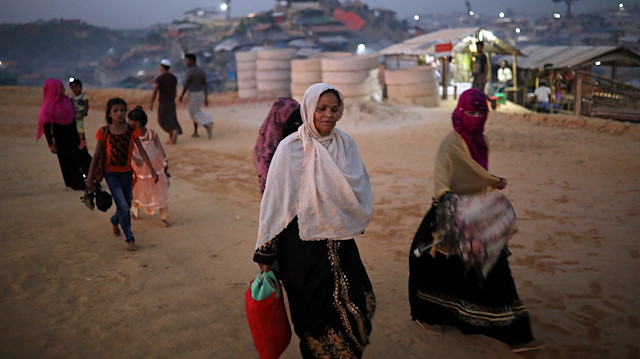
Rohingya refugees walk along the road in the evening at Balukhali camp in Cox’s Bazar, Bangladesh
Rohingya refugees from Myanmar in camps in Bangladesh began a protest on Monday, demanding that Bangladesh recognise their ethnicity as Rohingya and that officials and aid agencies stop sharing their family information with Myanmar.
Markets were shut at several of the refugee camps in southeast Bangladesh because of the protest. Rohingya working with non-government groups and the U.N. High Commissioner for Refugees also boycotted their jobs as part of the strike.
"The term 'Rohingya' is very important because we have been persecuted because of our identity," the protesting refugees said in a statement, adding that while the term was banned in Myanmar, it should not be banned in Bangladesh.
More than 700,000 Muslim Rohingya fled a sweeping army crackdown in mostly Buddhist Myanmar's Rakhine State last year, according to U.N. agencies. The crackdown was launched in response to Rohingya insurgent attacks on security forces.
A district leader of Bangladesh’s main opposition party who had come to the capital to seek its nomination to compete in December general elections was found dead after allegedly being picked up by police, local media reported Thursday.Abu Bakar Abu, 58, vice-president of the Jashore district unit of the Bangladesh Nationalist Party (BNP), had arrived in Dhaka to attend his nomination interview and went missing from his hotel four days ago.His body was discovered Tuesday floating in the Buriganga River near the capital, local news agency Bdnews24.com reported, quoting a police officer.“The body has almost decomposed. There were an undershirt and pajamas on the body. His nephews identified him as Abu Bakar Abu,” the officer said.Bangladesh halts scheduled Rohingya repatriationAbu’s relatives said some people claiming to be his kidnappers had phoned them earlier and demanded a ransom. They paid US$2,025 but he had not been freed, the report added.The victim had been elected chairman of the Majidpur union council in Jashore four times.The BNP alleged at a press conference Thursday that the police had picked up Abu from his hotel and brutally murdered him before dumping his body in the river.They also alleged that over the last several days, a number of their leaders and activists had been picked up by police to sow fear among opposition party members before the elections.Bangladesh to persuade Rohingyas to leave ‘voluntarily’
Bangladeshi opposition leader found dead
Rohingya regard themselves as native to western Myanmar's Rakhine State but Myanmar authorities and many citizens regard them as illegal immigrants from the Indian subcontinent.
Many are stateless as a 1982 law restricts citizenship for the Rohingya and other minorities not considered members of one of Myanmar's "national races".
The Myanmar government refuses even to use the word "Rohingya", as that would imply a distinct identify, instead calling them "Bengali".
Bangladesh has been urging the refugees to accept smart cards that help with identification and the distribution of aid. The smart cards however, identify an individual as a "forcibly displaced Myanmar national" and not as Rohingya.
The protesters also expressed concern about a UNHCR plan to collect biometric data and copies of documents, as they fear the UNHCR and Bangladeshi authorities could share the data with Myanmar, which could use the information against them.
Irish Foreign Minister Simon Coveney said he remains gravely concerned over the situation in Myanmar and the plight of refugees there.In a recent reply to a question in parliament from politician Maureen O'Sullivan on how concerns regarding the safe repatriation of the Rohingya to Myanmar can be addressed, Coveney said since the Myanmar army launched security operations in Rakhine state in August of last year, approximately 720,000 refugees, mostly Rohingya, have fled to Bangladesh."The people and government of Bangladesh have demonstrated extraordinary generosity in receiving such a large influx of refugees in very difficult circumstances," he said. "I remain very concerned at the ongoing situation in Myanmar and the plight of these refugees, who are living in extremely precarious conditions in overcrowded refugee camps."Coveney stressed that the signing of memoranda of understanding between Myanmar and Bangladesh and Myanmar and the United Nations Development Programme (UNDP) and UN Refugee Agency (UNHCR) on the repatriation of the Rohingya have been “important first steps on this path of return".But he noted that current conditions on the ground in Myanmar are not conducive to allow for the voluntary, safe, dignified and sustainable repatriation of Rohingya."In that regard, I am concerned by the recent arrangement between Myanmar and Bangladesh to begin the return of up to 5,000 refugees in the near future. I note the concerns expressed by UNHCR, who are on the ground, and the fact that UN agencies have not been included in these discussions. I also note concerning reports that many of the refugees concerned do not wish to be repatriated, given conditions on the ground in Rakhine state."Therefore, I call on Myanmar and Bangladesh to reconsider this arrangement and to take the necessary steps to create such conditions before taking any further or premature steps towards repatriation," he said.Coveney also called on the parties to undertake further dialogue with international partners while also allowing the voices of the refugee community to play a key role in determining their future.The Rohingya, described by the UN as the world's most persecuted people, have faced heightened fears of attack since dozens were killed in communal violence in 2012.Since Aug. 25, 2017, nearly 24,000 Rohingya Muslims have been killed by Myanmar’s state forces, according to a report by the Ontario International Development Agency (OIDA).More than 34,000 Rohingya were also thrown into fires, while over 114,000 others were beaten, said the OIDA report, titled "Forced Migration of Rohingya: The Untold Experience."Some 18,000 Rohingya women and girls were raped by Myanmar’s army and police and over 115,000 Rohingya homes were burned down and 113,000 others vandalized, it added.According to Amnesty International, more than 750,000 Rohingya refugees, mostly women and children, fled Myanmar and crossed into neighboring Bangladesh after Myanmar forces launched a crackdown on the minority Muslim community in August 2017. The UN has documented mass gang rapes, killings -- including of infants and young children -- brutal beatings and disappearances committed by Myanmar state forces. In a report, UN investigators said such violations may have constituted crimes against humanity.
Ireland 'very concerned' over situation in Myanmar
Bangladeshi authorities were not immediately reachable for comment.
Firas Al-Khateeb, a UNHCR representative, said data was being collected for a verification process which would help Rohingya refugees get better protection and ensure their access to services in Bangladesh.
"It is not linked to repatriation," he said, adding that the data was jointly maintained by Bangladesh and the UNHCR.
Refugees are refusing to return to Myanmar under a repatriation plan unless demands for justice, citizenship and the ability to go back to their original villages and lands are met.
The refugees say they had to flee from their homes after Myanmar soldiers and Buddhist civilians massacred families, burned villages and carried out gang rapes.
U.N-mandated investigators have accused the Myanmar army of "genocidal intent" and ethnic cleansing.
Myanmar denies almost all the accusations, saying its forces engaged in a counter-insurgency operation against "terrorists".