

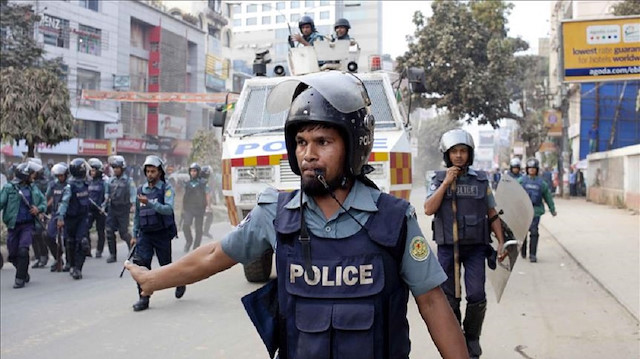
File photo
A district leader of Bangladesh’s main opposition party who had come to the capital to seek its nomination to compete in December general elections was found dead after allegedly being picked up by police, local media reported Thursday.
Abu Bakar Abu, 58, vice-president of the Jashore district unit of the Bangladesh Nationalist Party (BNP), had arrived in Dhaka to attend his nomination interview and went missing from his hotel four days ago.
His body was discovered Tuesday floating in the Buriganga River near the capital, local news agency Bdnews24.com reported, quoting a police officer.
“The body has almost decomposed. There were an undershirt and pajamas on the body. His nephews identified him as Abu Bakar Abu,” the officer said.
The Bangladeshi government on Thursday halted the first scheduled Rohingya repatriation to Myanmar following protests by the refugees. Md Abul Kalam, commissioner of the Bangladesh Refugee Relief and Repatriation Commission, told Anadolu Agency that all preparations were complete from their side, but the Rohingya were not willing to return to their home country.The formal process has not been suspended, he said, adding that the government will continue talks with the refugees in hopes to motivate them to willingly return.Earlier on Thursday, Rohingya refugees staged a protest in Cox's Bazar city against the scheduled repatriation saying their lives are at risk in their native Rakhine state.Troops have been deployed at the camps to prevent an outbreak of violence.According to a joint agreement between the Myanmar and Bangladeshi government, repatriation of 2,200 refugees was to begin on Thursday.However, rights groups, the UN and the U.S. have argued that the lives of the refugees in their home country are in danger.The Rohingya, described by the UN as the world's most persecuted people, have faced heightened fears of attack since dozens were killed in communal violence in 2012.Since Aug. 25, 2017, nearly 24,000 Rohingya Muslims have been killed by Myanmar’s state forces, according to a report by the Ontario International Development Agency (OIDA).More than 34,000 Rohingya were also thrown into fires, while over 114,000 others were beaten, said the OIDA report, titled "Forced Migration of Rohingya: The Untold Experience."Some 18,000 Rohingya women and girls were raped by Myanmar’s army and police and over 115,000 Rohingya homes were burned down and 113,000 others vandalized, it added.According to Amnesty International, more than 750,000 Rohingya refugees, mostly children, and women, fled Myanmar and crossed into neighboring Bangladesh after Myanmar forces launched a crackdown on the minority Muslim community in August 2017.The UN has documented mass gang rapes, killings -- including of infants and young children -- brutal beatings, and disappearances committed by Myanmar state forces. In a report, UN investigators said such violations may have constituted crimes against humanity.
Bangladesh halts scheduled Rohingya repatriation
Abu’s relatives said some people claiming to be his kidnappers had phoned them earlier and demanded a ransom. They paid US$2,025 but he had not been freed, the report added.
The victim had been elected chairman of the Majidpur union council in Jashore four times.
The BNP alleged at a press conference Thursday that the police had picked up Abu from his hotel and brutally murdered him before dumping his body in the river.
They also alleged that over the last several days, a number of their leaders and activists had been picked up by police to sow fear among opposition party members before the elections.
Bangladeshi authorities have announced the repatriation of Rohingya Muslims to Myanmar on a voluntary basis is ready to begin Thursday despite international concerns.Abul Kalam, a Bangladeshi refugee commissioner, told a news conference that "volunteers" were scheduled to be taken to the border of Myanmar in the afternoon hours.According to Kalam, around 2,200 refugees who were "approved" to be repatriated will be sent back in an initial group, while officials of Myanmar said they would receive 150 refugees per day.Meanwhile, International Committee of the Red Cross has said the conditions in Myanmar are not suitable for the safe return of Rohingya Muslims.The committee's UN observer Robert Mardini told reporters on Wednesday that the conflict had not yet been resolved between the Rohingya and the government of Myanmar, and they had nowhere to go as "so many villages" were destroyed.Mardini said: "We still believe that the conditions are not right for voluntary, safe, dignified returns, and our concerns are for people to be able to move freely, to be safe and secure, and have a normal life."Bangladesh sent troops into Rohingya camps in Cox's Bazar as forced repatriation to Myanmar fuels fear among refugees, the Guardian newspaper reported Wednesday.Refugees who are scheduled to return express their fear and refuse to go back over concerns for their safety. None of the "approved" refugees want to return to Myanmar without the protection of the UN.The Bangladesh government has assured that no refugees will be forced to return, but the measures taken in the camps have led to the concern that this might not be the case.The Rohingya, described by the UN as the world's most persecuted people, have faced heightened fears of attack since dozens were killed in communal violence in 2012.Since Aug. 25, 2017, nearly 24,000 Rohingya Muslims have been killed by Myanmar’s state forces, according to a report by the Ontario International Development Agency (OIDA).More than 34,000 Rohingya were also thrown into fires, while over 114,000 others were beaten, said the OIDA report, titled "Forced Migration of Rohingya: The Untold Experience."Some 18,000 Rohingya women and girls were raped by Myanmar’s army and police and over 115,000 Rohingya homes were burned down and 113,000 others vandalized, it added.According to Amnesty International, more than 750,000 Rohingya refugees, mostly children, and women, fled Myanmar and crossed into neighboring Bangladesh after Myanmar forces launched a crackdown on the minority Muslim community in August 2017.The UN has documented mass gang rapes, killings -- including of infants and young children -- brutal beatings, and disappearances committed by Myanmar state forces. In a report, UN investigators said such violations may have constituted crimes against humanity.
Bangladesh to persuade Rohingyas to leave ‘voluntarily’