

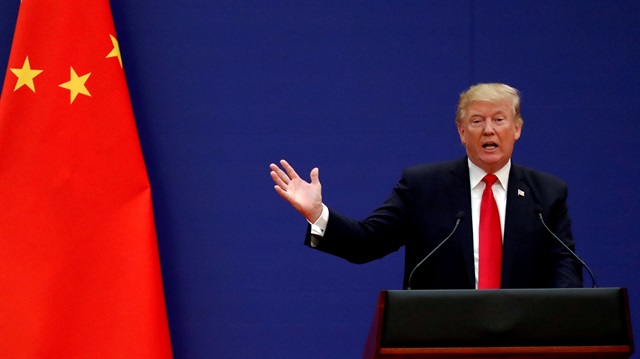
U.S. President Donald Trump delivers his speech as he and China's President Xi Jinping meet businness leaders in Beijing
Three days before U.S. President Donald Trump took office in January 2017, Chinese President Xi Jinping portrayed Beijing as the champion and defender of globalisation at the Davos World Economic Forum amid rising fears of trade protectionism.
A few months later, as Xi launched a forum on China's vast Belt and Road effort, promising to spread Chinese investment and soft power through the world, it appeared his country's global stature was rising.
But now the lustre on Beijing's trade and investment story has dulled amid rising U.S. tariffs, higher interest rates and capital flight from emerging markets, all of which threaten to erode global growth.
At the International Monetary Fund and World Bank annual meetings on the Indonesian resort island of Bali, some of that sentiment spilled into the open.
"I think there is a broad view growing in the West that China has in some ways taken advantage of the system," said Charles Dallara, former head of the Institute of International Finance, who attended the meetings. "It reminds me of the view in the West of Japan in the 1980s, very much so."
Calls to fix global trading rules are tellingly coming not just from the Trump administration. IMF managing director Christine Lagarde this week laid out what needed to be done.
"This means looking at the distortionary effects of state subsidies, improving the enforcement of intellectual property rights, and taking steps to ensure effective competition - to avoid the excesses of market-dominant positions," she said at a trade conference during the Bali meetings.
Lagarde did not mention China, but all those issues are charges frequently levelled by the Trump administration. Others were less restrained.
"We absolutely need to address the issue of overcapacities in China. Nobody can say that this is not a problem. This has to be dealt with," European Commissioner for Economic and Financial Affairs Pierre Moscovici said at the same event.
U.S. Treasury Secretary Steven Mnuchin struck a more confident tone at the Bali meetings compared with similar gatherings over the last year, when he was the target of near-universal criticism over Trump's tariff plans.
Fresh off a deal to revamp the North American Free Trade Agreement with Mexico and Canada, and with trade talks coming soon with the European Union and Japan, the U.S. administration is trying to build a coalition of allies to revamp global trade rules to combat technology transfer and other trade policies it associates with China.
Mnuchin said U.S. allies first viewed Trump's trade views as simply protectionist but now have a better understanding of his desire for "free, fair and reciprocal trade."
"This is not a coalition to pressure China. This is a coalition of like-minded people who have very similar issues as it relates to China," Mnuchin said.
International Monetary Fund Managing Director Christine Lagarde said she "would not associate" Federal Reserve Chairman Jerome Powell "with craziness" after U.S. President Donald Trump commented that the central bank, which has been raising U.S. interest rates, had "gone crazy," CNBC reported on Thursday.Powell and other policy makers are extremely serious, solid and certainly keen to base their decisions on actual information, Lagarde told CNBC in an interview, adding that central banks should remain independent in their functioning.Fed's Bullard hopes for more trade deals like NAFTA 2.0 to reduce uncertaintyIMF to launch financial assistance talks with Pakistan: Lagarde
IMF chief defends Powell after Trump says Fed has 'gone crazy'
International Monetary Fund Managing Director Christine Lagarde said on Thursday that she believes Chinese authorities are trying to maintain growth and stability in the face of a trade conflict with the United States, but added that this is a "complicated" balancing act."The Chinese authorities are certainly looking at options, I would think, in order to maintain a level of growth that would keep the economy under control, and we are seeing recent decisions from the PBOC to that effect," Lagarde said during a discussion at the IMF and World Bank annual meetings in Bali."I think that it's a complicated equation, where they have to both use the flexibility that is available, but at the same time be very attentive to their fiscal position," she added.
IMF chief says China faces balancing act as it seeks to maintain growth
Belt Aand Road
China is still a major political and economic power, but Chinese officials appeared more on the defensive this week, with the tone of debate at some IMF forums shifting more quickly than Beijing may have expected.
Vice finance minister Zou Jiayi, on a World Bank panel on Xi's signature Belt and Road Initiative, found herself fielding questions from other panelists and the audience over debt sustainability, how effectively small countries could negotiate with Beijing, and whether the effort was viable in the midst of a protracted trade war.
The debt burdens from the Belt and Road initiative came into sharper focus as Pakistan, a major recipient of Chinese-financed port, rail and road projects, formally sought an IMF bailout program during the Bali meetings.
Zou said China was using risk analysis methods from bodies such as the IMF and World Bank, and would supervise the projects' debt more vigorously.
But she also said that they are essentially commercial projects and that countries should exercise caution and make their own evaluations of their commercial viability.
And she said some of the risks came from a drastic change in external environment, giving an example of an unnamed African country with sound debt levels that sank into crisis after oil prices tanked and its currency fell.
David Dollar, a former U.S. Treasury official and a senior fellow at the Brookings Institution who spoke on the panel, said that Belt and Road could reduce trade costs, but that more work needed to be done.
"For low-income countries, there is really this risk of taking on too much debt even if the projects are very, very good," Dollar said.
China's central bank governor Yi Gang said the government would continue to let the market play a decisive role in establishing its currency exchange rate, refraining from using it as a weapon, amid an escalating trade war with the United States."We will not engage in competitive devaluation, and will not use the exchange rate as a tool to deal with trade frictions," Yi said in an International Monetary and Financial Committee (IMFC) statement posted on Saturday during the IMF and World Bank annual meetings in Indonesia's resort island of Bali.Yi said the government would keep the exchange rate "broadly stable", and China's monetary policy would remain neutral with more focus on guiding expectations.U.S. Treasury Secretary Steven Mnuchin said Chinese officials had told him that further yuan depreciation was not in China's interest.China echoes IMF pledges to avoid using currency as trade war toolMnuchin has reiterated his concerns that a major drop in the yuan's value this year against the dollar could be part of an effort to gain a trade advantage for Chinese exports or to offset the impact of U.S. tariffs.In a separate interview with domestic media published on Saturday, Yi said the central bank did not follow a rate hike by the Fed in September with one of its, as he felt China's market-based rate levels were appropriate and the yuan remained steady judging by its performance.He said decision to stay put was not an easy one, but the benefits of a non-move still trumped the potential setbacks."We still insist on prioritising domestic economic conditions when it comes to deciding on monetary policies," he was quoted as saying by Chinese financial magazine Caixin. Heeding China's call, Hong Kong tightens grip on dissentIMF members pledge to avoid using currencies as trade weapon
China's central bank says market to play decisive role in yuan exchange rate
China's top central banker on Saturday pledged to keep the yuan currency's value "broadly stable," a sign that Beijing may be trying to prevent a bruising trade dispute with the United States from spilling over into a currency war.People's Bank of China Governor Yi Gang's statement at the International Monetary Fund and World Bank annual meetings in Bali came as U.S. Treasury Secretary Steven Mnuchin said Chinese officials had told him that further yuan depreciation was not in China's interest.Mnuchin has reiterated his concerns that a major drop in the yuan's value this year against the dollar could be part of an effort to gain a trade advantage for Chinese exports or to offset the impact of U.S. tariffs.The yuan has fallen more than 8 percent against the dollar since the end of April to about 6.91 on Friday, close to the psychologically important 7.0 level not seen in a decade."China will continue to let the market play a decisive role in the formation of the RMB exchange rate," Yi said in an International Monetary and Financial Committee (IMFC) statement posted on Saturday. "We will not engage in competitive devaluation, and will not use the exchange rate as a tool to deal with trade frictions."His statement echoes currency pledges made in a communique issued by the IMF's member countries on Saturday to step up their trade dialogue as rising tariff frictions, and higher borrowing costs threaten to knock global growth.In the statement from the IMF's steering committee, the member countries also agreed to debate ways to improve the World Trade Organization so it can better address trade disputes."We acknowledge that free, fair, and mutually beneficial goods and services trade and investment are key engines for growth and job creation," the IMFC said in the statement."We will refrain from competitive devaluations and will not target our exchange rates for competitive purposes," it added.IMF chief says China faces balancing act as it seeks to maintain growthChina exerting 'unprecedented' influence campaign in USRate Hike WorriesOn Thursday, IMF Managing Director Christine Lagarde warned countries against engaging in currency and trade wars, which would hurt global growth as well as "innocent bystander" nations, including emerging markets that supply commoditiesSome of these countries, including Indonesia, the host of the IMF and World Bank meetings, are already struggling to contain capital outflows prompted by higher U.S. interests rates.Fears that rates could spike sharply higher - and the international trade tensions - touched off a searing sell-off in global stock markets over the past week.European Central Bank Governor Mario Draghi warned on Saturday that a "snap back" in rates and a sharp repricing of asset prices were the biggest risks to the economic outlook.Blaming the Sino-U.S. trade dispute, the IMF this week cut global growth forecasts for 2018 and 2019."The recovery is increasingly uneven, and some previously identified risks have partially materialised," the IMFC communique said, referring to threatened tariffs and outflow pressures.The United States and China have slapped tit-for-tat tariffs on hundreds of billions of dollars of each other's goods over the past few months, sparked by U.S. President Donald Trump's demands for sweeping changes to China's intellectual property, industrial subsidy and trade policies.Trump has frequently accused China of cheapening its currency to gain a trade advantage, claims Beijing has consistently rejected. The U.S. Treasury is due to release a key report on currency manipulation next week.Despite reassurances from China's central bank on currency policy, some analysts say yuan weakness will persist, as there is no clear path towards resolving the U.S.-China trade dispute and higher tariff rates loom in January."Clients in China remain unwilling to call a bottom in the yuan," NatWest Markets head of foreign exchange strategy Mansoor Mohi-uddin said in a research note. "This in turn makes us cautious about calling for a peak in the dollar globally."Further Federal Reserve rate hikes are expected to underpin the dollar's strength and increase capital outflow pressures on emerging market economiesBut Bank of Japan Governor Haruhiko Kuroda said the Fed's rate hikes were "basically good" for the world economy, though he was more cautious about escalating trade tensions due to their "rather unusual" scale.China opposes Malaysia's release of 11 Uighur MuslimsJapan's Abe pursues China thaw as US-Beijing ties in deep freezeUS STOCKS-Futures dip ahead of producer price data
China echoes IMF pledges to avoid using currency as trade war tool
Ineffective Institutions
Some delegates from China at the Bali IMF and World Bank meetings expressed frustration that Beijing's agenda was being bypassed while international institutions had largely been ineffective in deterring Trump's tariff actions.
"Personally I think unfortunately the G20 hasn't contributed much to reconciliation and coordination of macroeconomic policies across the world," said Xiang Songzuo, deputy director of International Monetary Institute at Renmin University of China, who was a speaker at a sideline event during the meetings in Bali.
"We wish all these forums including G20, UN, World Bank, IMF, WTO, would become stronger, stronger and more productive in containing all these wrong things - protectionism, unilateralism," Xiang added.
The current leaders of the G20, which bills itself as a leading forum that seeks to develop global policies and address the most pressing challenges, conceded that it is effectively sidelined on trade.
"The G20 can play a role in providing the platform for discussions," said Argentine Treasury Minister Nicolas Dujovne, chairman of this year's G20 finance leaders' meeting. "But the differences that still persist should be resolved by the members that are directly involved in the tensions."
Although there are reports that Xi and Trump will meet at the G20 leaders' summit on November, Mnuchin told Reuters that currency issues would be part of trade talks, and that the onus was squarely on China to take concrete steps before trade talks could resume.
"This can't just be talk; there have to be meaningful commitments to create a rebalanced trading relationship," Mnuchin told reporters on Saturday, adding that structural changes were needed to balance the relationship.
"This is not about buying more soybeans and buying more LNG," he said.
The International Monetary Fund said on Saturday its members pledged to refrain from competitive currency devaluations and step up dialogue on trade, as escalating trade frictions and higher borrowing costs threatened to knock global growth.The agreement came as U.S. Treasury Secretary Steve Mnuchin reiterated his concern over the yuan's weakening against the dollar - a drop that Washington suspects may be aimed at giving Chinese exports a trade advantage and offsetting U.S. tariffs.In a communique issued by the IMF's steering committee, the member countries also agreed to debate ways to improve the World Trade Organization so it can better address trade disputes."We acknowledge that free, fair, and mutually beneficial goods and services trade and investment are key engines for growth and job creation," the International Monetary and Financial Committee (IMFC) said in the statement."We will refrain from competitive devaluations and will not target our exchange rates for competitive purposes," it added.IMF to launch financial assistance talks with Pakistan: LagardeIMF chief says China faces balancing act as it seeks to maintain growthFears that escalating global trade tensions and rising U.S. interest rates could dent growth have roiled global markets in recent days and prompted warnings of heightened risks by finance leaders gathering for the IMF and World Bank annual meetings in the Indonesian resort island of Bali."The recovery is increasingly uneven, and some previously identified risks have partially materialised," the communique said, referring to threatened tariffs.The United States and China have slapped tit-for-tat tariffs on hundreds of billions of dollars of each other's goods over the past few months, sparked by U.S. President Donald Trump's demands for sweeping changes to China's intellectual property, industrial subsidy and trade policies.The bilateral tensions have flared over to currencies with the United States voicing concern about a weakening of the yuan to close to 7 to the dollar in recent months, a level not seen in a decade.Trump has frequently accused China of cheapening its currency to gain a trade advantage, claims Beijing has consistently rejected.Mnuchin on Saturday said Chinese officials told him at the Bali meetings this week that a further depreciation of China's yuan currency was not in the country's interests."And as I've said, the currency issue is an important issue for us in trade and will be part of our trade discussions," he told a news conference. "We want to make sure that depreciation is not being used for competitive purposes in trade."The comments come after Mnuchin expressed concern about the yuan slide, as the Treasury prepares to release a much-anticipated report next week on currency manipulation.Mnuchin also said he was "not losing any sleep" over the prospect that China could sell U.S. Treasury debt amid rising trade tension between the world's two largest economies.Mnuchin said no decision had been made on whether Trump would meet Chinese President Xi Jinping at the G20 leaders summit in Argentina at the end of November. No formal talks to try to resolve the trade dispute have taken place since Aug. 23.Tomato squeeze: US sanctions begin to distort Iran's economyIMF chief defends Powell after Trump says Fed has 'gone crazy'
IMF members pledge to avoid using currencies as trade weapon
The U.S. Justice Department said on Wednesday it had arrested and indicted a spy for China's Ministry of State Security on charges of economic espionage and attempting to steal trade secrets from several U.S. aviation and aerospace companies.Chinese operative Xu Yanjun was detained in Belgium in April after a Federal Bureau of Investigation probe and extradited to the United States on Tuesday. The Washington Post reported he was lured to Belgium by U.S. agents.The FBI called it an unprecedented extradition and said the indictment showed the direct oversight of China's government in economic espionage against the United States.The charges come as Washington increases pressure on Beijing over its trade policies and alleged theft of U.S. intellectual property.Cybersecurity experts said the arrest was another sign of the escalating trade tensions between the two countries, adding they had seen increasing espionage by Beijing for business advantage."China is actively engaging in targeted and persistent intrusion attempts against multiple sectors of the economy, including biotech, defense, mining, pharmaceutical, professional services, transportation and more," said CrowdStrike Chief Technology Officer Dmitri Alperovitch.A U.S. Department of Justice statement said Xu, a deputy division director for the State Security Department of China's Jiangsu province, targeted several U.S. aerospace companies, including GE Aviation, a subsidiary of General Electric Co .It described another unnamed firm as "one of the world's largest aerospace firms, and a leading manufacturer of commercial jetliners and defense, space and security systems," and a third as a leader in unmanned aerial vehicle technology.GE Aviation has supplied engines for large Boeing Co and Airbus SE aircraft, and is working on a new generation of engines for commercial planes and heavy-lift military helicopters.The indictment against Xu said he targeted aviation firms since around December 2013. It also said he made contact with experts working for the firms and recruited them to travel to China, often for the initial purpose of delivering a university presentation and paying their costs and a stipend."This unprecedented extradition of a Chinese intelligence officer exposes the Chinese government's direct oversight of economic espionage against the United States," the statement quoted Bill Priestap, the FBI's assistant director for counterintelligence, as saying.John Demers, the assistant U.S. attorney general for national security, said the case was not an isolated incident."It is part of an overall economic policy of developing China at American expense," he said. "We cannot tolerate a nation stealing our firepower and the fruits of our brainpower."In Beijing, foreign ministry spokesman Lu Kang called the accusations a "pure fabrication"."We hope the American side can justly, and in accordance with the law, safeguard the legal rights of the Chinese national," Lu told a regular news briefing on Thursday.Xu's lawyers did not immediately respond to requests for comment.The maximum penalty for conspiracy and attempt to commit economic espionage is 15 years, while that for conspiracy and attempt to steal trade secrets is 10 years.The Ministry of State Security is China's intelligence and security agency and is responsible for counterintelligence, foreign intelligence and political security.Cybersecurity experts said former U.S. President Barack Obama and Chinese President Xi Jinping had reached an understanding in 2015 on cyber espionage, but the agreement appeared be withering away.Chris Painter, the former U.S. State Department official who negotiated the agreement, said in a Twitter post it was "not surprising that now the relationship has deteriorated, so has the agreement."Late last month, the Department of Justice reported the arrest of a Chinese citizen in Chicago on charges he covertly worked for a high-ranking Chinese intelligence official to help try to recruit engineers and scientists, including some who worked as U.S. defense contractors.NBC News on Tuesday quoted U.S. officials as saying a professor at a top cancer research center in Houston facing child pornography charges was also under scrutiny for alleged economic espionage for China. 
US says China spy charged with trying to steal aviation secrets