

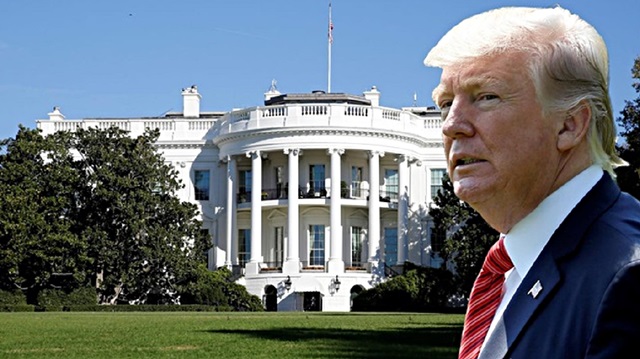
File photo
The U.S. on Tuesday sanctioned a wide network businesses it says support a branch of Iran's Islamic Revolutionary Guards Corps (IRGC) that recruits Iranian and Afghan child soldiers for combat in Syria.
The Treasury Department said the financial network supports the Basij Resistance Force, a paramilitary force subordinate to the IRGC.
In all the U.S. sanctioned at least 20 businesses and banks, including a steel company, several financial groups, and a mine development firm. All are alleged to be part of Bonyad Taavon Basij, or Basij Cooperative Foundation, which is accused of funneling money to the force through a complex system of shell companies and financial measures.
The sanctions come amid the Donald Trump administration's push to apply financial pressure on Tehran.
Treasury Secretary Steven Mnuchin said in a statement accompanying the sanctions announcement that the network "is an example of how the IRGC and Iranian military forces have expanded their economic involvement in major industries, and infiltrated seemingly legitimate businesses to fund terrorism and other malign activities."
"This vast network provides financial infrastructure to the Basij’s efforts to recruit, train, and indoctrinate child soldiers who are coerced into combat under the IRGC’s direction,” said Mnuchin said.
The Treasury Department said "many of" the designated firms have "significant international dealings across the Middle East and with Europe."
As a result of the blacklistings, Americans are generally prohibited from doing business with the firms and any assets belonging to them within U.S. jurisdiction have been frozen.
European Union sanctions against Russia are damaging Italian companies, Prime Minister Giuseppe Conte said on Tuesday.His comments come a day after Deputy Prime Minister Matteo Salvini had defined the EU sanctions a "social, cultural and economic absurdity".In the coalition contract drawn up in May, Italy's ruling parties wrote that Russia should not be seen as "a menace but rather an economic and commercial partner, potentially increasingly significant". Italy resisting EU push to impose sanctions over cyberattacks
'Sanctions against Russia damage Italian companies'
U.S. President Donald Trump on Monday reiterated that he made no deal with Turkey to lift U.S. sanctions in exchange for the release of an American pastor who had been detained there and who returned to the United States over the weekend."We had no deal with Turkey," Trump told reporters at the White House. "I feel much differently about Turkey today than I felt about them two days ago. I have a very good feeling toward Turkey -- two days ago, I did not."Trump thanks Erdoğan 'for his help' in Brunson caseAndrew Brunson was arrested in December 2016 and charged in the Aegean province of Izmir with being a member of the Fetullah Terrorist Organization (FETÖ), the group behind a defeated coup earlier that year.After being transferred this July from jail to house arrest, on Friday Brunson was sentenced to just over three years in prison, but released due to time served and his good behavior in custody.The charges against him included spying for both FETÖ and the PKK, a group recognized as terrorist by the U.S. and EU, and which is responsible for some 40,000 deaths in Turkey, including women and children.Trump threatening and imposing sanctions on Turkey over the issue sparked bilateral tensions and spooked markets.
'No sanctions deal with Turkey over pastor'
Turkey and Italy are the last buyers of Iranian crude outside China, India and the Middle East, according to tanker data and an industry source, the latest sign that shipments are taking a major hit from looming U.S. sanctions.The Islamic Republic has exported 1.33 million barrels per day so far in October to India, China, Turkey and the Middle East, according to Refinitiv Eikon data. No vessels are shown heading to Europe with Iranian crude.However, an industry source who also tracks the exports estimated shipments at 1.5 million bpd, including vessels which are not showing on AIS satellite tracking, of which a 1 million-barrel tanker is going to Italy.That's down from at least 2.5 million bpd in April, before President Donald Trump in May withdrew the United States from a 2015 nuclear deal with Iran and reimposed sanctions. The figures also mark a further fall from 1.6 million bpd in September.The expected loss of a sizeable amount of Iranian supply has helped drive a rally in oil prices, which on Oct. 3 hit their highest since late 2014 at $86.74 a barrel. Crude has since eased to $81 although analysts say the Iranian export drop remains supportive."It's one of the reasons why prices are still above $80," said Eugen Weinberg, analyst at Commerzbank.Iran Embassy in Ankara evacuated after bomb reportsIran says it won't comment yet on missing journalist Khashoggi caseThe October figures add to signs that buyers are sufficiently wary of the U.S. sanctions to stop or scale back their Iranian crude dealings, and that exports are falling more steeply than some in the market expected.For sure, definitive export data is hard to uncover. Tanker schedules are often adjusted, exports vary week by week and the tracking of tankers, while easier than in the past due to satellite information, remains both art and science.In the first week of October, Iran's crude exports averaged 1.1 million bpd according to Refinitiv and less than 1 million bpd according to another industry source.While Washington has said it wants to cut Iran's oil exports to zero, Iran and Saudi Arabia say that is unlikely to happen. The Trump administration is considering waivers on sanctions for countries that are reducing their imports.India, a major buyer, has ordered Iranian oil for November.Iran, which has pledged to block any OPEC supply increase that the country deems to be against its interests, says it has found new buyers for its oil and its crude output has fallen only slightly.For September, Iran told OPEC its crude output dropped by 50,000 bpd to 3.76 million bpd, while consultants and government agencies that OPEC uses to monitor production reported a larger fall to 3.45 million bpd.Indeed, Iran may not yet have cut production to match the rate of decline in its exports, as the country appears to be storing more oil on ships, as it did during sanctions that applied until the 2015 nuclear deal.Iran arrests member of military over Ahvaz parade attack'US is seeking regime change in Iran'
Iranian crude exports fall further as Trump's sanctions loom
The European Union on Monday adopted a new sanction regime on individuals and entities that contribute to the development and use of chemical weapons.The European Council adopted the new system of sanctions against the spread of chemical weapons during the EU Foreign Affairs Council in Luxembourg."The restrictive measures target persons and entities who are directly responsible for the development and use of chemical weapons as well as those who provide financial, technical or material support, and those who assist, encourage or are associated with them," said a written European Council statement.The statement added that the EU will be able to impose the sanctions on persons and entities "regardless of their nationality and location.""Sanctions consist of a travel ban to the EU and an asset freeze for persons, and an asset freeze for entities. In addition, EU persons and entities are forbidden from making funds available to those listed," it added.Italy resisting EU push to impose sanctions over cyberattacks
EU sanctions target chemical weapons crackdown