

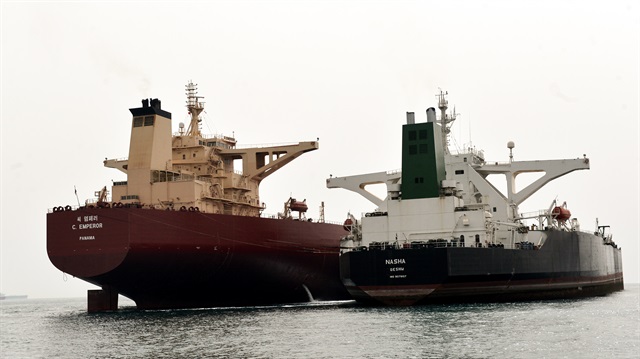
Iranian crude exports fall further as Trump's sanctions loom
Turkey and Italy are the last buyers of Iranian crude outside China, India and the Middle East, according to tanker data and an industry source, the latest sign that shipments are taking a major hit from looming U.S. sanctions.
The Islamic Republic has exported 1.33 million barrels per day so far in October to India, China, Turkey and the Middle East, according to Refinitiv Eikon data. No vessels are shown heading to Europe with Iranian crude.
However, an industry source who also tracks the exports estimated shipments at 1.5 million bpd, including vessels which are not showing on AIS satellite tracking, of which a 1 million-barrel tanker is going to Italy.
That's down from at least 2.5 million bpd in April, before President Donald Trump in May withdrew the United States from a 2015 nuclear deal with Iran and reimposed sanctions. The figures also mark a further fall from 1.6 million bpd in September.
The expected loss of a sizeable amount of Iranian supply has helped drive a rally in oil prices, which on Oct. 3 hit their highest since late 2014 at $86.74 a barrel. Crude has since eased to $81 although analysts say the Iranian export drop remains supportive.
"It's one of the reasons why prices are still above $80," said Eugen Weinberg, analyst at Commerzbank.
The Iranian Embassy in Ankara has been evacuated after Turkish security forces received a call on Monday about a possible suicide bomb attack, according to reports.Turkish police cordoned off the streets and evacuated the embassy employees, including the Iranian ambassador.Details to follow.
Iran Embassy in Ankara evacuated after bomb reports
Iran said on Monday it will adopt a wait-and-see approach to the case of prominent critic of Tehran's arch rival Saudi Arabia Jamal Khashoggi, who disappeared on Oct. 2 after entering the Saudi consulate in Istanbul."We prefer to wait until more details and facts are revealed ... It is too early to comment," Foreign Ministry spokesman Bahram Qasemi told a news conference, broadcast live on state TV.Saudi threatens to retaliate against any sanctions over Khashoggi disappearanceMoroccan press calls for probe into Khashoggi caseSaudi stocks plunge 7 pct on Khashoggi fallout; biggest drop since 2014Fiancee demands accountability if Khashoggi murderedTrump says Saudi Arabia faces 'severe punishment' if Khashoggi was killed
Iran says it won't comment yet on missing journalist Khashoggi case
The October figures add to signs that buyers are sufficiently wary of the U.S. sanctions to stop or scale back their Iranian crude dealings, and that exports are falling more steeply than some in the market expected.
For sure, definitive export data is hard to uncover. Tanker schedules are often adjusted, exports vary week by week and the tracking of tankers, while easier than in the past due to satellite information, remains both art and science.
In the first week of October, Iran's crude exports averaged 1.1 million bpd according to Refinitiv and less than 1 million bpd according to another industry source.
While Washington has said it wants to cut Iran's oil exports to zero, Iran and Saudi Arabia say that is unlikely to happen. The Trump administration is considering waivers on sanctions for countries that are reducing their imports.
India, a major buyer, has ordered Iranian oil for November.
Iran, which has pledged to block any OPEC supply increase that the country deems to be against its interests, says it has found new buyers for its oil and its crude output has fallen only slightly.
For September, Iran told OPEC its crude output dropped by 50,000 bpd to 3.76 million bpd, while consultants and government agencies that OPEC uses to monitor production reported a larger fall to 3.45 million bpd.
Indeed, Iran may not yet have cut production to match the rate of decline in its exports, as the country appears to be storing more oil on ships, as it did during sanctions that applied until the 2015 nuclear deal.
Iran has arrested a member of its military in connection with a gun attack on a military parade in the city of Ahvaz last month which killed 25 people, semi-official Fars News agency reported on Sunday.An Iranian ethnic Arab opposition movement called the Ahvaz National Resistance, which seeks a separate state in oil-rich Khuzestan province, claimed responsibility for the attack.Daesh terror organization also claimed responsibility. Neither group provided conclusive evidence to back up their claim."Eleven people were summoned and one was arrested, all of whom were military, and the case has been sent to Tehran," Gholam-Hossein Mohseni Ejei, spokesman for the judiciary, was cited as saying by Fars.Ejei did not provide any further details.Activists in the Ahvaz region have accused Iranian security forces of detaining their colleagues after the shooting attack last month.Separately, Iran's Intelligence Minister Mahmoud Alavi said his ministry had helped to uncover and destroy "300 teams of militants", the Islamic Republic News Agency (IRNA) reported on Sunday.Alavi did not give further details on the identities of the militants, nor did he indicate when the cells were uncovered. 'US is seeking regime change in Iran'
Iran arrests member of military over Ahvaz parade attack
The United States is seeking "regime change" in Iran, President Hassan Rouhani said on Sunday, adding that the current U.S. administration is the most hostile that the Islamic Republic has faced in its four decades.Tensions have increased between Iran and America after U.S. President Donald Trump withdrew from a multi-lateral agreement on Iran's nuclear programme in May."In the past 40 years there has not been a more spiteful team than the current U.S. government team toward Iran, Iranians and the Islamic Republic," Rouhani said in a speech broadcast on state TV."There was a time when there was one person who had enmity. The rest were moderate. Now...the worst have gathered around each other," he added in a speech marking the beginning of the academic year at Tehran University.Rouhani accused the Americans of using psychological and economic warfare and questioning the legitimacy of the Islamic Republic."Reducing the legitimacy of the system is their final goal. When they say getting rid of, regime change in their own words, how does regime change happen? Through reducing legitimacy, otherwise a regime doesn't change,"He used the English phrase "regime change" to emphasise his point.Washington reintroduced steps against Iran's currency trade, metals and auto sectors in August.With U.S. curbs on Iran's oil exports set to come into force next month, some Iranians fear their country is entering an economic slump that may prove worse than the period from 2012 to 2015, when it last faced major sanctions.Vice-president Eshaq Jahangiri played down the impact of the planned restrictions. Iran has been able to find new partners to buy its oil even though some countries have stopped purchases, Jahangiri said on Sunday, according to Islamic Republic of Iran Broadcasting (IRIB)."America will certainly not be able to reduce Iran's oil exports to zero," he said."America thinks Saudi Arabia can replace this oil. But right now Iran's oil has reached more than $80 and with half the previous exports we will have the same income as before," he added on comments on the IRIB website.Tomato squeeze: US sanctions begin to distort Iran's economyIran's Khamenei orders officials to resolve economic crisisGermany extradites Iranian diplomat to Belgium
'US is seeking regime change in Iran'