

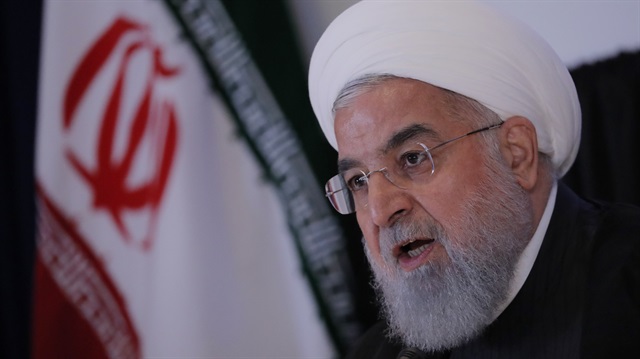
Iran's President Hassan Rouhani
The United States is seeking "regime change" in Iran, President Hassan Rouhani said on Sunday, adding that the current U.S. administration is the most hostile that the Islamic Republic has faced in its four decades.
Tensions have increased between Iran and America after U.S. President Donald Trump withdrew from a multi-lateral agreement on Iran's nuclear programme in May.
"In the past 40 years there has not been a more spiteful team than the current U.S. government team toward Iran, Iranians and the Islamic Republic," Rouhani said in a speech broadcast on state TV.
"There was a time when there was one person who had enmity. The rest were moderate. Now...the worst have gathered around each other," he added in a speech marking the beginning of the academic year at Tehran University.
Rouhani accused the Americans of using psychological and economic warfare and questioning the legitimacy of the Islamic Republic.
"Reducing the legitimacy of the system is their final goal. When they say getting rid of, regime change in their own words, how does regime change happen? Through reducing legitimacy, otherwise a regime doesn't change,"
He used the English phrase "regime change" to emphasise his point.
Washington reintroduced steps against Iran's currency trade, metals and auto sectors in August.
With U.S. curbs on Iran's oil exports set to come into force next month, some Iranians fear their country is entering an economic slump that may prove worse than the period from 2012 to 2015, when it last faced major sanctions.
Vice-president Eshaq Jahangiri played down the impact of the planned restrictions. Iran has been able to find new partners to buy its oil even though some countries have stopped purchases, Jahangiri said on Sunday, according to Islamic Republic of Iran Broadcasting (IRIB).
"America will certainly not be able to reduce Iran's oil exports to zero," he said.
"America thinks Saudi Arabia can replace this oil. But right now Iran's oil has reached more than $80 and with half the previous exports we will have the same income as before," he added on comments on the IRIB website.
Tomato paste is not the most obvious economic indicator, but in Iran, where it is a staple that some people have started panic-buying, it says a lot about the impact of renewed U.S. sanctions.While Iran makes its own paste from an abundant crop of locally grown tomatoes, sanctions reimposed by U.S. President Donald Trump since August have played havoc with supply.A 70 percent slide in the rial this year has prompted a scramble for foreign currency that has made exports much more valuable in local terms than selling produce at home.Some shops are limiting purchases of tomato paste, which is used in many Persian dishes, and some lines have sold out as people buy up existing stock.The government has responded by banning tomato exports, one of a raft of interventions to try to limit economic instability that has fuelled public protests and criticism of the government this year.But the tomato policy is not working. An industry representative said tomatoes were being smuggled abroad."We have heard that trucks full of tomatoes are still leaving the country, especially to Iraq," Mohammad Mir-Razavi, head of the Syndicate of Canning Industry, said by telephone."They put boxes of greenhouse tomatoes on top and hide normal tomatoes at the bottom," he said, referring to an exemption for hot-house grown tomatoes that left a loophole.It is one of many ways in which the sanctions are hurting ordinary Iranians while benefiting those with access to hard currency.Washington reintroduced steps against Iran's currency trade, metals and auto sectors in August after the U.S. withdrawal from a deal that lifted sanctions in return for limits on Iran's nuclear programme. Trump said the deal was not strict enough.With U.S. curbs on Iran's oil exports set to come into force next month, some Iranians fear their country is entering an economic slump that may prove worse than the period from 2012 to 2015, when it last faced major sanctions."There is an emerging consensus that the economy will go through a period of austerity similar to that recorded during the Iran-Iraq war," said Mehrdad Emadi, an Iranian economist who heads energy risk analysis at London's Betamatrix consultancy."COMING SOON"Jumps in prices are occurring in a range of goods -- particularly imports such as mobile telephones and other consumer electronics, but also some staples. A bottle of milk, 15,000 rials last year, now sells for 36,000.An 800-gramme (28-ounce) can of tomato paste was selling in Tehran stores for around 60,000 rials in March; it is now 180,000 rials, or $1.24 at the unofficial rate, prompting a scramble by households to stock up. The price of tomatoes has increased more than five-fold compared to last year.Signs on the shelves of some stores limit each customer to two cans. Iranian online shopping site Digikala lists the top nine tomato paste items as out of stock, and the rest as "coming soon". In supermarkets in Najaf in neighbouring Iraq, meanwhile, supplies of Iranian tomato paste are plentiful.Adding to the pressure is a fourfold rise in the price of cans, Mir-Razavi said. Traders importing material to make cans sought to buy dollars at a little-used official rate of 42,000 rials; authorities asked them to use a more expensive rate. The issue has delayed shipments of material to factories.The government is mounting a campaign against price-gouging, periodically ordering shopkeepers to sell at lower prices. But some shopkeepers respond by not selling at all, believing prices will eventually rise again as the sanctions bite.BANKS STABILISEDIran, a big oil producer with a diverse economy, has shown its farming, manufacturing and distribution sectors can ride out long periods of war and sanctions.The Tehran Stock Exchange index has soared 83 percent this year as shares of exporting companies have rocketed. Urban real estate prices have also risen as Iranians plough their savings into property rather than keeping them in depreciating rials.The rial's plunge, which in the unofficial market has taken it to around 145,000 against the dollar from 42,890 at the end of 2017, according to currency tracking website bonbast.com, may even have strengthened the financial system in one way.Banks and pension funds have been struggling with massive debts. Emadi said the rial's slide, to as low as 190,000 in late September, had given the government huge windfall profits on its dollar holdings; authorities appear to have injected some of those profits into insolvent banks to shore them up, he said.But while official data for the last few months has not yet been released, Emadi said he believed the economy was already in a recession that could deepen in coming months.GEOPOLITICSThe International Monetary Fund predicted this week that the economy would shrink 1.5 percent this year and 3.6 percent in 2019, before recovering slowly.That would make the slump less deep than the recession of 2012, when the economy shrank over 7 percent, and not nearly as damaging as the Iran-Iraq war of 1980-1988, when it shrank by about a quarter.The IMF also forecast the average inflation rate would jump to a peak above 34 percent next year, briefly returning to its level in 2013.How much the current recession resembles past periods of economic pain for Iran will depend on the extent to which Washington can use the sanctions to push other countries into cutting oil and non-oil trade with the Islamic Republic.U.S. officials have said the sanctions will be tougher than the steps in 2012-2015. They aim to reduce Iranian oil exports more sharply, and to disrupt exports to Iran from trading hubs such as Dubai more aggressively."I think the return of the sanctions has had a devastating effect on their economy and I think it's going to get worse," Trump's national security adviser John Bolton told Reuters in late August.But Emadi said that if European nations succeeded in creating a special payments system permitting trade with Iran to continue, and if Tehran cracked down on endemic corruption, the economy might start recovering gradually a year from now.In the meantime, many Iranians may continue to struggle with surging prices and an unstable currency.Peyman Mohammadian, 28, an unemployed university graduate in the western city of Andimeshk, said he had tried to protect 5 billion rials in savings by converting them into dollars last month at a rate of 183,000.Since then, the rial has partially rebounded as authorities have sold dollars to support it and threatened currency speculators with arrest. Mohammadian said this left him in a quandary.“On one hand, I want the dollar to rise so I don't lose my money. But on the other hand, I want it to drop below 100,000 -- otherwise inflation will be so high that I won't be able to get married for 10 years.”
Tomato squeeze: US sanctions begin to distort Iran's economy
Iran's Supreme Leader Ayatollah Ali Khamenei has ordered officials to urgently find solutions to overcome a crisis spurred by the reimposition of U.S. economic sanctions, the semi-official Fars news agency reported on Thursday."There is no crisis and no problems in the country that we cannot resolve... Officials should find solutions to overcome the existing economic hardship and to disappoint the enemy by resolving it," Fars quoted Khamenei as telling officials on Wednesday night."With unity we can overcome all crises."Germany extradites Iranian diplomat to BelgiumKhamenei also said Iran could resist the pressure of U.S. sanctions by relying on its own natural and human resources.In May, President Donald Trump pulled the United States out of a 2015 international deal that aimed to curb Iran's nuclear programme and he reimposed sanctions on Tehran in August.Trump plans to impose harsher sanctions in November on Iran's oil and banking sectors.Iran's rial currency has lost 70 percent of its value against the U.S. dollar since April. 
Iran's Khamenei orders officials to resolve economic crisis
An Iranian diplomat suspected of helping to plan a bomb attack against Iranians living in exile in France has been extradited to Belgium, German authorities announced Wednesday.Assadollah Assadi was arrested in the southern German state of Bavaria on July 1 after a Belgian court issued a European arrest warrant for him.German prosecutors stressed that Assadi cannot benefit from diplomatic immunity in the country as he was accredited in neighboring Austria and came for a holiday to Germany.Assadi is accused of providing explosives to a couple living in Belgium in order to carry out a bomb attack during a rally on June 30 in neighboring France of the National Council of Resistance of Iran, an umbrella bloc of Iranian opposition groups in exile.Belgian police stopped the couple in their car allegedly before they could carry out the attack.Iran has dismissed the accusation and claims it is part of a plot to undermine ties between European capitals and Tehran.
Germany extradites Iranian diplomat to Belgium