

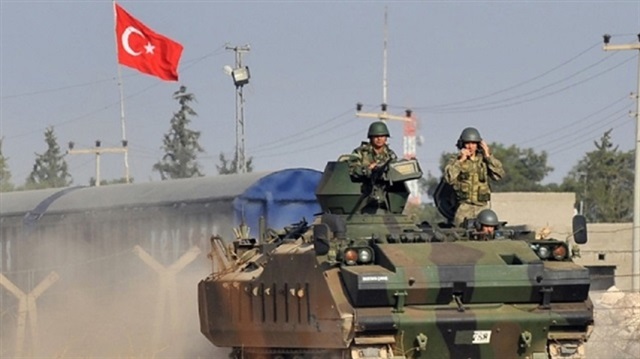
File photo
Turkey, ramping up its intensive efforts to prevent bloodshed and ensure the safety of civilians in the last opposition-held stronghold of Syria’s Idlib, has prepared a list of 400 terror suspects to be arrested.
Turkish intelligence units have completed a list of suspected terrorists, including some who are in Assad’s intelligence organization al-Muhaberat, Kurdistan Workers’ Party (PKK) and Daesh terrorists.
Turkish security units also aim to take necessary measures against foreign fighters.
Normalization process for Idlib
Turkish President Recep Tayyip Erdoğan and his Russian counterpart Vladimir Putin agreed to turn Syria's northwestern Idlib province into a demilitarized zone that will extend between 15 to 20 kilometers (9-12 miles) into Idlib by Oct. 15. The weapon-free zone will be formed between the Assad regime forces and opposition groups, while Russia will guarantee that there will be no intervention targeting Idlib. The region is planned to be normalized in six months by prioritizing security, education and health issues.
Located near the Turkish border, Idlib is home to more than 3 million Syrians, many of whom fled to other cities following attacks by Assad regime forces.
HTS terrorists will be purged
The region will also be cleared of terrorists from Tahrir al-Sham (HTS), including the al-Qaeda-linked group formerly known as the Nusra Front, which is one of the most powerful terror alliances in Idlib.
With the evacuation of foreign fighters, it is predicted that the issue of the HTS, which Turkey designated as a terror group in August 2018, will be mostly solved.
The number of foreign fighters from Egypt, Saudi Arabia, Morocco, Jordan and the United Arab Emirates (UAE) reportedly exceeds 4,000.
Turkey and Russia on Monday agreed to turn Syria's northwestern Idlib province into a demilitarized zone."We have agreed on the establishment of a weapons-free zone between the opposition- and [Assad] regime-controlled areas," Turkish President Recep Tayyip Erdoğan said in a news conference with his Russian counterpart Vladimir Putin in the Black Sea coastal city of Sochi, following a meeting between the two leaders.Following the news conference, Ankara and Moscow signed a memorandum of understanding calling for the stabilization of the situation in Idlib's de-escalation zone, in which acts of aggression are prohibited."I believe that with this memorandum, we have prevented a great humanitarian crisis in Idlib," Erdoğan said.Putin said the demilitarized zone will extend between 15 to 20 kilometers (9-12 miles) deep into Idlib by Oct. 15.He added that the establishment of the zone would be accompanied by the withdrawal of armed groups, including the al-Nusra Front.Putin said all heavy weapons had to be withdrawn from the zone by Oct. 10, according to Erdoğan’s proposal. This includes tanks, rocket launchers, guns and mortars of all opposition groups.Iran welcomes Turkey-Russia deal over IdlibJoint patrolsHe also said Russia and Turkey would restore transit routes between Syria's Aleppo, Latakia, Hama by the end of 2018.Erdoğan said Russia and Turkey will conduct joint patrols along the zone's perimeter.He added Turkey would strengthen observation points in the Idlib de-escalation zone."The opposition will remain in areas in which they are already present. We will ensure that radical groups will not operate in the area," Erdoğan said.He said Russia will take necessary measures to protect the de-escalation zone in Idlib."We will jointly ensure the detection and prevention of both third parties' provocations and violations against this agreed memorandum," Erdoğan added.Putin said: "Russia and Turkey reaffirmed their determination to fight terrorism in Syria in all its forms. [...] The practical implementation of the planned steps will give an additional impetus to the process of a political settlement of the Syrian conflict, will accelerate work on the Geneva platform and will contribute to the return of peace to the Syrian land."The Russian president said that this approach was supported by the Syrian side. He said consultations with Damascus could be held in the near future.Erdoğan also said "terror nests" east of the Euphrates river posed the "biggest" threat for Syria's future."The main structure that attempts against Syria's territorial integrity and threatens Turkey's national security is PYD/YPG," Erdoğan said, adding these "terror swamps" should be drained.Bilateral relationsErdogan said the trade volume between Russia and Turkey increased 33 percent in the first of half of 2018 and reached around $15 billion.He added 6 million Russian tourists will have visited Turkey by the end of this year.Erdogan also said Ankara expected Moscow to launch the visa-free regime once again."Our ministries are working in this regard and we expect to get immediate results about this," he added.Putin said Russia and Turkey should trade in local currencies.Turkey, Russia cooperation to be ‘hope’ for regionVideo: Turkish president Erdoğan meets his Russian counterpart in Sochi
Turkey, Russia agree on 'weapons-free zone' in Idlib
Turkey strives for the formation of a Syrian constitution and elections in which Syrians both in the country and abroad can vote, President Recep Tayyip Erdoğan said on his return flight from an official visit to Azerbaijan.“Everyone is allegedly concerned about Syria’s territorial integrity. But when it comes to putting this concern into practice, everyone has conducted parceling. One country has 22 bases, and another has five. Bases have been established. Turkey has no such interest. We are not engrossed in parcelization or whatnot. We seek firstly the preparation of a constitution, and secondly for elections to be held with the participation of all Syrians both in the country and abroad. Come, let’s all abandon Syria together. There can be no other solution,” Erdoğan said.“They say the regime called them [U.S.] to Syria, and we say the locals called us. That is the difference between us. We do not recognize the regime or the Syrian government, they do. We recognize the Syrian public. Nobody wanders around Idlib with Russian, U.S., German or French flags. They walk around with Turkish flags. This is of significance. We couldn’t leave these victims, these oppressed people alone,” he added.Turkey deploys large military convoy to Syria as Idlib offensive loomsErdoğan-Putin meetingErdoğan will pay a one-day working visit to Russia’s coastal city of Sochi on Monday. Erdoğan will hold a bilateral meeting with Russian President Vladimir Putin.“We will especially discuss the Syria matter in our bilateral talks with Mr. Putin. We will evaluate the latest situation in Idlib once again. If the situation in Idlib continues like this, there may be grave results. Idlib has been calm for the last two to three days. It appears like our efforts have yielded results, however we are still not satisfied,” Erdoğan said.The Syrian regime has recently announced plans to launch a major military offensive in the area, long controlled by various armed opposition groups.The UN warned that such an offensive would lead to the "worst humanitarian catastrophe in the 21st century."Health workers protest regime attacks in Syria's IdlibPossible humanitarian corridors in IdlibThe Turkish president said he would discuss the creation of humanitarian corridors in Syria’s Idlib to prevent civilian casualties, which was mentioned by Russian Foreign Minister Sergey Lavrov on Friday, with Putin during his Sochi visit.“We will have the opportunity to discuss these matters with Putin in Sochi. We fulfill our responsibilities in Syria. What we did in Afrin and Jarabulus is evident. We struggle against all terror organizations. Likewise, we are fighting against terror in Idlib. We have 12 observation points in Idlib, Russia has 10 and Iran has a few. It is true that we are strengthening our observation points in Idlib. We cannot have a weakness in this area, so we will continue to strengthen. Turkey is the most distressed country when it comes to this matter. The people who leave [Idlib] will come to Turkey. We must take our own precautions,” Erdoğan saidAnkara has established a dozen military observation posts around Idlib, which it has reinforced with troops and equipment in recent weeks.Located near the Turkish border, Idlib province is home to more than 3 million Syrians, many of whom fled from other cities following attacks by regime forces.Turkey's resolve to stop displacement in Syria's IdlibTurkey-U.S. ties“Our stance is very clear, and it will continue to be so. We made our offer to the U.S. at the beginning. If you’re going to clear Raqqa of terror organizations and Daesh, then let’s do this together. We’re putting two brigades on duty. We are working alongside the Free Syrian Army (FSA), just give us logistic and air support and we will clear this place. I said this to Trump myself, and later during meetings with delegations. They said they would work with the YPG-PYD. So we said it was their choice, and each to his own. Later, we made our move. We cleared Afrin. We didn’t obtain permission from anyone. There is oppression there, and we will stand up against that oppression,” Erdoğan said.The PYD and its military YPG wing are Syrian branches of the PKK, which has waged war against Turkey for more than 30 years. The U.S. has largely ignored the PYD/YPG links to the PKK, which the U.S., EU, and Turkey list as a terrorist group.Clashes between Daesh, YPG/PKK continue in east SyriaTurkey to bolster military presence in Northern Cyprus“We don’t have a base problem in Northern Cyprus. It’s only a matter of minutes for us to reach Northern Cyprus and the Eastern Mediterranean from Turkey. But Greece is not as close. There is the psychological dimension of that matter. In that sense, we may establish a base if we need it. Our presence there is important. We will not reduce our military presence there. We will increase our military presence, not decrease it. They do not listen. If they did, we would have sorted this out with Kofi Annan. What was the promise that was made during the referendum, and what was done? We said yes and they said no. They were accepted into the EU and we were not. From now on, we will do as we see fit there,” Erdoğan said.Cyprus has been divided since 1974, when a Greek Cypriot coup was followed by violence against the island's Turks, and Ankara's intervention as a guarantor power.The latest attempt to reunify the long-divided Mediterranean island ended in failure after two years of negotiations in 2017. Greek Cypriot voters also rejected the Annan peace plan in a 2004 referendum that was approved by Turkish Cypriot voters.Embattled German spymaster wants to double agency staffUpcoming presidential visit to Germany could positively impact tiesErdoğan will pay a state visit to Germany in late September, the first official visit since 2014.“I will meet with the chancellor [Angela Merkel] twice. We will evaluate our political, military, economic and trade ties, as well as the fight against terror. Germany appointed a special representative to complete preliminary work, and I sent my special representative Mr. İbrahim Kalın to Germany. Germany has taken this very seriously, as have we. Hopefully this type of a meeting with Germany after an extended period of time will affect the upcoming period very positively. I am hopeful. I sensed this from our telephone meetings with the chancellor too. Treasury and Finance Minister Berat Albayrak will hold preliminary meetings. We will also have the opportunity to evaluate the activities of the Fetullah Terrorist Organization (FETÖ) and the Kurdistan Workers’ Party (PKK) in Germany,” Erdoğan said.“During the visit, we will also meet with big German companies. We will meet with companies with investments in Turkey and those who may reinvest in Turkey. Our Religious Affairs Directorate built a beautiful mosque in Cologne. We will open the mosque during this visit. I will deliver an address there,” he added.
Those allegedly defending Syria’s territorial integrity dividing country: Erdoğan
As warplanes of the Assad regime and Russia have been viciously attacking the last opposition-held stronghold of Syria’s Idlib since Sept. 4, Turkey ramped up its military deployment in northern Syria against a looming offensive in the region early on Sunday morning.A military convoy consisting of 50 vehicles, including tanks and heavy artillery to provide fire support, arrived in Idlib's southwestern town of Jisr al-Shughur where regime forces first began their attacks on the province’s countryside.The Turkish army’s eleventh observation point is located in the Eshtabraq village of Jisr al-Shughur. Another strategic aspect of the Jisr al-Shungur town is that it is the region where Assad forces made a massive military buildup when they first signaled an Idlib offensive.Under the Astana agreement, Turkish forces are present at 12 points from Idlib's north to south.Video: Turkey deploys more armored vehicles to Syrian borderOn the other hand, a batch of the Turkish army’s Fırtına (storm) self-propelled howitzers have been relocated to Turkey’s southern Hatay province from the Kilis-Syria border, according to reports.Turkey has been reinforcing its military presence on the border with Syria and had instructed over 50,000 Free Syrian Army (FSA) fighters stationed in Afrin, Azaz, Jarabulus, al-Bab and al-Rai to “be ready for military deployment” early in September.The number of Turkish soldiers dispatched to northern Syria exceeds 30,000 in the areas within the scope of the Euphrates Shield and Olive Branch operations and Idlib.Syria has been locked in a vicious civil war since early 2011 when the Assad regime cracked down on pro-democracy protests with unexpected ferocity.Since then, hundreds of thousands of people have been killed and more than 10 million others were displaced, according to UN officials.'Solution to Idlib must be political, not military'Russia for humanitarian corridor in Idlib, Lavrov saysPutin discusses Syria's Idlib with Russia's security councilTurkey is working to reach ceasefire in Syria's Idlib: FM
Turkey deploys large military convoy to Syria as Idlib offensive looms
The people in the northwestern Syrian province of Idlib will not be displaced from their homelands with Turkey’s determination, the Istanbul-based Humanitarian Relief Foundation (IHH) said Sunday.“People of Idlib are trying to make the world listen to their voices. With Turkey’s resolve, these people will stay in their lands and we will protect them,” Erhan Yemelek, the IHH’s Syria coordinator told Anadolu Agency.Yemelek said Idlib has become a city that hosts internally displaced Syrians from every part of the country.Stating that the city currently has 3-4 million people, he said: “After the Tehran Summit, people of Idlib got worried. They waited for the world to turn its direction to Idlib.”On Sept. 7, a trilateral summit between the presidents of Turkey, Russia and Iran underlined that “there could be no military solution to the Syrian conflict" and called for advancing the political process to reach a negotiated solution.Turkey's President Recep Tayyip Erdogan called for a cease-fire in Idlib during the summit.Yemelek added that Turkey was the guarantor country (with Russia and Iran) of the region, and people there have been praying day and night for Turkey to not leave them alone.Stressing that Syrian people have been suffering for the last seven or eight years, he said they did not want to be a burden on Turkey’s shoulders and wanted to live in their own lands.He also called on all non-governmental organizations to help meet the needs of people living in camps in the rural areas near Idlib’s border.The Syrian regime recently announced plans to launch a major military offensive in Idlib, which has long been controlled by various armed opposition groups.Later, the UN warned that such an offensive would lead to the "worst humanitarian catastrophe in the 21st century".Located near the Turkish border, Idlib is home to more than 3 million Syrians, many of whom fled from other cities following attacks by regime forces.
Turkey's resolve to stop displacement in Syria's Idlib
The UN on Thursday called for the full implementation of a Turkish-Russian agreement that would avert widespread violence in northwestern Syria's Idlib province."If properly implemented, this could save 3 million civilians – including 1 million children – from catastrophe," Secretary General Antonio Guterres told reporters at the UN's New York headquarters."I call on all the parties to implement the agreement with a strong commitment to the protection of civilians, and to ensure humanitarian access, adhere to international humanitarian law and work urgently for greater progress in the Geneva process, in particular supporting my special envoy in the creation of a constitutional committee," Guterres added.Turkey to continue anti-terror activities in SyriaAnkara and Moscow signed an agreement Monday that calls for the demilitarization of Idlib, following a summit in Russia's coastal Black Sea town of Sochi.Opposition groups in Idlib will remain in areas in which they are already present, while Russia and Turkey will conduct joint patrols in the area with a view to preventing any renewal of fighting.Turkish and Russian military forces, meanwhile, will conduct joint patrols along the zone's perimeter.Syria’s Idlib under siege by foreign terroristsGuterres thanked Turkish President Recep Tayyip Erdogan and Russian President Vladimir Putin for their efforts.Located near the Turkish border, Idlib is home to more than 3 million Syrians, many of whom fled to other cities following attacks by Assad regime forces.Last month, the regime announced plans to launch a major military offensive in Idlib, Syria’s last opposition stronghold.Details of Turkish-Russian Idlib deal revealed
UN chief urges full implementation of Idlib pact