

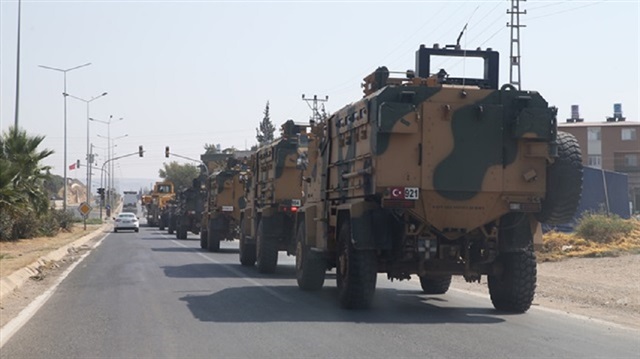
The Turkish Army's military reinforcements to northern Syria
As warplanes of the Assad regime and Russia have been viciously attacking the last opposition-held stronghold of Syria’s Idlib since Sept. 4, Turkey ramped up its military deployment in northern Syria against a looming offensive in the region early on Sunday morning.
A military convoy consisting of 50 vehicles, including tanks and heavy artillery to provide fire support, arrived in Idlib's southwestern town of Jisr al-Shughur where regime forces first began their attacks on the province’s countryside.
The Turkish army’s eleventh observation point is located in the Eshtabraq village of Jisr al-Shughur. Another strategic aspect of the Jisr al-Shungur town is that it is the region where Assad forces made a massive military buildup when they first signaled an Idlib offensive.
Under the Astana agreement, Turkish forces are present at 12 points from Idlib's north to south.
More military reinforcements including tanks, according to reports from the ground arrived at the Syrian border in Turkey's southern Hatay province.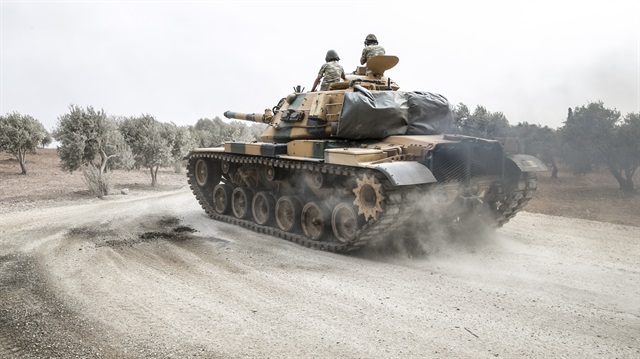
Turkey deploys more armored vehicles to Syrian border
On the other hand, a batch of the Turkish army’s Fırtına (storm) self-propelled howitzers have been relocated to Turkey’s southern Hatay province from the Kilis-Syria border, according to reports.
Turkey has been reinforcing its military presence on the border with Syria and had instructed over 50,000 Free Syrian Army (FSA) fighters stationed in Afrin, Azaz, Jarabulus, al-Bab and al-Rai to “be ready for military deployment” early in September.
The number of Turkish soldiers dispatched to northern Syria exceeds 30,000 in the areas within the scope of the Euphrates Shield and Olive Branch operations and Idlib.
Syria has been locked in a vicious civil war since early 2011 when the Assad regime cracked down on pro-democracy protests with unexpected ferocity.
Since then, hundreds of thousands of people have been killed and more than 10 million others were displaced, according to UN officials.
Turkish presidential spokesperson on Friday said it is everyone's common belief that there must be a political and not military solution in Syria’s northwestern Idlib province.Speaking to reporters after a preparatory meeting with representatives of France, Germany and Russia for the upcoming four-party summit on Syria, Ibrahim Kalin said they expect maintenance of Idlib's current status, protection of civilians, and prevention of humanitarian crisis there."Everyone's common point is that the solution must be political rather than military," he said.Kalin said there is a general consensus that the consequences of a possible attack on Idlib will be very serious and it will cause humanitarian crises and a new wave of migration."Of course, a new wave of migration would not only put burden on Turkey. It could cause a new chain of crises from here to Europe. Therefore, nobody wants this," he stressed.Kalin said any Syrian migrant in any part of the world would not return to their village or city in Syria before their security is guaranteed.Stating that the bombing of Idlib will be "unacceptable" and that Turkey will play its part to eliminate the security risks there, the presidential spokesperson said:"Our expectation here from the international community and the leaders is that they give more open and clear support to Turkey."He also added that Turkish President Recep Tayyip Erdogan's upcoming visit to Russian city of Sochi on Monday and efforts afterwards were of high importance.Since the beginning of September, at least 30 civilians have been killed in Idlib and Hama, and dozens injured, by airstrikes and attacks by the regime and Russian warplanes, according to the White Helmets civil defense agency.The Syrian regime has recently announced plans to launch a major military offensive to the area, long controlled by various armed opposition groups.The UN warns that such an offensive would lead to the "worst humanitarian catastrophe in the 21st century.”
'Solution to Idlib must be political, not military'
A humanitarian corridor will be created in Syria’s Idlib to prevent civilian casualties, Russian Foreign Minister Sergey Lavrov said on Friday. Addressing a meeting of the German-Russian Forum in Berlin, Lavrov promised that they would take measures to prevent civilian casualties in the area."Whatever we do we will try to keep in mind the issues and the interests of civilians in that area… a humanitarian corridor will be created in Idlib, just as we did in Homs and East Ghouta," he said.People of Idlib see migrating to Europe as last resort"We will not act in the way the U.S.-led coalition acted in Mosul or in Raqqa when there were no negotiations about local cease-fires with opposition groups," he added. Lavrov said currently, talks were underway between Turkish and Russian officials on the situation in Idlib, the last opposition stronghold in Syria. "And next week the two presidents will be looking at the situation," he said. Turkish President Recep Tayyip Erdoğan and his Russian counterpart Vladimir Putin are expected to meet in the Russian city of Sochi on Monday.Germany wants Russia to avert Idlib offensivePro-Assad forces flee in panic of Turkey’s military deployments at the borderTurkey's Erdoğan, Russia's Putin to meet in Sochi on Monday
Russia for humanitarian corridor in Idlib, Lavrov says
President Vladimir Putin discussed the situation in Syria's opposition-held Idlib with members of Russia's Security Council on Friday, the RIA news agency cited the Kremlin as saying.Putin told the Security Council he was concerned by activity in the last major opposition-held stronghold in Syria, Kremlin spokesman Dmitry Peskov was cited as saying. Pro-Assad forces flee in panic of Turkey’s military deployments at the borderTurkey's Erdoğan, Russia's Putin to meet in Sochi on MondayTurkey is working to reach ceasefire in Syria's Idlib: FM
Putin discusses Syria's Idlib with Russia's security council
Turkey is working to achieve a ceasefire in Syria's opposition-held northwest and is ready for cooperation to fight terrorist groups in the Idlib area, Turkish Foreign Minister Mevlüt Çavuşoğlu said on Friday.Speaking at a joint news conference with his Pakistani counterpart, Çavuşoğlu said Turkish President Recep Tayyip Erdoğan will speak with Russian President Vladimir Putin on the topic of Syria on Monday."Turkey is open to cooperation with everyone regarding efforts to fight terror groups in Syria," said Çavuşoğlu at a joint news conference in Islamabad with Pakistani Foreign Minister Shah Mehmood Qureshi.Video: Idlib locals flee to Turkish-controlled areas for safetyRecalling Turkey's efforts to find a political solution to the ongoing Syrian crisis, he said the efforts to reach a cease-fire in Idlib continue."We will continue our efforts with Iran and Russia... We will continue our efforts in international platforms as well. We have received tremendous support from many countries as well as United Nations and other organizations. Therefore, we should continue our efforts to bring peace and stability to the region," he added.Çavuşoğlu arrived in Islamabad on Thursday on an official visit upon the invitation of the Pakistani foreign minister.He was received by Pakistani President Arif Alvi, and Prime Minister Imran Khan.UN chief says US power in decline, world 'in pieces'The Turkish minister praised "strong" bilateral relations between Turkey and Pakistan, expressing willingness to further enhance cooperation in all areas. "We will devote more efforts to further enhance our solidarity, brotherhood, relations, and cooperation with Pakistan," he said.TradeThe two countries agreed to convene the 6th high level joint working group meeting soon in Islamabad and restart negotiations on a free trade agreement (FTA) between the two countries.Qureshi said the two sides have decided to enhance bilateral and economic relations."Our relations are very strong which are based on a strong historic, cultural and regional background and now we would strengthen these relations further," Qureshi said.Video: Turkish, Pakistani Foreign Minister meet in IslamabadBoth side also discussed the current trade volume and termed it unsatisfactory. The trade volume between Turkey and Pakistan was around $650 million by the end of 2017."The current trade volume is not satisfactory and we have decided to remove all hurdles in way of enhancing the trade between both countries," Qureshi said.He thanked Turkey for supporting his country on different international forums especially at the Financial Action Task Force (FATF) meeting in February this year in Paris, where the U.S. and the U.K. moved to put Pakistan back on a list of countries which have failed to stem terror financing."Today I have an opportunity to say: 'thank you very much,' to my Turkish counterpart who helped and support us in the FATF meeting," Qureshi said.During the delegation level meeting, Qureshi also briefed Çavuşoğlu about his upcoming visit to Afghanistan."I have briefed the Turkish foreign minister regarding my expected visit to Kabul and we agreed to play our role to bring peace in Afghanistan," he said.US should reconsider its alliances in Syria: Turkish FM
Turkey is working to reach ceasefire in Syria's Idlib: FM