

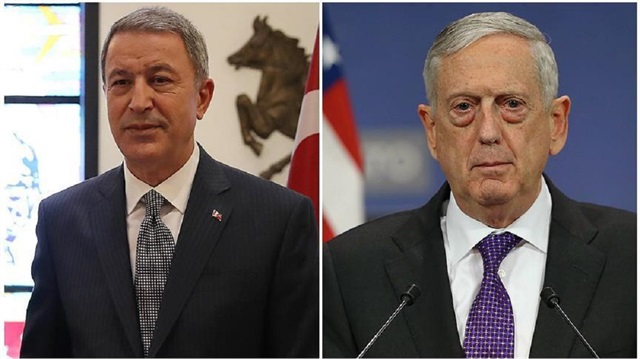
National Defense Minister Hulusi Akar and U.S. Defense Secretary Jim Mattis
National Defense Minister Hulusi Akar and U.S. Defense Secretary Jim Mattis spoke over the phone late Monday, a Defense Ministry source told Anadolu Agency.
Akar and Mattis exchanged views on the Turkey-U.S. defense relations, Syria and the fight against terrorism, the source, who spoke on condition of anonymity due to restrictions on talking to the media, said.
Syria has been locked in a vicious civil war since early 2011, when the Bashar al-Assad regime cracked down on pro-democracy protests - which erupted as part of the "Arab Spring" uprisings - with unexpected ferocity.
Germany’s foreign minister on Monday heavily criticized U.S. President Donald Trump for abruptly and unilaterally imposing sanctions against trade partners like Turkey, China and Russia.Speaking at the annual Ambassadors' Conference in Berlin, Heiko Maas vowed to take measures to protect European firms from such unilateral sanctions.“Washington’s sanctions policy forces us Europeans to formulate a response. Because it is affecting us, Germany and Europe, when the U.S. abruptly and unilaterally imposing often unspecified sanctions against Russia, China, Turkey and maybe in the future against our other important trading partners," he stressed.Maas argued that the European Union member states should take joint steps against the U.S. dominance in global finance, and proposed a European alternative to the U.S.-dominated SWIFT payment system.“We have to further strengthen the autonomy and sovereignty of Europe in the fields of trade, economy and finance policies,” he stressed.“It’s not going to be easy but we have already started working on it. We are working on proposals to establish independent payment channels and creating a European Monetary Fund,” he added.Canada appeals for German backing amid Saudi rights rowIran applies to UN court against US sanctionsGermany says Turkey’s stability important for EuropeMerkel rejects EU proposal for sharper emissions cuts targets
Germany slams US President Trump’s sanctions policy
President Emmanuel Macron on Monday said preserving European Union unity was more important than forging a close relationship with post-Brexit Britain, and hit out at what he called U.S. President Donald Trump's "aggressive" isolationism.Macron, who met Prime Minister Theresa May for talks on Britain's departure from the EU during the summer holiday, said he wanted to reach a Brexit deal by the end of the year and showed no signs of breaking ranks with other EU capitals."France wants to maintain a strong, special relationship with London but not if the cost is the European Union's unravelling," he told a gathering of French ambassadors.Brexit, Macron said, "is a sovereign choice, which we must respect, but it can't come at the expense of the European Union's integrity."Macron targets French welfare spending as deficit pressure risesIn a one-and-a-half hour speech outlining his diplomatic priorities for the year ahead, Macron made no major policy shifts, but spoke forcefully on what he labelled the "crisis of multilateralism" and the need to make Europe more "sovereign".Macron called on Europe to be "a trade and economic power", which defends its strategic interests and financial independence with tools that can fend off U.S. extraterritorial sanctions."Multilateralism is going through a major crisis which collides with all our diplomatic activity, above all because of U.S. policy," he said."The partner with whom Europe built the new post-World War order appears to be turning its back on this shared history," he said.In his first year, Macron banked on nurturing relationships with awkward leaders such as U.S. President Donald Trump and Russian leader Vladimir Putin, appearing engaged on the world stage but often remaining non-committal and trying to mediate without unsettling anyone.That approach has been tested after Trump shunned Macron and other allies, pulling out of a global climate pact, imposing extraterritorial sanctions on Iran, and imposing tariffs on EU steel and aluminium.In Syria, despite French strikes, the French leader has had little influence over Putin.Meanwhile, French forces' operations to combat an Islamist uprising in West Africa, started under Macron's predecessor and made a priority by the 40-year old, have struggled to root out jihadists in Mali and neighbouring countries.
Macron says Brexit cannot divide EU, criticises Trump's isolationism