

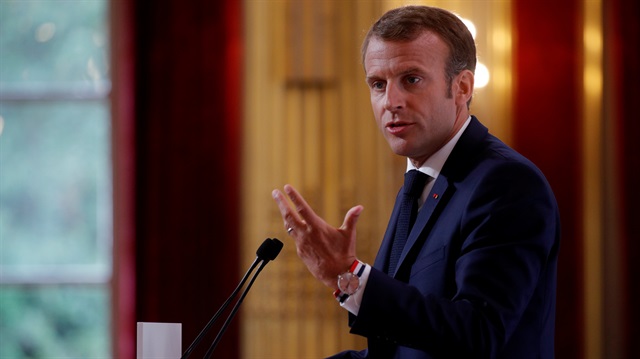
French President Emmanuel Macron
President Emmanuel Macron on Monday said preserving European Union unity was more important than forging a close relationship with post-Brexit Britain, and hit out at what he called U.S. President Donald Trump's "aggressive" isolationism.
Macron, who met Prime Minister Theresa May for talks on Britain's departure from the EU during the summer holiday, said he wanted to reach a Brexit deal by the end of the year and showed no signs of breaking ranks with other EU capitals.
"France wants to maintain a strong, special relationship with London but not if the cost is the European Union's unravelling," he told a gathering of French ambassadors.
Brexit, Macron said, "is a sovereign choice, which we must respect, but it can't come at the expense of the European Union's integrity."
French President Emmanuel Macron's government will tackle social spending in the next wave of its reforms as weaker than expected growth puts pressure on the budget deficit, the prime minister said on Sunday.Prime Minister Edouard Philippe said in an interview in Le Journal du Dimanche that the government would press on with its reform drive in the face of record unpopularity after little more than a year in office.Macron has so far largely turned a deaf ear to criticism of his reforms, with detractors dubbing him the president of the rich after cuts to taxes on capital income during his first year in office, which he said encouraged investment.His government has sold its pro-business reforms on promises that they will boost growth and jobs, but Philippe said that growth would be weaker than expected next year.US, UK, France vow response to Syria chemical attacksPhilippe told Le Journal du Dimanche that the 2019 budget would be based on a growth forecast of 1.7 percent rather than the 1.9 percent forecast in April.The prime minister acknowledged that the lower growth is likely to weigh on the public budget deficit, which is already under pressure from plans to make a payroll tax credit scheme permanent."But that does not prevent us from sticking to our commitments on reducing taxes while reining in public spending and debt," he added.The slower growth outlook raises the chances that when the government produces its 2019 budget at the end of September it may need to change its public deficit target, previously pegged at 2.3 percent of economic output.Turkey, France to act against US sanctionsHowever, business daily Les Echos reported that the government could be aiming at a deficit close to 2.6 percent this year -- the same as in 2017 -- and as much as 3 percent next year."Sure, it's a higher than expected number, but choices had to be made," Les Echos quoted an unnamed government source as saying.FISCAL SQUEEZEThe government has been under pressure from Brussels and the International Monetary Fund to detail plans to rein in public spending. France is among the global frontrunners in the spending stakes.Philippe said the government is particularly keen on reducing spending on what he described as ineffective policies such as housing or subsidised jobs.He said that housing allowances, family welfare benefits and pension payouts would increase by only 0.3 percent in 2019 and 2020. That is far less than the 1.5 percent average inflation rate economists polled by Reuters expect next year and the 1.8 percent expected in 2020.Meanwhile, the government would consider reducing unemployment benefits over time, Philippe said.Criticisms of Macron's aloof leadership style and a summer scandal over his top body guard beating May Day protesters helped to push his approval ratings to a record low of only 34 percent in August, according to an Ifop poll for Le Journal du Dimanche.Philippe also responded to criticism saying that the government's policies were designed to reward workers and discourage unmeasured increases in welfare handouts.Philippe said that tax on overtime pay would be axed from September 2019 on top of plans do away with worker contributions to financing health and unemployment benefits while also getting rid of housing tax.Efforts to shrink France's vast public sector would be maintained, he added, with plans to cut 4,500 state jobs in 2019 and more than 10,000 in 2020."This is going to be a real bloodbath for the state and the public services," far-left leader Jean-Luc Melenchon told reporters in response to Philippe's comments. 
Macron targets French welfare spending as deficit pressure rises
In a one-and-a-half hour speech outlining his diplomatic priorities for the year ahead, Macron made no major policy shifts, but spoke forcefully on what he labelled the "crisis of multilateralism" and the need to make Europe more "sovereign".
Macron called on Europe to be "a trade and economic power", which defends its strategic interests and financial independence with tools that can fend off U.S. extraterritorial sanctions.
"Multilateralism is going through a major crisis which collides with all our diplomatic activity, above all because of U.S. policy," he said.
"The partner with whom Europe built the new post-World War order appears to be turning its back on this shared history," he said.
In his first year, Macron banked on nurturing relationships with awkward leaders such as U.S. President Donald Trump and Russian leader Vladimir Putin, appearing engaged on the world stage but often remaining non-committal and trying to mediate without unsettling anyone.
That approach has been tested after Trump shunned Macron and other allies, pulling out of a global climate pact, imposing extraterritorial sanctions on Iran, and imposing tariffs on EU steel and aluminium.
In Syria, despite French strikes, the French leader has had little influence over Putin.
Meanwhile, French forces' operations to combat an Islamist uprising in West Africa, started under Macron's predecessor and made a priority by the 40-year old, have struggled to root out jihadists in Mali and neighbouring countries.